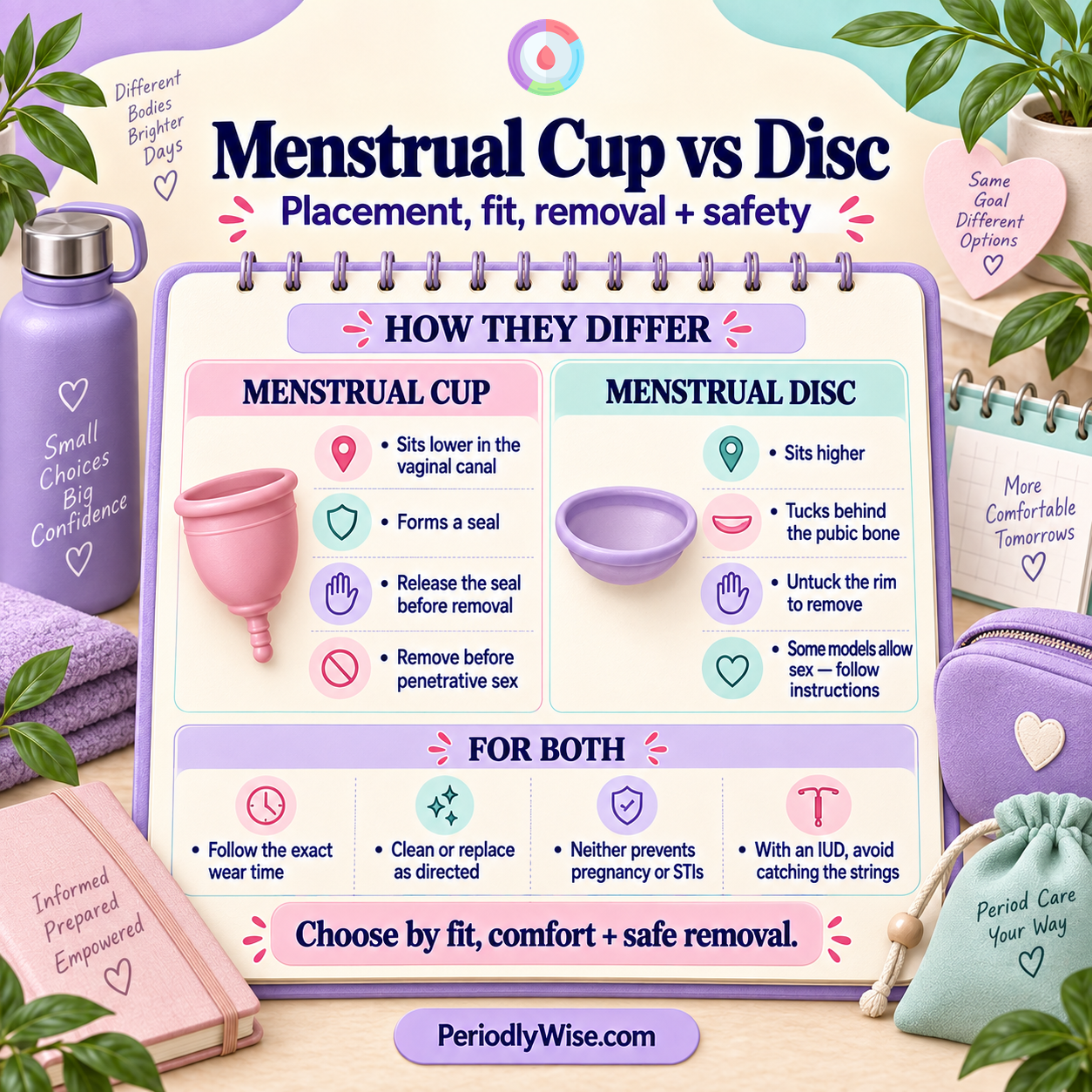
A menstrual cup and a menstrual disc do the same basic job: they collect menstrual fluid inside the vagina instead of absorbing it. They are not the same shape, however, and they do not sit in the same place. A cup is usually bell-shaped and forms a seal against the vaginal walls. A disc has a flexible rim and sits higher, with its front edge tucked behind the pubic bone.
Those differences affect insertion, removal, leaks, comfort, mess, and whether a product can stay in during penetrative vaginal sex. They also change what you need to do if you use an intrauterine device. There is no universal winner. The useful question is which design you can position, wear, remove, clean, and replace safely in your real routine.
This guide compares the categories, not every brand. Sizes, firmness, capacity, removal aids, materials, wear limits, and reuse rules vary. The instructions supplied with your exact product are the final practical limit.
Menstrual cup vs disc at a glance
| Feature | Menstrual cup | Menstrual disc |
|---|---|---|
| Where it sits | Lower in the vaginal canal, below the cervix. | Higher in the vaginal fornix, with the rim tucked behind the pubic bone. |
| How it stays in place | The open rim and vaginal walls create a seal; designs and firmness vary. | The rim is supported by vaginal anatomy and the pubic bone; it does not rely on cup-style suction. |
| Removal motion | Reach the base, pinch or otherwise release the seal, then ease it out. | Hook or grip the rim or removal aid, untuck it, and pull it out while keeping it as level as possible. |
| Reusable or disposable | Most are reusable, but follow the product label. | Available as reusable or single-use products. |
| Vaginal penetration | Remove an ordinary cup before penetrative vaginal sex. | Some discs are marketed for intercourse; use only as the manufacturer directs. |
| Leak pattern | Leaks may reflect an incomplete opening, poor seal, position, fit, fullness, or anatomy. | Leaks may reflect an untucked rim, fit, position, fullness, or movement during toileting. |
| Key skill | Folding, opening, checking the seal, and breaking it before removal. | Aiming back, tucking behind the pubic bone, and reaching the rim to remove. |
| Pregnancy and STI protection | None. | None. A menstrual disc is not a contraceptive diaphragm. |
How placement changes the experience
A cup unfolds below the cervix. It should not cover the cervix like a cap; it collects fluid as it passes into the vagina. Many users check around the rim or gently rotate the cup, but the right check depends on the design. A cup that presses the bladder, rubs at the opening, or causes persistent cramping may be the wrong position, length, diameter, or firmness for that body.
A disc is pinched narrow, directed down and back, then pushed behind the cervix area and tucked above the pubic bone. Its higher position means the user usually reaches farther for removal. Some people find the rim easier to hook than a cup base; others find the blood reservoir harder to keep level while withdrawing it.
Neither product can pass through the cervix and disappear into the uterus. It can, however, sit high or become difficult to grasp when pelvic-floor muscles are tense. Pause, breathe, bear down gently if the instructions recommend it, and change position. Do not use tweezers or another tool inside the vagina.
- Check the manufacturer's size guide; age or childbirth alone does not determine every person's fit.
- Consider cervix height during menstruation, because it can change across the cycle and affect available space.
- Think about finger reach, grip, hand mobility, long nails, tremor, pelvic pain, and restroom accessibility.
- A removal loop, tab, notch, or stem may help you locate a product, but it does not replace the stated removal technique.
- A correctly placed product should not cause ongoing pain, pressure, numbness, urinary difficulty, or rectal discomfort.
Which option may fit your routine?
| Situation | Cup may be worth trying | Disc may be worth trying | Important caution |
|---|---|---|---|
| You prefer a lower reach | The base or stem may be easier to locate. | A disc usually requires reaching higher. | Never pull only on a stem if the instructions require releasing the seal first. |
| You dislike a cup-style seal | A softer or different cup may help, but still needs a seal. | A disc is supported differently and may feel more comfortable. | Pain or pressure is not something to push through. |
| Heavy or fast flow | A suitable capacity may reduce changes. | A suitable reservoir may reduce changes. | Brand capacities are not directly comparable; empty sooner if full and seek care for abnormal heavy bleeding. |
| Public restrooms | Removal may be controlled once practiced; plan handwashing and cleaning. | Removal can be messier for some users; a removal aid may help. | Carry backup and follow the product's between-emptying instructions. |
| Swimming or exercise | Either can work when it fits securely. | Either can work when properly tucked and comfortable. | Test at home before relying on a new product for a long event. |
| Penetrative vaginal sex | Remove it first. | Some models are designed for this use. | Neither prevents pregnancy or STIs; stop if there is pain or displacement. |
| IUD or IUS | Possible expulsion concern; release the seal and avoid strings. | No cup-style suction, but the rim can still interact with strings during removal. | Ask your clinician and follow brand instructions; check for signs of displacement. |
| Reducing waste | Most cups are reusable. | Choose a reusable disc; disposable discs create ongoing waste. | Reuse only products specifically designed for reuse and replace as directed. |
A first-cycle trial plan
Learning often takes more than one attempt. Practice when you have time, privacy, clean hands, and a backup product rather than making a new cup or disc carry an entire workday immediately.
- Read the whole insert. Confirm material, size, maximum wear time, cleaning method, replacement signs, and whether the product is reusable.
- Inspect the product. Do not use it if the rim, body, pull tab, or surface is torn, sticky, cracked, warped, or otherwise damaged.
- Wash and prepare it exactly as directed. Wash your hands before and after handling it. Do not improvise with scented cleansers or disinfectants.
- Practice insertion at home. Try a relaxed squat, sitting on the toilet, or one leg raised. A small amount of compatible water-based lubricant may help if the instructions allow it.
- Check comfort and placement. Walk, sit, cough, and use the toilet. Remove it if you have persistent pain, pressure, urinary trouble, or numbness.
- Use a short first interval. Check for leaks and fullness earlier than the maximum label time so you learn how the product behaves on your flow.
- Practice the correct removal. For a cup, break the seal before pulling. For a disc, untuck the rim and withdraw slowly; do not yank an IUD string or scrape tissue with a nail.
- Record what happened. Note flow day, hours worn, leaks, comfort, bathroom access, removal difficulty, and whether a different size or design question is worth discussing.
Emptying, cleaning, storage, and replacement
Wear time is a ceiling, not a target. Some products state up to 12 hours, but flow, the particular model, and the instructions may require earlier emptying. A heavy-flow day can fill a product well before its maximum time. Overnight use is appropriate only when the product allows it and the total interval stays within its instructions.
The CDC advises washing hands before and after using menstrual products and cleaning cups daily during use. It also advises sanitizing cups after a period by thorough rinsing and boiling for one to two minutes. Because materials and products differ, follow the manufacturer's method when it is more specific; do not boil a product that says not to, and do not reuse a single-use disc.
In a public restroom, the exact safe routine depends on the product. You may be able to empty and reinsert after clean handling, wipe it as instructed, or bring a spare and wash the used reusable product later. Plan before the stall rather than placing the product on an unclean surface.
- Use potable water and only the cleanser or sanitation method permitted by the manufacturer.
- Avoid douching and avoid putting fragrance, bleach, household disinfectant, oils, or harsh detergent on vaginal tissue.
- Clear cup air holes only by the safe method in the instructions; never enlarge them with a sharp object.
- Dry and store a reusable product as directed, often in a breathable container rather than an airtight damp space.
- Replace it for damage, persistent odor that cleaning does not resolve, surface changes, or the brand's stated lifespan.
- Wrap and bin disposable products; do not flush cups or discs down the toilet.
Leaks, discomfort, and difficult removal
A leak does not automatically mean you need the largest product. First note whether the leak began immediately or only after several hours. Immediate leaking may suggest position, opening, tucking, or fit. Later leaking may mean the reservoir reached capacity, shifted during movement, or was affected by clots. Residual blood in the vaginal canal can also appear soon after insertion without meaning the product is leaking continuously.
Some disc users notice fluid release while using the toilet. Pelvic pressure can temporarily untuck some discs, sometimes called self-emptying or auto-dumping. It is not a guaranteed feature and does not prove that the fit is correct. Wash your hands, retuck the rim if the instructions say to, and change size or design if unplanned leaks continue.
Persistent pain deserves a pause. Pressure on the bladder or rectum, painful insertion, burning, recurrent tearing, or difficulty relaxing may relate to fit, dryness, irritation, pelvic-floor tension, infection, vulvodynia, vaginismus, prolapse, or another condition. An external product is a valid alternative while you seek advice.
- If a cup will not open, review the fold and position; do not repeatedly scrape sore tissue.
- If a cup rides high, relax, squat, and bear down gently; reach the base rather than pulling forcefully on the stem.
- If a disc slips from behind the pubic bone, the size, firmness, insertion angle, or anatomy may not match that model.
- If removal is difficult, stop, rest, and try again with clean hands. Seek medical help when you cannot remove it, pain is severe, or you feel unwell.
- Unusual discharge, strong new odor, sores, fever, urinary symptoms, or pain that continues after removal needs assessment.
Cups, discs, and an IUD or IUS
FSRH guidance says evidence suggests there could be an increased risk of intrauterine contraception expulsion with menstrual cup use. It also explains that a cup forms a seal, while a disc sits between the pubic bone and posterior fornix without requiring suction. That difference does not make disc removal risk-free: either device can accidentally engage the contraceptive threads.
Ask the clinician who manages your IUD or IUS about when to begin internal period products after insertion and whether string length or your expulsion history changes the advice. With a cup, fully release the seal before moving it downward. With either product, identify the product rim or base rather than pulling on a thin structure that could be a contraceptive thread.
Seek review if the threads suddenly feel longer, shorter, or missing; you feel hard plastic at the cervix or vagina; you develop new pelvic pain or a major bleeding change; or pregnancy is possible. Use backup contraception according to clinical advice until position is confirmed.
Safety limits and when to get care
Toxic shock syndrome is rare but serious, and the NHS states that it can occur with a tampon or menstrual cup. Evidence for discs is more limited, so it is not responsible to promise that one internal product category has no risk. Use clean hands, stay within the exact wear time, do not reuse a disposable item, and remove the product if you become suddenly unwell.
A cup or disc is not treatment for heavy bleeding. Needing to empty a cup more often than recommended, flooding through protection, bleeding for more than seven days, large clots, fatigue, or shortness of breath can be signs of heavy menstrual bleeding. Capacity markings and emptying counts may help describe your pattern, but they are not a diagnosis and are not standardized across products.
Avoid internal menstrual products during postpartum lochia and follow your maternity team's timing after birth, pregnancy loss, pelvic surgery, or a procedure. If you have previously had toxic shock syndrome, recurrent vaginal infection, significant pelvic pain, or anatomy-related concerns, ask a clinician before use.
Three realistic choice examples
Example 1: A person with a low cervix and limited finger reach may find a shorter cup base easy to locate, while a high disc rim is frustrating. That does not make cups easier in general; it means reach and anatomy shaped this result.
Example 2: A person who dislikes cup pressure but can comfortably tuck and remove a disc may prefer a reusable disc. They still check it early on heavy days, carry backup, and follow the model's cleaning and replacement rules.
Example 3: An IUD user likes a cup but has not discussed use since insertion. The next step is not to switch blindly to a disc. It is to obtain method-specific advice, learn the string and displacement precautions, and use a removal technique that never pulls against the IUD.
Frequently asked questions
Is a menstrual cup or disc easier for beginners?
Neither is universally easier. A cup requires opening and seal release; a disc requires higher placement, tucking, and rim removal. Reach, hand mobility, cervix height, pelvic comfort, and the product's removal aid matter. Practice at home with backup and stop if it hurts.
Which is better for heavy flow?
Choose by the tested capacity and fit of the specific model, then check earlier than its maximum wear time. Cup and disc capacities vary and marketing numbers are not a diagnosis. Frequent filling, flooding, clots, dizziness, fatigue, or breathlessness deserves medical advice.
Can I sleep or swim with a cup or disc?
Usually, if the specific product permits overnight or water use, it fits comfortably, and the total wear time stays within its instructions. Empty it sooner when your flow requires it and test a new product at home before a long swim or night.
Can I use a menstrual cup or disc with an IUD?
Discuss this with your clinician and read both device instructions. Evidence suggests possible increased expulsion risk with cup use. Release the cup seal before removal and, with either product, take care not to catch or pull IUD strings. Seek review for changed threads, pain, unusual bleeding, or pregnancy possibility.
Can I have sex while wearing one?
Remove an ordinary menstrual cup before penetrative vaginal sex. Some discs are marketed for intercourse, but only use a disc that specifically permits it and stop for pain or displacement. Neither product prevents pregnancy or sexually transmitted infections.
Can a cup or disc get lost or stuck?
It cannot travel through the cervix into the uterus, but it can sit high or be hard to grip. Relax, change position, and follow the removal instructions without using tools. Seek medical help if you cannot remove it or have severe pain, fever, or other concerning symptoms.
Save your period timing and note flow, leaks, comfort, emptying intervals, and product changes. A short record can make your next purchase or clinical conversation much more specific.
Open the Period TrackerThe bottom line
A menstrual cup and disc are different tools, not a better-and-worse pair. A cup seals lower and must be released before removal. A disc sits higher behind the pubic bone and is untucked by its rim. Either can be comfortable, reusable, and reliable when the design fits the person's body and routine.
Start with safe removal, accurate product instructions, and a realistic trial. Comfort matters as much as advertised capacity. If the product hurts, cannot be removed, repeatedly leaks despite correct use, or coincides with infection, IUD displacement, or heavy-bleeding warning signs, stop troubleshooting alone and get appropriate care.