
Tampons have a limited shelf life, but there is no single expiry rule for every brand. Some boxes carry an expiry or best-before date; others need the manufacturer's guidance and a production date. The familiar advice that all tampons last five years misses differences between products, wrappers and storage conditions.
An old box at the back of a cupboard is a different question from a tampon left inside the vagina too long. Shelf life concerns an unused product. Wear time begins when you insert it. A new tampon still needs timely changing, and a short wear time does not make a damp or damaged product suitable.
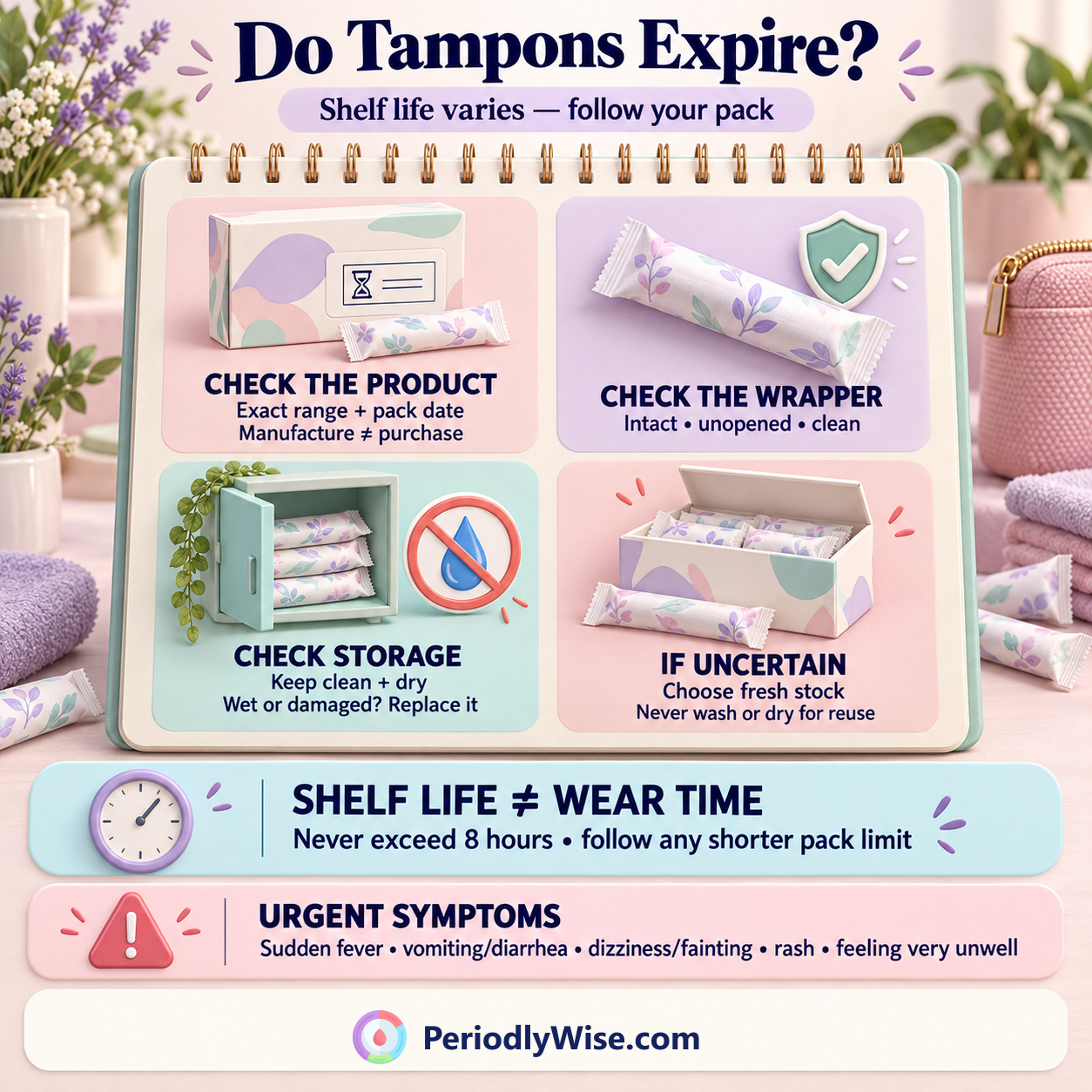
Check the pack, individual wrapper and storage history together. If those checks leave you uncertain, use a fresh, suitable period product and ask the manufacturer about the old stock. Appearance alone cannot settle an unknown product's age or suitability.
Shelf life and wear time answer different questions
Shelf life describes how long an unused product is expected to meet the manufacturer's quality standards under the stated storage conditions. An expiry date is an instruction on a particular pack. A manufacturer may use the term shelf life rather than expiry, but that does not mean its products should be stored indefinitely.
Wear time is the much shorter period after insertion. The FDA advises changing tampons every four to eight hours and never wearing one for longer than eight hours. Follow your own pack if it gives a shorter limit. Both the unused product and the way it is worn matter.
How long do tampons last? Check the actual product
Tampax's US guidance distinguishes its three-year Radiant ranges from its five-year alternatives. These are examples for named products, not a rule for another brand or every country. The relevant starting point is manufacture, not the day you happened to buy the box.
Natracare provides another reason to read the pack: its FAQ lists three years and says expiry is printed on packaging, while an older brand article refers to four years. Do not resolve conflicting general pages by choosing the longer interval; use your pack's date or ask about that batch.
This comparison helps with checking labels; it is not a recommendation to buy one brand. Packaging and market instructions can change. A photograph of an old box online may not describe the product in your hand.
| Product or situation | What the guidance means | What to check |
|---|---|---|
| Product or situationTampax Radiant / Compact Radiant | What the guidance meansUS guidance gives a three-year shelf life. | What to checkExact range, manufacture date and local instructions. |
| Product or situationOther Tampax products listed by the manufacturer | What the guidance meansUS guidance gives five years from manufacture. | What to checkDo not count five years from purchase. |
| Product or situationNatracare | What the guidance meansIts FAQ and older article give different general intervals. | What to checkUse the printed pack date; ask about unclear batches. |
| Product or situationAnother brand or country | What the guidance meansThere is no universal interval to borrow. | What to checkCurrent instructions for that exact product and market. |
| Product or situationUnknown product or age | What the guidance meansAppearance cannot establish its shelf life. | What to checkUse fresh stock while you seek confirmation. |
A date within range does not override a wet wrapper, damage or contamination. Passing a date does not tell you an infection has occurred; it tells you to stop relying on that product's labelled suitability.
How to read the box, date and lot code
Look over every panel and the bottom of the carton. Wording may include expiry, EXP, use by, best before or a manufacturing date. Do not assume an unexplained number is a date, and do not decode a lot code using another company's format.
A batch code helps a manufacturer identify production information. A retail barcode mainly identifies a product for sale; it is not automatically a readable manufacturing date. Kotex distinguishes the lot code from the UPC product code, illustrating why both may be requested for a quality enquiry.
A receipt helps you remember when stock entered your home, but cannot establish how long it was stored before sale. If you transfer wrapped tampons to a pouch, keep a photograph of the box and instructions so identification is not lost.
- Identify the brand, exact range, absorbency and country of sale.
- Find expiry or manufacturing information without guessing its meaning.
- Keep the lot code and a clear box photograph for the manufacturer.
- Check the individual wrapper and whether storage has remained clean and dry.
- If date or condition cannot be confirmed, choose fresh stock rather than extending an estimate.
Does opening the box start a new expiry clock?
Opening the outer carton does not renew shelf life or create a universal new deadline. Each unused tampon should remain in its own undamaged wrapper until needed. The wrapper and original storage instructions still matter after opening the box.
Wrapped tampons in a clean, dry pouch are different from loose products rolling around with crumbs, spilled cosmetics or leaking toiletries. Inspect carried supplies periodically. A case can protect a wrapper from damage, but cannot restore one that has already torn.
Do not unwrap a batch in advance for a decorative jar. Once exposed to dirt or moisture, resealing with tape does not recreate the original protection. If you accidentally open one and will not use it immediately as directed, choose an unopened one when needed.
Storage: protect the wrapper from moisture and damage
Choose a clean, dry location away from repeated shower steam, splashes and direct heat. Cleveland Clinic explains that damp storage can allow mold and that original individual sleeves matter. A drawer that repeatedly gets wet is a poor long-term home even when the carton looks tidy.
The word bathroom does not establish that every tampon there is ruined. Consider actual conditions: is the pack dry, protected and within its stated life, or beside a leaking pipe? Replace products affected by water rather than drying them and assuming the problem has gone away.
Keep a travel pouch dry too. A sealed container can protect from splashes, but do not shut damp items inside. Separate supplies from cleaning liquids, perfumes and toiletries that could leak onto wrappers.
- Keep the carton or a readable photograph of its date and lot code.
- Leave tampons wrapped until use and avoid crushing or puncturing packs.
- Carry a small, regularly checked supply rather than years of forgotten spares.
- Replace products affected by leaks, floodwater, dirt or damaged seals.
- Follow product-specific temperature and storage instructions.
Keep, check or replace: a practical decision table
Do not rely on one reassuring detail. A sealed box can have a wet history, and a recent receipt can belong to older stock. These examples combine information you can check; they are not laboratory tests of cleanliness.
If a wrapper or tampon is visibly affected, replacement is more useful than debating how many months remain. If a whole carton was soaked or contaminated, set it aside rather than sorting apparently dry pieces for internal use.
| What you find | What it tells you | Practical decision |
|---|---|---|
| What you findDate within range; intact wrapper; dry storage | What it tells youBasic checks agree with labelled use. | Practical decisionFollow product instructions and the ordinary safe-use routine. |
| What you findPrinted expiry has passed | What it tells youThe labelled period has ended. | Practical decisionReplace it; ask if the meaning of the date is unclear. |
| What you findTorn, open or dirty wrapper | What it tells youOriginal protection is compromised. | Practical decisionDo not insert it; choose an undamaged wrapped product. |
| What you findDamp, stained or water-damaged supply | What it tells youStorage has not remained reliably dry. | Practical decisionReplace affected supplies; do not wash or dry for reuse. |
| What you findUnusual color, visible mold or unexpected smell | What it tells youThere is a product-quality concern. | Practical decisionDo not use it; retain package details for an enquiry. |
| What you findLoose spare with unknown age | What it tells youIdentity or shelf life cannot be verified. | Practical decisionUse fresh stock rather than assuming five years remain. |
Put unwanted tampons and applicators in the appropriate waste bin under local guidance; do not flush them. Keep packaging information to report defects, but do not continue using suspect stock while waiting for a reply.
Can you tell by looking or smelling?
Visible damage, unexpected discoloration or an unusual smell are reasons not to use a product. Their absence is not proof that an unknown old tampon is suitable: the core may not be fully visible inside an applicator, and a home inspection cannot verify microbiological quality.
Do not pull a tampon apart to certify it and then reconstruct it. Do not rinse, boil, microwave, spray with disinfectant or add fragrance. None of those actions extends shelf life or recreates an intact product intended for internal use.
What if you already used an old or expired tampon?
Finding an old date after use does not mean you definitely have an infection or toxic shock syndrome. There is no reliable home calculation of personal risk from the age of a box. Focus on removing the questionable product, how long it was worn and how you feel.
If still inserted, remove it with clean hands. Use a fresh suitable product, or an external option if irritated. Do not douche or use leftover antibiotics or antifungal treatment simply because it was old; symptoms need appropriate assessment rather than an assumed diagnosis.
Contact a professional for persistent itching, burning, pain, unpleasant odor or unusual discharge, and sooner if worsening. If you cannot remove it or are unsure one remains, seek help rather than using tools or inserting another. NHS inform advises medical help for a retained or uncertain tampon.
- Record approximate insertion and removal times, including time beyond the label limit.
- Note symptoms, when they began and whether you feel generally unwell.
- Save a picture of the product name, lot code and date if available.
- Seek urgent care for sudden illness rather than waiting for the next period.
Toxic shock syndrome: symptoms matter more than a date
Toxic shock syndrome, or TSS, is rare but serious. Expiry is not a diagnostic test: a newly bought tampon does not rule it out, and an expired box does not prove it. This is a separate question from deciding whether to keep unused stock.
The NHS describes quickly developing symptoms including fever, vomiting or diarrhea, dizziness and a rash. Marked weakness, confusion, fainting or breathing difficulty are especially concerning. You do not need every symptom, a visible rash or a specific thermometer reading before seeking help.
For sudden illness during or soon after use, remove the tampon if possible and seek urgent medical attention. Tell the clinician about tampon use. Do not delay emergency care because removal is difficult or the product was within its expiry date.
A safe-use routine still matters with a fresh tampon
Use tampons only for menstrual bleeding and choose the lowest absorbency that manages flow. Unnecessarily high absorbency can be uncomfortable when removal happens relatively dry. Do not use a tampon for ordinary discharge or as a precaution before bleeding starts.
Plan changes around actual insertion time, including travel and sleep. If sleep may exceed the pack's limit, choose an external option. A reminder can support your routine, but cannot confirm a tampon is present or make longer wear safe.
- Read the exact product's leaflet and follow shorter local wear limits.
- Wash hands before and after changing it.
- Change within four to eight hours under FDA guidance, sooner if needed; never exceed eight.
- Remove the previous tampon before inserting another; use each once.
- Stop use and seek advice for pain, unusual discharge or unexpected symptoms.
Travel, free supplies and borrowed tampons
Free tampons at a school, workplace or public dispenser are not automatically unsuitable. Check individual wrapping, cleanliness and dryness. If identity or instructions are missing, ask for the box or choose an option you can verify.
A borrowed spare raises the same questions: intact wrapper, identifiable product and reliable storage. Recognizable brand colors do not establish age or absorbency. You need not use something with unclear packaging just because it was offered kindly.
Carry a small protected supply and external backup when travelling. Replace wrappers damaged by keys or toiletry leaks. A pharmacist, school nurse, clinic or period-support service may help when supplies are difficult to obtain; avoiding questionable stock should not require a premium brand.
Reduce waste without guessing about old stock
Buy an amount that fits actual use, especially if you alternate products or menstruate infrequently. Put earlier in-date supplies at the front and keep brands identifiable. Rotation is easier than finding unlabelled boxes years later.
Write a purchase date as an inventory note, separate from manufacture and expiry. Record product name, pack date, lot code and storage location if helpful. Do not change a printed date or turn a purchase note into a new expiry calculation.
Cycle tracking can support supply planning, but a predicted period is not a product-safety check. Track changes in bleeding for their own sake. Do not attribute pain, discharge or a missed period to old tampons without considering other explanations and appropriate care.
Frequently asked questions
Do all tampons expire after five years?
No. Shelf life depends on the exact product and packaging. Some listed products have three-year guidance, others five. Use the pack date or manufacturer-confirmed information rather than a universal number.
Does shelf life start when I buy the box?
Not necessarily. Guidance may count from manufacture. A purchase date helps with rotation but does not show how old the product already was.
What if there is no expiry date?
Check the manufacturer's guidance and ask about the lot code. A missing date does not mean unlimited life. If identity, age or storage cannot be confirmed, choose fresh stock.
Do organic cotton tampons last longer?
An organic label does not establish longer shelf life or remove storage requirements. Follow that exact product's packaging and current manufacturer instructions.
Is a sealed wrapper enough after water exposure?
Do not assume so. Replace supplies affected by dampness, leaks or contamination rather than drying them for internal use. An intact wrapper is only one part of the check.
Does an expired tampon definitely cause TSS?
No. A date cannot diagnose TSS or predict an individual's outcome. Sudden fever, vomiting, diarrhea, dizziness, rash or serious illness needs urgent care regardless of product age.
Can I disinfect an old tampon?
No home cleaning method renews shelf life or packaging protection. Do not wash, boil or spray it for use. Choose an intact product that meets its instructions.
Can I wear a fresh tampon longer than eight hours?
No. Shelf life and wear time are separate. Never exceed eight hours and follow shorter local pack limits. Choose an external option if timely changing is uncertain.
Use PeriodlyWise to note period dates and plan suitable supplies. Keep product dates and tampon-change reminders separate from cycle estimates.
Open the period trackerThe decision to make
Treat an old tampon as a product to verify, not a five-year promise. Date, wrapper and reliable dry storage should agree with the manufacturer's instructions; uncertainty is a reason to choose fresh stock.
After using a questionable tampon, remove it and respond to symptoms rather than assuming harm or ignoring sudden illness. Good stock management and timely changes solve different parts of the safety question.