
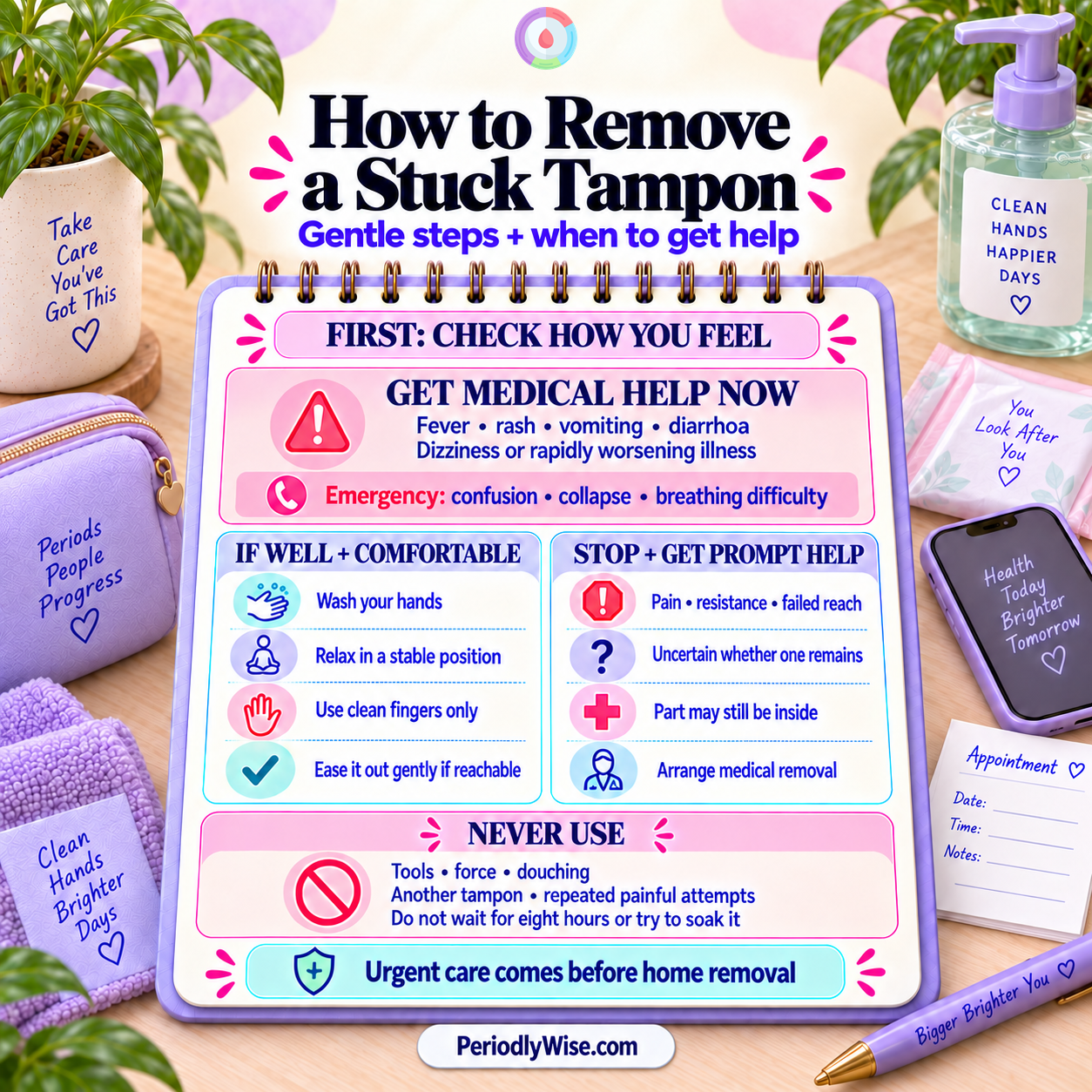
If you feel well, you may try gentle removal with clean fingers; if the tampon will not come out easily, get medical help promptly. Do not use tweezers or other objects, force a painful removal, or wait for it to fall out. If you have fever, rash, vomiting, diarrhea, dizziness or feel suddenly unwell, seek immediate medical attention instead of spending time on home attempts. Confusion, collapse or difficulty breathing require emergency help.
A missing string can be frightening, but a tampon cannot migrate into your abdomen or disappear elsewhere in your body. It stays in the vagina, sometimes higher or turned sideways. A clinician can help remove it. Needing that help is not a failure, and you do not have to prove that you tried hard enough before asking.
This guide explains a cautious finger-only approach, the point at which to stop, what to tell a clinic and what to do afterward. It applies to an ordinary menstrual tampon, not a fragile object, a stuck medical device or every type of menstrual cup. If you are unsure what is inside, choose professional assessment rather than experimenting.
First decide whether home removal is appropriate
Before looking for the string, check how you feel. Feeling ill changes the priority from retrieval to medical assessment. You do not need every warning symptom or a particular temperature reading to ask for urgent help. If easily possible, remove the tampon while arranging care, but do not delay care because you cannot reach it.
If you otherwise feel well and can comfortably try, a gentle finger-only attempt is reasonable. If you do not want to try, have difficulty reaching, or know internal touch is painful for you, contact a clinician directly. The Healthdirect guidance recommends prompt removal and medical help when it cannot be removed easily. There is no requirement to keep trying first.
| Situation | Next step | Do not |
|---|---|---|
| SituationWell, tampon comfortably reachable | Next stepTry gentle removal with clean fingers only. | Do notUse force, tools or repeated painful attempts. |
| SituationCannot remove it, cannot find it, or uncertain whether one remains | Next stepContact a doctor, sexual health clinic or urgent-care service promptly, ideally today. | Do notInsert another tampon or wait for symptoms. |
| SituationFever, rash, vomiting, diarrhea, dizziness or rapid illness | Next stepSeek immediate medical assessment and mention tampon use. | Do notWait for a rash, a full symptom list or successful home removal. |
| SituationConfusion, collapse or breathing difficulty | Next stepUse local emergency services immediately. | Do notDrive yourself when faint, confused or seriously unwell. |
Why a tampon can be difficult to find
The string may have tucked inside, or the tampon may be compressed higher in the vagina. Inserting a second tampon before removing the first or having vaginal penetration with one in can push it higher. A forgotten tampon at the end of a period can also become difficult to notice. None of these situations means you are dirty or careless; the practical task is to locate and remove it safely.
The cervix is not an opening a tampon can pass through. The reassurance is about where it can go, not permission to leave it there. A tampon can remain lodged and may not come out by itself. Bowel movements and urination are not reliable ways to resolve it; urine leaves through the urethra, not the vagina.
Not feeling a string does not prove that a tampon is present, and not finding one with a finger does not reliably exclude it. Keep the uncertainty explicit. If you remember inserting one but cannot confirm removal, a clinician can check instead of you repeatedly searching or inserting another product.
Gentle steps to remove a stuck tampon
Only try these steps if you feel well, know this is a menstrual tampon and can do so without pain. Find a private place and a stable position. There is no advantage to rushing, straining hard or reaching with an object. The stopping rule matters as much as the technique: if it is not easy, stop and arrange medical help.
The approach below follows the finger-only guidance from Healthdirect and Cleveland Clinic. It is not a guarantee that everyone can retrieve a tampon themselves. You do not need to complete every step if you become uncomfortable, and you can skip home removal altogether.
- Clean your hands. Wash with soap and water. Keep nails smooth and short enough not to scratch; do not put soap inside the vagina.
- Choose a comfortable, stable position. Squat if comfortable, or sit on the toilet. Take slow breaths and let your muscles relax. A gentle bearing-down movement, like a bowel movement, may bring it lower; do not strain forcefully.
- Feel gently with one clean finger. Try to locate the string or soft tampon. Do not scrape, dig or repeatedly sweep if this hurts.
- Grip only if comfortably reachable. If you can hold the string, pull gently. If needed and comfortable, use two fingers to hold the tampon itself and ease it out slowly.
- Stop for pain or resistance. If you cannot reach or grip it, it does not move easily, or the attempt is painful, stop. Do not switch to tweezers, scissors or another object.
- Check what came out and wash your hands. Dispose of the tampon in the bin. If it appears incomplete, another may remain or you are unsure, ask a clinician to check rather than searching aggressively.
If the string broke, disappeared or pulling feels dry
A hidden or broken string does not make the tampon impossible to remove. If the tampon itself is comfortably reachable, clean fingers can grip it. If it is beyond reach, medical removal is the next step, not a stronger tool. Avoid hard repeated pulls on a string when the tampon resists.
A mostly dry tampon can feel uncomfortable to remove, particularly with light flow or more absorbency than needed. Do not leave a stuck tampon in simply to wait for it to become soaked. Do not pour liquid into the vagina to wet it, and do not force it past painful resistance. Contact a clinician if gentle removal is not possible.
If insertion or removal is repeatedly painful, discuss that separately after the current tampon is dealt with. A different product may suit you better, but changing brand or absorbency is not a substitute for assessing persistent pain. You do not need to use internal products to manage a period.
What not to do: tools, flushing and repeated attempts
The impulse to find a quick workaround is understandable. However, a longer object is not a safer version of a finger. It can injure tissue or push the tampon farther away. Instruments used by a trained clinician during an examination are not a reason to imitate that procedure at home.
Do not try to wash a retained tampon out. Douching, soap, disinfectant, scented sprays and internal rinsing do not solve the problem and can irritate the vagina. Medication cannot retrieve it either. Do not use leftover antibiotics or an antifungal product to cover up odor while leaving the cause unassessed.
- No tweezers, scissors, hooks or applicators: clean fingers only for a comfortable home attempt.
- No force or endless searching: pain, resistance and failure to reach it are reasons to stop.
- No second tampon or vaginal penetration: avoid pushing a retained product higher; use external protection while seeking help.
- No waiting for it to fall out: if you cannot remove it, contact a medical service promptly.
If you are unsure whether a tampon is still inside
Uncertainty can happen after sleep, travel, a busy day or changing products. Start with what you actually remember: insertion time, whether removal was seen and whether a second tampon was used. Finding a wrapper or noticing the absence of a string cannot confirm the answer. A short factual account is more useful than repeatedly trying to reconstruct every minute.
If you think one may remain and cannot comfortably locate and remove it, arrange an examination. Do not insert another tampon to test whether there is room. A pad or period underwear can provide external protection while you obtain help. If you removed one but remember possibly inserting two, tell the clinician that too.
For example: I inserted a tampon last night and cannot confirm that I removed it. I cannot find the string and have stopped trying. That is enough to start the conversation. An app, calendar or symptom checklist cannot establish whether a foreign body remains.
Odor, discharge and toxic shock syndrome warning signs
Unpleasant odor, unusual discharge, itching, pain with urination or pelvic discomfort can occur with a retained tampon and need assessment. They are not a way to identify a specific infection at home. Normal smell does not make a known retained tampon safe to leave in. Conversely, odor alone does not mean you have toxic shock syndrome (TSS).
TSS is rare but can become life-threatening quickly. The NHS warning guidance emphasizes urgent treatment. Sudden fever, vomiting or diarrhea, rash, muscle aches, dizziness or rapidly worsening illness during or after tampon use needs immediate medical attention. You do not need all the signs, and a rash can be less obvious on darker skin.
If the tampon is easily removable, remove it while arranging help. If it is not, say so and seek care without delay. Removing it does not replace assessment when you feel ill. Do not stay home to see whether the symptoms improve, and do not drive yourself if faint, confused or severely unwell.
| What you notice | How to respond | Important distinction |
|---|---|---|
| What you noticeNew odor or discharge, itching or local discomfort | How to respondPrompt medical assessment, especially if retention is possible. | Important distinctionSymptoms do not identify the organism or prove TSS. |
| What you noticeFever, rash, vomiting, diarrhea, dizziness or rapid systemic illness | How to respondImmediate medical attention; report tampon use and whether it is still inside. | Important distinctionDo not wait for the full symptom list or a home diagnosis. |
| What you noticeConfusion, collapse or breathing difficulty | How to respondCall local emergency services now. | Important distinctionHome retrieval must not delay emergency care. |
What happens when a clinician removes it?
Contact a primary-care doctor, gynecology or sexual health clinic, or urgent-care service. Explain that a tampon may be retained and needs removal. If the first service cannot see you promptly, ask where to go instead of waiting for a routine appointment days away. Tell them immediately about fever, rash, dizziness, severe pain or other illness so they can choose the right urgency.
The clinician will ask about the timing, symptoms and attempts, then examine as needed to locate and remove the tampon. They may use appropriate examination equipment or a removal instrument. That is a clinical procedure, not a technique to copy with household tools. Further tests or treatment depend on the findings; there is no reason to self-prescribe an antibiotic beforehand.
You can ask for an explanation before each step, a chaperone and a pause or stop if needed. Mention anxiety, previous painful examinations, accessibility needs or trauma so the team can support you. You do not have to apologize or give a perfect timeline. The immediate question is what may remain and how you are feeling, not a judgment about your menstrual habits.
After removal: external protection and symptom follow-up
Wash your hands and discard the used tampon in the bin, not the toilet. Use a pad or period underwear while any soreness settles and follow the clinician's instructions if you needed help. Do not reinsert the same tampon. If part looks missing or you are uncertain whether another remains, arrange a check rather than assuming the problem is resolved.
Do not douche or disinfect the vagina afterward. Gentle washing of the outside is enough; the NHS discharge guidance advises against internal washing. Persistent odor, unusual discharge, urinary pain or pelvic discomfort still warrants medical advice. Removing the product may be an important first step, but does not automatically explain or treat every symptom.
New fever, rash, vomiting, diarrhea, dizziness or rapid illness after removal still needs immediate attention. There is no guaranteed symptom-free waiting period that proves safety. Tell the service approximately how long the tampon may have been present and when it came out. Keep the account simple and follow the care plan rather than relying on online reassurance alone.
Preventing another retained tampon without adding anxiety
Use one tampon at a time and confirm the previous one is out before opening another. A simple insertion reminder can help, especially when routines change. Keep the reminder practical rather than repeatedly checking inside. At the end of the period, make a final removal check based on your actual product use.
The FDA advises changing tampons every four to eight hours and never wearing one longer than eight, while following the exact label and using the lowest absorbency needed. Eight hours is a wear-time ceiling, not permission to wait with a stuck tampon. Follow stricter local or product advice and choose external protection when a timely change is not possible.
| Habit | Why it helps | Practical detail |
|---|---|---|
| HabitOne tampon at a time | Why it helpsReduces forgotten or displaced products. | Practical detailConfirm removal before inserting another. |
| HabitRecord insertion time | Why it helpsMakes total wear time easier to remember. | Practical detailCount from insertion, including sleep or travel. |
| HabitLowest needed absorbency | Why it helpsAvoids using more absorption than the flow requires. | Practical detailFollow the label; do not use a tampon outside menstruation. |
| HabitRemove before vaginal penetration and at period end | Why it helpsAvoids pushing it higher or forgetting the final product. | Practical detailDo not assume a missing string means it has already come out. |
| HabitAsk about recurrent pain or difficulty | Why it helpsSupports a product choice and assessment suited to you. | Practical detailPads and period underwear are valid alternatives. |
Frequently asked questions
Can a tampon get lost in my body?
It can lodge high in the vagina, but cannot pass through the cervix into the uterus or abdomen. This reassurance does not mean you should leave it there. If you cannot remove it or remain unsure whether one is present, seek prompt medical help.
Can I use tweezers if my fingers cannot reach it?
No. Household tools can injure tissue or push the tampon farther in. If a comfortable finger-only attempt fails, stop and contact a clinician. Clinical removal equipment is used under examination conditions and should not be copied at home.
What if the tampon string snapped?
If the tampon itself is comfortably reachable, clean fingers may grip it. Do not force a painful or resistant removal. If you cannot reach or remove it easily, a doctor or urgent-care service can help; a broken string is not a reason to use a tool.
Should I wait for a dry tampon to soak up more blood?
Do not delay removal of a stuck tampon to make it wetter, especially near or beyond the wear-time limit. Do not add water or other liquids internally. If gentle removal hurts or fails, seek help instead of pulling harder or waiting.
Does leaving it longer than eight hours mean I have TSS?
No; TSS is rare and exceeding a time limit does not diagnose it. Remove the tampon promptly and get help if you cannot. Fever, rash, vomiting, diarrhea, dizziness or sudden illness requires immediate assessment, regardless of the exact number of hours.
Do I need antibiotics after it is removed?
That depends on symptoms and examination findings; do not start leftover or borrowed medicine yourself. Ask a clinician if there is odor, unusual discharge, pain or uncertainty about complete removal. Systemic illness needs urgent assessment even after the tampon is out.
What if I am embarrassed or this is my first tampon?
You can seek care directly without trying internal removal. Clinicians see retained products and are there to help. Ask for explanation, privacy, a chaperone and support for anxiety or pain. Being inexperienced or needing help does not make you responsible for enduring a painful attempt.
Can this method remove a stuck cup, disc or another object?
Do not assume so. These products have different removal instructions, and fragile or unidentified objects need professional assessment. Do not use tools. For a known menstrual cup or disc, follow its specific instructions and seek help if removal is painful or unsuccessful.
PeriodlyWise can help you keep actual period dates. For a retained-tampon concern, separately note approximate insertion and removal times, symptoms and any medical advice. A tracker cannot locate a tampon or assess infection; getting the right care comes first.
Open the period trackerThe takeaway
A stuck tampon is usually a solvable problem, but it should be removed promptly. Use clean fingers only if the attempt is comfortable; stop for pain, resistance or failure and seek help. Never use tools or internal cleaning. Urgent illness takes priority, and medical assessment remains necessary for warning symptoms even after removal.