Yes, ibuprofen can reduce menstrual bleeding for some people, as well as help period cramps. It belongs to a group of medicines called non-steroidal anti-inflammatory drugs, or NSAIDs. By reducing prostaglandins, these medicines can reduce some of the processes involved in painful, heavy periods.
That does not make ibuprofen an instant period stopper. The amount of benefit varies, it is not suitable for everyone, and heavy bleeding can have causes that need their own assessment. A dose that relieves cramps does not prove that the bleeding is harmless or that you should take more to reduce it further.
This guide explains the evidence without promising a particular percentage reduction. It also separates period-flow treatment from medicine safety: a drug can reduce uterine menstrual blood loss in some circumstances while increasing the risk of bleeding in the stomach or intestines. Both facts matter when deciding what to do.
How can ibuprofen reduce period bleeding?
Prostaglandins are chemical messengers involved in uterine contractions and other local processes during menstruation. NSAIDs reduce their production. This helps explain why the same medicine can ease cramps and, in some people, reduce menstrual blood loss. It is not a hormonal treatment and it is not contraception.
The MedlinePlus ibuprofen guide describes how NSAIDs reduce substances involved in pain and inflammation. Their effects are not limited to the uterus. They can also affect the stomach, kidneys, circulation and bleeding risk, so the potential benefit has to be considered alongside your health and other medicines.
The evidence about menstrual blood loss concerns oral treatment, not rubbing ibuprofen gel onto the abdomen. Skin gels and sprays have their own indications and instructions. Do not swallow a topical product or assume that a product for muscle pain is a treatment for heavy menstrual bleeding.
What can you reasonably expect?
Think of ibuprofen as a possible option for reducing symptoms, not a switch that turns menstruation off. Your response may differ from a friend's even when you both describe your periods as heavy. The cause of bleeding, treatment suitability and the plan used all matter.
A useful outcome might be fewer episodes of flooding or easier daily activities, not complete absence of blood. It is equally important to notice when flow does not improve, when bleeding starts between periods, or when new symptoms appear despite better pain relief.
| Question | What ibuprofen may do | Important limit |
|---|---|---|
| QuestionCan it reduce period blood loss? | What ibuprofen may doYes, for some people, often with a modest benefit. | Important limitThe response is not guaranteed and varies by circumstance. |
| QuestionCan it help cramps? | What ibuprofen may doIt can reduce pain related to prostaglandins. | Important limitPain improvement does not establish the bleeding's cause. |
| QuestionWill it stop or delay my period? | What ibuprofen may doIt is not a reliable way to stop or postpone menstruation. | Important limitDo not escalate doses to try to switch a period off. |
| QuestionWill it reduce flow by a fixed percentage? | What ibuprofen may doResearch supports an effect, not an individual promise. | Important limitA claim such as '50% for everyone' is misleading. |
| QuestionCan it manage an emergency bleed? | What ibuprofen may doIt is not a substitute for urgent assessment. | Important limitHeavy bleeding with faintness, chest pain or breathlessness needs care. |
For example, if cramps improve but you are still repeatedly soaking protection, record those as two separate outcomes. 'The tablets helped the pain' should not hide 'the bleeding is still affecting my safety or daily life'.
What does the research actually show?
The Cochrane review of NSAIDs for heavy menstrual bleeding found a modest benefit compared with placebo. The evidence came from a limited number of small trials and was low to moderate in quality. The review covers the NSAID group; not every result is an ibuprofen-only result.
An older randomized ibuprofen study included only 24 people with several different causes of excessive bleeding. It found benefit in a subgroup with primary heavy bleeding, not across every cause studied. That small study is not a basis for promising the same response to everyone or copying its regimen without advice.
A precise percentage on social media can sound more certain than the evidence allows. Group averages do not predict your result, and study doses are not personal prescribing instructions. A clinician may choose a different treatment when reducing flow is the main priority or when an underlying condition changes the balance.
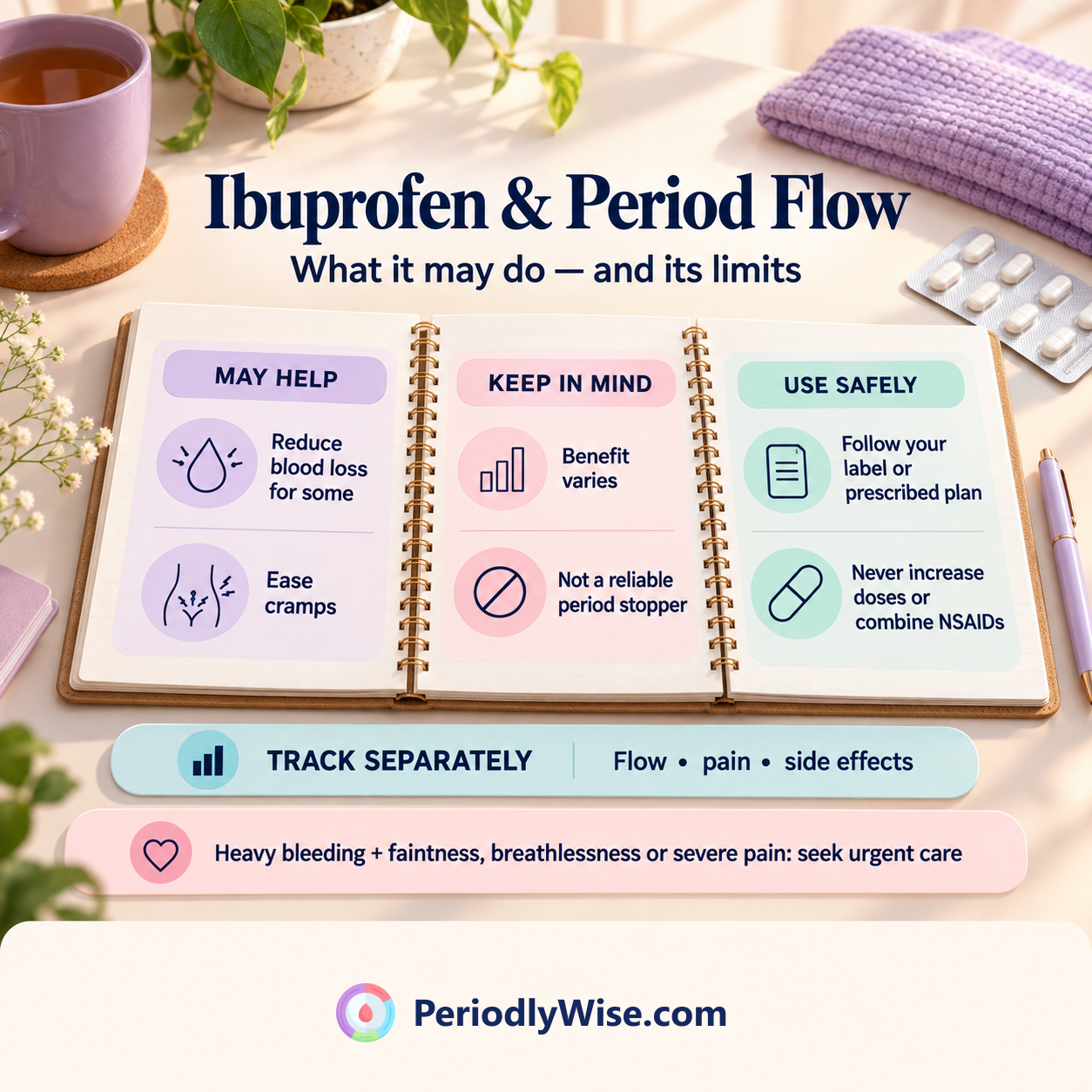
How to approach use safely
Read the instructions for the exact oral product sold in your country. Tablet strength, formulation, age restrictions, maximum daily amount and permitted duration vary. The NHS ibuprofen guide advises using the smallest necessary dose for the shortest necessary time. A local packet or your prescribed plan takes priority over an online example.
A clinician-directed plan for heavy bleeding may differ from occasional use for cramps, and some uses of NSAIDs for heavy menstrual bleeding are off-label. That means the use is outside the product's specific licence, not that you should improvise a dose. Ask a pharmacist or clinician whether ibuprofen is appropriate and what timing and duration to follow.
- Confirm the medicine, strength and formulation; do not rely on tablet colour or brand name alone.
- Check your health conditions, pregnancy possibility and every medicine or supplement you use.
- Follow the local label or individual prescription for amount, spacing and maximum duration.
- Check combination cold, flu or pain products for hidden ibuprofen or another NSAID.
- Record what you take and when, along with flow, pain and any side effects.
- Seek advice if bleeding remains troublesome or symptoms change; do not solve this by taking extra.
Taking oral ibuprofen with or after food may reduce stomach upset, but food does not remove the risk of an ulcer or gastrointestinal bleeding. If you take more than directed, contact a poison-information or urgent medical service for advice rather than waiting to feel ill.
Who should check before taking ibuprofen?
Heavy periods do not automatically make ibuprofen a safe choice. Some conditions make NSAIDs unsuitable, and others require an individualized decision. This is particularly important if heavy bleeding might be related to a bleeding disorder or to a medicine that affects clotting.
The following list is a screening aid, not a complete list of contraindications. Tell the pharmacist or clinician about previous reactions, current illness and prescribed medicines. If you have been told to avoid NSAIDs, do not restart them simply because you have read that they can reduce period flow.
| Health context | Why it matters | What to do |
|---|---|---|
| Health contextPrevious stomach ulcer or gut bleeding | Why it mattersIbuprofen can cause ulcers and gastrointestinal bleeding. | What to doDo not self-start; check the product warnings and medical advice. |
| Health contextReaction to ibuprofen, aspirin or another NSAID | Why it mattersAllergy or NSAID-triggered asthma can be serious. | What to doAvoid a known trigger; ask about suitable alternatives. |
| Health contextKidney, heart or liver disease, or previous stroke | Why it mattersNSAIDs can increase important health risks. | What to doGet individualized advice before use. |
| Health contextVomiting, dehydration or a significant acute illness | Why it mattersKidney risk and overall suitability may change. | What to doCheck with a clinician rather than adding ibuprofen automatically. |
| Health contextBleeding disorder, anticoagulant or antiplatelet treatment | Why it mattersThe medicine can add to bleeding risk. | What to doAsk the treating team; do not stop prescribed treatment yourself. |
| Health contextPregnancy, possible pregnancy or trying to conceive | Why it mattersBleeding may not be a period, and pregnancy changes medicine safety. | What to doGet appropriate testing and advice before treating flow with ibuprofen. |
Do not stack painkillers or overlook interactions
Do not combine ibuprofen with another NSAID such as naproxen, mefenamic acid or diclofenac unless a clinician has specifically directed the combination. Aspirin also needs particular care. Taking several anti-inflammatory painkillers does not create a safer or more reliable way to reduce flow.
Blood thinners, prescribed aspirin, some antidepressants, steroids and blood-pressure medicines can affect the safety decision. Tell a pharmacist about all of them, including medicines you only take occasionally. Do not stop a prescribed blood thinner or low-dose aspirin on your own because your period is heavy. Ask the prescriber for a bleeding-management plan.
Paracetamol, also called acetaminophen, is a different medicine that may help pain but is not a dependable treatment for reducing menstrual blood loss. Whether it can be used alongside another medicine depends on your circumstances and product limits. Aspirin is not an interchangeable flow-reducing substitute and can increase bleeding.
Pregnancy possibility changes the question
A period-like bleed does not always prove that you are not pregnant. If pregnancy is possible and bleeding is unusual, use an appropriate testing timeline and seek advice about the bleeding. Do not use ibuprofen to mask symptoms or assume that lighter bleeding excludes a pregnancy-related problem.
Avoid ibuprofen in pregnancy unless a healthcare professional advises it. The FDA warns that NSAIDs from around 20 weeks can affect fetal kidneys and amniotic fluid, with additional risks later in pregnancy. This warning is not permission to self-treat earlier in pregnancy.
If you have already taken a dose and then discover a pregnancy, tell your clinician what product, amount and date were involved; do not jump to conclusions about harm. Severe or one-sided pain, shoulder-tip pain, faintness or heavy bleeding needs urgent assessment instead of waiting for another dose or test.
Heavy bleeding still deserves an explanation
Heavy menstrual bleeding is judged partly by its effect on your life, not by whether you can calculate an exact volume. Repeated flooding, leakage, prolonged bleeding, fatigue or avoiding school and work are useful reasons to ask for help. A partial response to ibuprofen does not identify the cause.
The NICE heavy-menstrual-bleeding guideline recommends assessment and a full blood count alongside treatment. A clinician considers symptoms and history before deciding whether further investigations are needed. Iron deficiency or anaemia can need treatment too; ibuprofen does not replace iron or correct depleted stores.
Mention bleeding between periods or after sex, a new change in your usual pattern, severe pain, a copper IUD, medicines affecting clotting, and a personal or family history of easy bleeding. Bleeding after menopause should be assessed rather than treated as another heavy period. Not everyone needs the same tests, and treatment need not wait for every investigation to finish.
What if reducing flow is the main goal?
The NHS describes several treatments for heavy periods, including tranexamic acid, hormonal options and selected anti-inflammatory medicines. The best choice depends on the cause, preferences, need for contraception, pregnancy plans and medical history. An over-the-counter medicine is not automatically the best long-term option.
Tranexamic acid and a levonorgestrel-releasing intrauterine system can reduce blood loss more than NSAIDs in the overall review evidence, but each has its own suitability checks. A hormonal IUS is different from a copper IUD. Some people prefer a non-hormonal option; others value contraception and flow control together.
A clinician may sometimes use treatments together, including an NSAID and tranexamic acid, after assessing suitability. Do not create that combination yourself from an online list. Procedures or specialist treatment may be appropriate for some underlying causes or when medicines do not help enough.
What to track to judge whether the plan helps
Use the same simple measures before and during treatment. A record of flooding, protection changes and daily impact is often more practical than trying to estimate millilitres. Different pads, cups and tampons hold different amounts, so product counts are context rather than an exact blood-loss measurement.
Keep pain and flow separate. A person may sleep better because cramps improve but still need frequent protection changes. Also record side effects rather than counting only the benefits. You do not need a perfectly completed cycle diary before contacting a clinician, and you should never wait to complete one during a possible emergency.
- Start and end dates, usual cycle timing and any bleeding between periods.
- Flooding, leakage, clots and how often protection becomes soaked.
- Pain severity and whether symptoms limit sleep, work, school or normal activity.
- Exact medicine, strength, amount and time taken, including other pain products.
- Stomach symptoms, dizziness, rash, breathing changes or other possible side effects.
- Fatigue, breathlessness, pregnancy possibility and relevant contraceptive changes.
If ibuprofen does not help, do not keep increasing it
More medicine is not a substitute for reviewing the treatment plan. If flow remains heavy, you repeatedly need medication each cycle, or the pattern has changed, contact a clinician. Bring your product packet and record so the discussion can distinguish an unsuitable medicine, an inadequate plan, side effects and a cause that needs investigation.
You do not have to prove that every self-care option has failed. Heat or gentle movement may ease cramps, and rest can help you cope, but they do not establish the cause of heavy bleeding or treat anaemia. The goal is safer, more manageable periods and an appropriate explanation for ongoing symptoms.
When to seek urgent care
The ACOG guidance highlights emergency care when hourly protection changes continue for more than two hours with chest pain, breathlessness or dizziness. Do not use that example as a reason to wait if you feel faint, collapse, have severe pain or bleeding feels rapidly out of control.
Medicine reactions create a separate urgent concern. Stop ibuprofen and seek urgent help for vomiting blood, black tarry stools or signs of a severe allergic reaction such as swelling or difficulty breathing. New chest pain, stroke-like symptoms or marked illness also needs immediate care. These symptoms are not ordinary period side effects.
Frequently asked questions
Does ibuprofen stop a period immediately?
No. It may reduce menstrual blood loss for some people, but it is not a reliable way to stop or delay a period. Do not take extra doses to try to make bleeding stop.
How much can it reduce the bleeding?
The response varies. Research supports a modest average benefit for NSAIDs, but small studies and different causes of heavy bleeding make a fixed percentage promise unreliable. Your own response needs to be assessed alongside safety.
What dose should I take for heavy bleeding?
Follow your local product instructions or an individual prescribed plan after checking suitability. A heavy-bleeding regimen may be off-label and is not something to copy from a study or social-media post. Ask a pharmacist or clinician rather than increasing the dose yourself.
When should I start taking it?
Follow the timing and duration in your product instructions or clinician's plan. A plan for recurrent heavy bleeding can differ from occasional cramp treatment. Do not take high doses before a period in an attempt to postpone it.
Why can it reduce periods but cause other bleeding?
Reducing prostaglandins can reduce menstrual blood loss in some people, while NSAID effects on the digestive tract and bleeding risk can cause harm elsewhere. A lighter period does not mean the medicine is risk-free.
Can I combine it with another anti-inflammatory?
Do not combine ibuprofen with other NSAIDs such as naproxen, mefenamic acid or diclofenac without explicit medical direction. Check combination products too. If you take prescribed aspirin or a blood thinner, ask the treating team and do not stop it yourself.
Will paracetamol or aspirin reduce flow in the same way?
They are not interchangeable. Paracetamol may help pain but is not a dependable flow-reducing treatment. Aspirin can increase bleeding and should not be substituted for ibuprofen to make a period lighter.
Do I still need care if the medicine helped?
Yes, if bleeding stays heavy or unusual, symptoms recur, or you have warning signs. Symptom relief does not diagnose the cause, treat iron deficiency or rule out a pregnancy-related problem. Urgent symptoms need care regardless of how well cramps improve.
Record bleeding, symptoms and medicine context to make changes easier to explain. Calendar predictions support planning; they do not diagnose heavy bleeding or decide whether a medicine is safe for you.
Open the period trackerA possible benefit, with clear limits
Ibuprofen can reduce menstrual blood loss and cramps for some people. The effect varies, and it is not a reliable period-stopping or delaying method. Check whether it is suitable, follow a local-label or prescribed plan and avoid combining NSAIDs or increasing doses to chase an effect.
If bleeding remains heavy, is new or unusual, or comes with fatigue, breathlessness, severe pain or pregnancy possibility, get appropriate advice. Urgent bleeding symptoms or serious medicine reactions need immediate attention rather than another dose.