Seed cycling has not been established as an effective treatment for hormone imbalance, irregular periods, PMS or infertility. That answer needs some nuance: there is emerging research, including small studies in people with polycystic ovary syndrome (PCOS). It would be inaccurate to say that no research exists. It would also be inaccurate to turn those findings into a promise that a particular seed schedule will fix your cycle.
The key distinction is between eating nutritious seeds and proving that their timing makes a therapeutic difference. Flax, pumpkin, sesame and sunflower seeds can fit into meals. Whether rotating two pairs around ovulation adds a benefit is a separate question that the available evidence does not settle.
This guide separates the popular protocol from the research, explains what a personal symptom diary can and cannot tell you, and outlines sensible precautions. You do not need to buy a special blend, achieve a textbook 28-day cycle, or blame yourself if a food routine does not change your periods.
What is seed cycling, and what does the schedule claim?
Seed cycling means alternating specific seeds across two parts of the menstrual cycle. The commonly advertised schedule uses flax and pumpkin first, then sesame and sunflower. Some descriptions specify one tablespoon of each seed daily. This is a popular protocol, not a clinically validated dose or prescription. Research protocols differ, so a social-media tablespoon schedule cannot be assumed equivalent to a trial intervention.
The first part is usually called the follicular phase and the second the luteal phase. A real luteal phase follows ovulation; it does not automatically begin on calendar day 15. The table describes the marketing convention, not a recommendation to use those dates to identify fertility.
| Popular phase | Commonly described seeds | Important limit |
|---|---|---|
| First half, often labeled days 1-14 | Flax and pumpkin | Day 1 is the start of a period; day 14 is not a guaranteed ovulation date. |
| Second half, often labeled days 15-28 | Sesame and sunflower | A fixed 28-day schedule does not establish a luteal phase or hormone need. |
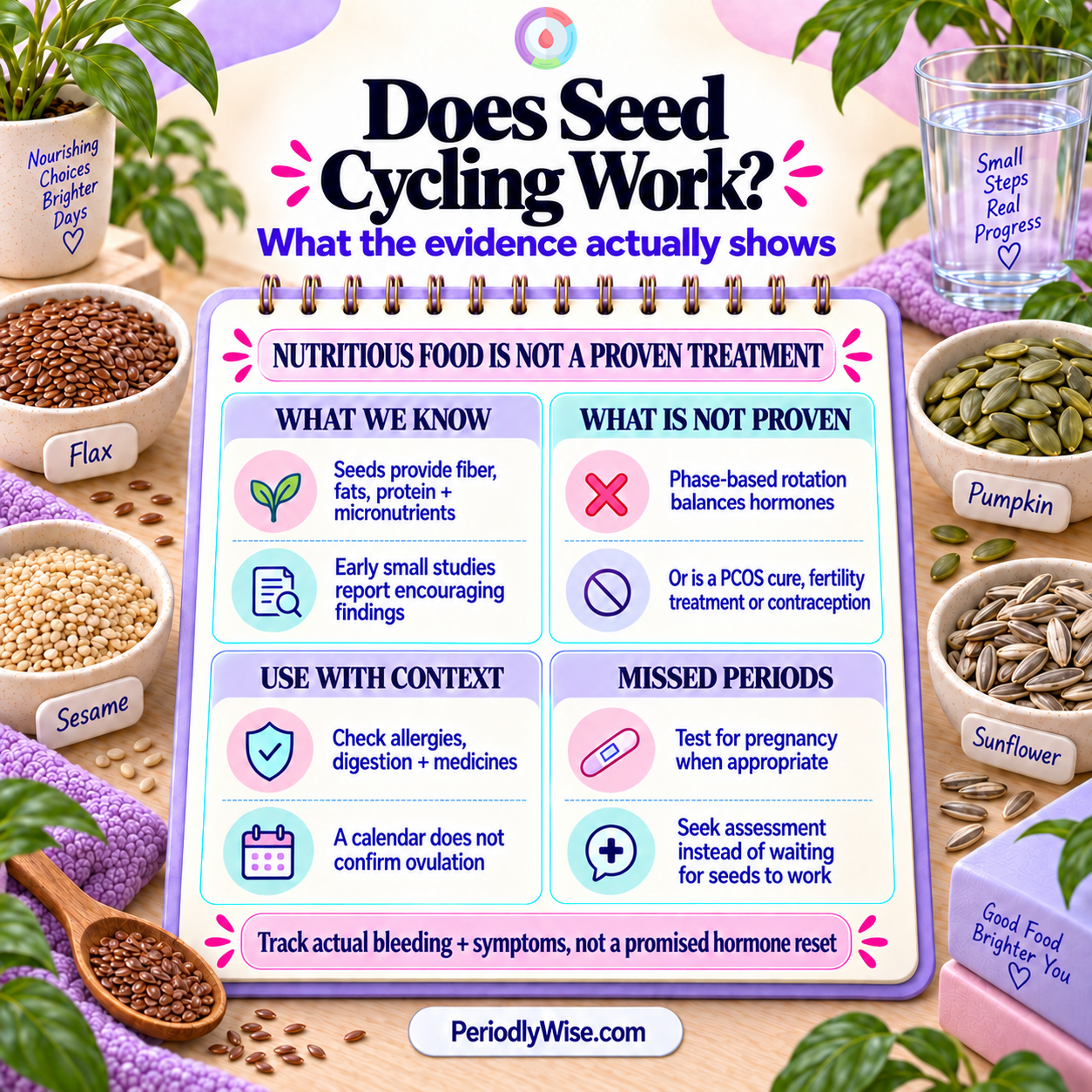
Nutritious food is not the same as a hormone switch
Seeds supply a mix of fats, fiber, protein and micronutrients. Flax also contains lignans, plant compounds studied for biological effects. These facts make seeds interesting foods and research subjects; they do not show that one pair raises estrogen at the right time or another pair reliably increases progesterone. A proposed mechanism is a reason to investigate a claim, not proof that it works in people.
The phrase balance your hormones is particularly vague. Which hormone, measured when, in whom, and to what clinical benefit? Normal hormone levels change across the cycle. A single blood-test movement is not automatically an improvement, and different disorders require different assessment. Food marketing rarely answers those questions before promising smoother periods, clearer skin or easier conception.
For a useful comparison, a study would need to separate the seeds themselves from the schedule: for example, comparable amounts of the same seeds rotated by phase versus eaten without rotation. Otherwise, improvement might relate to an overall dietary change rather than timing. That distinction is the central uncertainty for seed cycling.
What the published studies can actually tell us
The evidence is not one uniform body of research. Some studies examine a single seed, others combine seed cycling with broader changes, and reviews group different approaches together. These are related questions, but they are not interchangeable. Read the intervention and comparison group before accepting a headline about the entire protocol.
| Research | What was examined | What remains uncertain |
|---|---|---|
| 2023 PCOS study | Seed cycling alongside a portion-controlled diet; reported hormonal changes. | The combined intervention does not establish the independent benefit of phase-based rotation. |
| 2025 randomized PCOS trial | 70 participants; daily milled flaxseed for 12 weeks. Some hormonal measures changed, others did not. | One seed taken daily is not the four-seed rotating protocol; laboratory outcomes do not prove fertility benefit. |
| 2025 systematic review | Ten studies combined seed cycling and individual-seed interventions; encouraging signals with important limitations. | Different interventions, small samples and limited follow-up restrict conclusions about the schedule. |
| Registered trial NCT07052500 | Listed as completed, with no results posted when checked on October 1, 2026. | Registration and completion are not published evidence of benefit. |
PCOS, PMS, fertility and menopause are different claims
For PCOS, a diet can be part of a broader care plan, but the right plan depends on your symptoms and goals. A promising seed study is not a reason to stop metformin, hormonal treatment or an ovulation treatment. The 2023 international guideline favors sustainable, individualized nutrition rather than one superior diet. Consider a registered dietitian if changing food feels confusing or restrictive.
For PMS, ask about symptoms and everyday function, not just hormone numbers. Is mood, sleep or pain meaningfully better, and does the pattern recur? A routine that makes breakfast easier can have value without proving a phase-specific effect. If symptoms disrupt work, relationships or daily life, discuss assessment and treatment rather than relying on a seed calendar.
For fertility, a period arriving sooner is not proof of ovulation, egg quality, implantation or improved live-birth chances. Seed cycling is not a fertility treatment or contraception. For perimenopause or menopause, results from reproductive-aged participants with PCOS cannot simply be transferred to a different life stage. You deserve an answer suited to the problem you are trying to address, not one remedy advertised for every hormone-related concern.
Why an irregular cycle makes the calendar rule unreliable
If your cycles vary, a day-14 switch assumes information you may not have. Ovulation may occur later, or not occur in a particular cycle. Eating a second seed pair does not create a luteal phase. An app prediction is an estimate, not a hormone measurement or confirmation of ovulation. Do not use the seed schedule to decide that unprotected sex is safe.
Some routines suggest following moon phases when periods are absent. That may organize a food habit, but it does not identify your biological cycle or diagnose why bleeding stopped. Similarly, hormonal contraception can change bleeding and ovulation patterns, so a withdrawal bleed should not automatically be treated as evidence of a natural cycle phase.
You can enjoy seeds without trying to map every serving to an uncertain phase. If your actual goal is understanding irregular periods, record the dates and symptoms and investigate the cause. Changing the calendar label does not solve the underlying uncertainty.
A practical way to include seeds without buying a promise
Treat seeds as ingredients that need to fit your appetite, budget, allergies and overall meals. A modest amount mixed into porridge, yogurt, a salad or another familiar dish may be easier than swallowing dry spoonfuls. Use food-grade products, follow preparation and storage instructions, and keep meals varied. There is no established therapeutic seed-cycling dose to reach.
You do not need a subscription, a branded hormone blend or an exact rotation to eat seeds. Compare the ingredients and cost rather than assuming a premium packet has proven effects. Blends may also contain herbs or supplements, making their safety and evidence different from those of ordinary foods. More is not automatically better, and a trial's measured dose is not a personal recommendation.
Avoid turning this into a restrictive rule. Seeds do not replace adequate meals, iron treatment for diagnosed deficiency, or evaluation of a missed period. If following the schedule adds anxiety, expense or food guilt, a simpler varied diet may be the more workable choice. The aim is nourishment, not perfect compliance with an unproven protocol.
Safety: allergies, digestion, medicines and pregnancy
Natural ingredients can still cause problems. Check every ingredient, including the contents of a premixed product. Sesame is a major food allergen; seeds of other types can also trigger reactions. Do not test a known allergy by trying a small amount. Breathing difficulty, throat swelling or collapse after eating requires emergency help.
The NCCIH safety summary notes digestive effects at higher intakes, possible medicine interactions and uncertainty around pregnancy and breastfeeding. Its advice also cautions against raw or unripe flaxseed. Do not assume concentrated flax extracts or oils have the same safety as your usual food use; ask a clinician or pharmacist about your specific product.
| Situation | Practical response | Avoid this assumption |
|---|---|---|
| Known seed allergy or a reaction | Avoid the trigger; check labels and cross-contact advice. | A hormone goal makes an allergen safe. |
| Bloating, fullness or diarrhea | Reduce or stop the added product and seek advice for persistent symptoms. | Digestive discomfort is a required detox or proof it is working. |
| Prescription medicines, especially blood-thinning treatment | Discuss the exact seed, extract or oil and amount with a pharmacist or clinician. | Food-like supplements cannot interact with treatment. |
| Pregnancy, possible pregnancy or breastfeeding | Ask about safety before adopting concentrated products or a high-intake routine. | PCOS research establishes safety for every pregnancy or breastfeeding situation. |
How to track changes without mistaking them for proof
A diary can help you explain what happened, but it is not a controlled trial. Start with a clear question: less disruptive cramps, fewer days of breast tenderness, or the actual interval between periods. Choose an observable outcome rather than writing 'hormones improved.' Note food changes alongside sleep, illness, exercise, medicines and contraception so the context is not lost.
A useful sequence is to record your existing pattern before changing anything, if you are otherwise well and there is no reason to delay care. Keep the method of recording consistent. Do not make several major changes together and then credit the seed schedule for everything. Never stop prescribed treatment to make your experiment easier to interpret.
- Define the goal. Write down the symptom and how it affects your day; avoid a vague hormone target.
- Record actual bleeding. Separate spotting from your usual flow and keep predicted dates clearly labeled as estimates.
- Describe the food change. Note seeds, product ingredients, approximate amount and start date without inventing a medical dose.
- Keep context. Record changes in medicines, contraception, sleep, stress, illness, meals and activity.
- Track tolerance and symptoms. Include digestive effects, pain, mood, bleeding duration and disruption of daily activities.
- Review with perspective. A better cycle is encouraging, not proof of causation. Seek care for persistent problems or warning signs.
What would count as useful improvement?
A shorter cycle is not automatically a healthier cycle, and less bleeding is not automatically better. Improvement depends on the starting problem: fewer days lost to pain, a more understandable pattern, or better nutrition without troublesome side effects. If a clinician is assessing hormones or ovulation, let them choose the test and timing rather than ordering panels to demonstrate that seeds worked.
One apparently better month cannot separate a food effect from normal variation. People often begin a new routine after an unusually difficult cycle; the next may be easier regardless. Expectations can also change how symptoms are noticed. These possibilities do not dismiss your experience. They explain why your experience alone cannot establish the treatment claim.
A practical diary might say: Added a seed topping to breakfast; cramps were less disruptive this month, but sleep improved and pain medicine changed too. That is more informative than 'seed cycling cured my hormones.' Keep the benefit you notice in proportion to what you can actually infer.
When to investigate instead of waiting for seed cycling
A late period needs its own explanation. If pregnancy is possible, use a test at an appropriate time: from the first day of a missed period, or at least 21 days after the last unprotected sex if you do not know when it is due. A negative result taken too early is not definitive. NHS testing guidance explains when to repeat and seek advice.
Arrange assessment for persistent cycle changes, three missed periods in a row, or symptoms that interfere with daily life. Pregnancy, contraception, PCOS, thyroid conditions, under-fueling and other causes require context; the seed schedule cannot distinguish them. Seek advice sooner if the change is worrying or accompanied by additional symptoms. You do not have to finish an advertised three-month challenge first.
Seek urgent care for severe abdominal or pelvic pain, fainting, or heavy bleeding with feeling unwell. Possible pregnancy with pain and unusual bleeding needs urgent assessment even without a positive home test. Likewise, severe mood symptoms or thoughts of self-harm require prompt help. A symptom diary should support care, never delay it.
- Ask about the cause: What explains this symptom pattern, and is investigation needed?
- Ask about meaningful options: Which treatments have evidence for my symptoms and goals?
- Ask about the product: Is it compatible with my allergies, medicines and pregnancy plans?
- Ask about follow-up: What change should prompt earlier contact, and when should we review the plan?
Frequently asked questions
Does seed cycling really balance hormones?
It has not been established as a reliable hormone-balancing treatment. Some studies report promising findings, but they do not prove that phase-based rotation produces a specific clinical benefit. Ask what outcome is being claimed and whether the actual protocol was tested.
How long does seed cycling take to work?
There is no established treatment timeline. A study lasting several weeks does not create a guarantee that your periods will change within that time. Do not postpone pregnancy testing, investigation or treatment while waiting for an advertised number of cycles.
Can seed cycling cure PCOS?
No cure or replacement for PCOS care has been demonstrated. Foods can be part of an individualized plan, but a seed schedule should not replace prescribed care or assessment of metabolic, bleeding or fertility concerns.
Can I eat all four seeds together?
If they suit your allergies and dietary needs, they can be used as ordinary foods. The evidence does not establish that you must separate them by cycle phase to gain nutritional value. A mixture is not proven hormone treatment either.
What if I switch on the wrong day?
There is no validated medical switching date, and day 14 is not a guaranteed ovulation day. Do not treat a missed switch as hormonal damage or personal failure. Keep the routine optional and avoid using it for fertility decisions.
Does seed cycling help you get pregnant?
Improved conception or live-birth rates have not been established for the protocol. Bleeding after starting it does not confirm ovulation. If you are trying to conceive with irregular periods, seek individualized advice rather than waiting for the schedule to prove itself.
Can I seed cycle while taking birth control?
Seeds may fit into meals, but hormonal contraception changes how bleeding and ovulation relate to calendar dates. Ask about any concentrated product or medicine interaction. Do not change contraception or rely on seeds for pregnancy prevention.
Are seed-cycling supplements better than food?
There is no established superiority. Extracts, oils and blends can differ from whole seeds in ingredients, dose and safety. Review the full label and discuss the exact product with a clinician or pharmacist, especially with medicines, pregnancy or breastfeeding.
Use PeriodlyWise to record actual period dates and keep a short symptom note alongside them. Predictions are estimates; they cannot show whether seeds changed hormones or confirm ovulation. Bring the pattern to a clinician when you need assessment.
Open the period trackerThe takeaway
Seeds can be part of varied, enjoyable meals. Seed cycling remains an unproven therapeutic protocol, with emerging research that needs better separation of food effects from timing. Choose food for nourishment, keep expectations realistic, and get the right care for the symptom you want to improve.