
Your period returns, your baby seems unsettled at the breast, or the pump collects less than usual. It is understandable to connect those events. But a period is not an automatic switch that turns milk production down, and it does not make breast milk unsafe. You can usually continue your established feeding routine while checking what has actually changed.
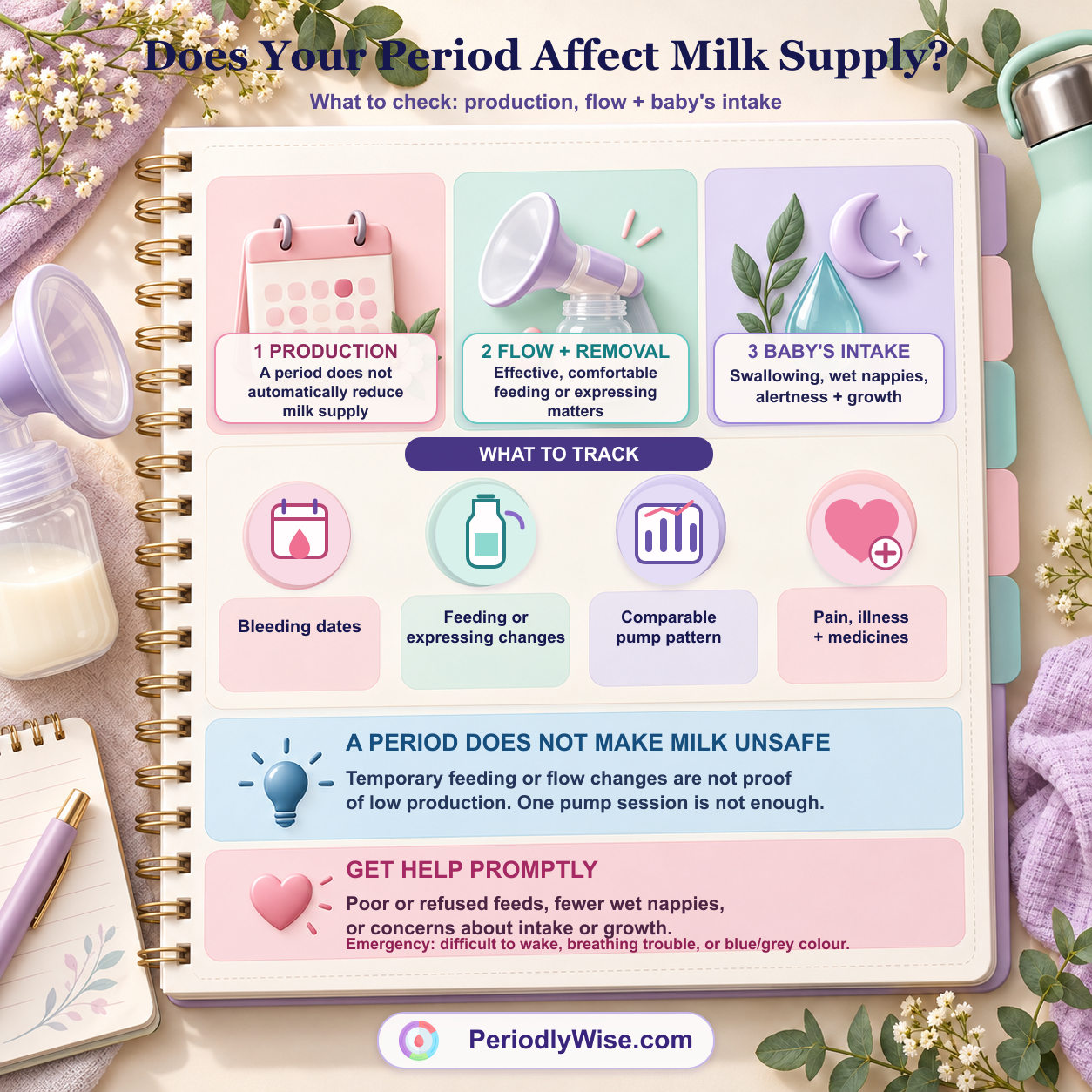
The useful distinction is between milk production, milk flow and the baby's intake. A baby can react to a different flow or feeding experience without being underfed. Equally, a real intake problem must not be dismissed as hormones just because bleeding started. The response should depend on feeding and health signs, not on how convincing the calendar pattern looks.
This guide explains the evidence limits, practical checks for direct breastfeeding and expressing, and when to seek help. It does not prescribe a pumping quota, mineral dose or infant feeding volume. Newborns, premature babies and babies with medical or growth concerns need their own feeding plan, which takes priority over general cycle advice.
Does menstruation directly lower milk production?
The Australian Breastfeeding Association's January 2026 guidance says a direct supply effect is unlikely and distinguishes possible taste or flow changes from production. Healthdirect explains that hormonal changes may alter how a baby feeds, which can in turn affect supply. These are not instructions to ignore a genuine change; they are reasons not to assume one cause.
For example, if uncomfortable feeding leads to fewer effective feeds over several days, less milk removal can reduce the signal to make milk. That is different from proving that menstrual bleeding itself removed a fixed percentage of supply. A return to comfortable, effective feeding may help, but recovery is individual. A persistent or substantial fall deserves assessment rather than a promise that everything will reset on a particular cycle day.
What the evidence can and cannot tell you
An often-cited 1982 study by Hartmann and Prosser followed milk composition in small groups, including six women during an ovulatory cycle. It observed brief changes in substances such as sodium, chloride, potassium and lactose. That is evidence about composition in a small physiological study, not proof that every breastfeeding parent loses a predictable volume at menstruation.
Composition measurements also do not establish that milk becomes harmful, that every baby notices a taste change, or that calcium and magnesium tablets prevent feeding problems. There is no reliable universal percentage or exact recovery deadline to apply to your own output. Use the evidence to frame questions, then use feeding assessment to decide what your baby needs.
| Observation | Reasonable interpretation | What it does not prove |
|---|---|---|
| ObservationFussiness around a period | Reasonable interpretationA temporary change in feeding experience is possible. | What it does not proveThat milk is unsafe or the baby is receiving too little. |
| ObservationSmall studies of milk composition | Reasonable interpretationSome components can vary around an ovulatory cycle. | What it does not proveA universal supply drop, a fixed percentage or a treatment dose. |
| ObservationLess effective feeding over several days | Reasonable interpretationReduced milk removal can affect production. | What it does not proveThat the period is the only cause or support is unnecessary. |
| ObservationLower volume from one pump session | Reasonable interpretationTime, recent feeds, equipment and let-down need context. | What it does not proveThe baby's full daily intake or permanent loss of supply. |
Check intake before trying to boost supply
Start with the baby, not the pump bottle. The NHS guide to getting enough milk emphasizes effective sucking and swallowing, wet nappies, alertness and growth. These signs work together. A contented-looking baby is not a substitute for a weight review when there are concerns, and prolonged time at the breast does not guarantee effective transfer.
Ask a midwife, child-health professional or qualified lactation specialist to observe a whole feed if you are unsure. Explain the baby's age, any prematurity, recent weights, wet nappies and what feeding looks like now. You do not need several cycles of data or a dramatic pump decline before seeking help.
- Feeding: look for effective rhythmic sucking and swallowing, not only time latched.
- Urine: compare wet nappies with the baby's age-specific guidance and usual pattern.
- Behaviour: note alertness and ability to wake and feed, not only crying or fussiness.
- Growth: use an appropriate professional weight and growth review when indicated.
- Change: report repeated refusal, weaker feeding, pain, illness or a marked decline promptly.
Why the baby's age changes the interpretation
Newborn expectations change rapidly over the first days. NHS guidance describes at least six heavy wet nappies in 24 hours from day five onward, while the first 48 hours can look different. Do not turn that newborn reference into a stand-alone test for every baby, especially with prematurity, illness, mixed feeding or a medical plan. Stool patterns also change with age; one universal daily stool count is not appropriate throughout breastfeeding.
An older baby may feed differently after solids, longer sleep or a change in routine. The Office on Women's Health also explains that softer breasts and shorter feeds can be normal as breastfeeding becomes established. Distinguish those changes from reduced intake or poor growth. If a feeding plan requires waking for feeds or scheduled expressing, do not abandon it because the baby seems settled or because a period has returned.
A practical response when the baby is otherwise well
If the baby is alert, feeding effectively and has reassuring intake and growth signs, maintain responsive feeding rather than rationing feeds until your breasts feel full. The Australian Breastfeeding Association's supply guidance supports effective milk removal and offering feeds in response to cues. Shorter, more frequent opportunities may be easier when the baby is unsettled.
This is a supportive starting point, not a treatment plan for dehydration or growth faltering. You do not have to force a baby onto the breast, prolong painful feeds or create an exhausting round-the-clock pumping programme to prove commitment. Choose a realistic plan with skilled help, particularly when several feeding methods are involved.
- Check the baby's current feeding, wet nappies and alertness. Seek help now if any of these are concerning.
- Offer the breast at early feeding cues in a comfortable, calm setting; offer the other breast when appropriate.
- Check positioning and attachment. Ask someone qualified to observe feeding rather than repeatedly correcting it by guesswork.
- If a feed is missed or ineffective, discuss expressing and how to provide enough milk safely for this baby's age and needs.
- Review recent changes in sleep, feeds, pumping, illness, medicines or contraception alongside the bleeding dates.
- Arrange follow-up if the change persists, recurs with practical difficulty or leaves intake uncertain. Do not wait for a second cycle.
If you pump: compare the routine, not one bottle
Expressed volume is useful information, particularly if you exclusively pump, but it needs context. The Australian Breastfeeding Association's expressing guide cautions against judging supply from how much you can express alone. A session just after breastfeeding cannot be compared fairly with a longer overnight interval. Pump response is not a direct measurement of what a nursing baby transfers.
For exclusive pumping, do not dismiss a sustained fall in total available milk. Review the usual 24-hour pattern, missed sessions, recent feeds, flange comfort, valves and other parts according to the manufacturer's instructions. The CDC recommends pumping about as often as the baby drinks breast milk when separated or exclusively expressing; individual clinical plans may differ.
Comfortable suction matters more than the highest setting. Pain, nipple injury or a pump that suddenly stops removing milk warrants help rather than simply longer sessions. There is no cycle-specific output target or power-pumping schedule that every parent should follow. If stored milk is running short, ask promptly how to meet the baby's needs while the cause is assessed.
Sore nipples and painful breasts need their own check
Cycle-related sensitivity can happen, but cracked skin, a pinched nipple after feeding, ongoing pain or a new one-sided hot area should not automatically be labelled premenstrual. Check attachment and seek support early. Pain may cause you to shorten or avoid feeds, so addressing the discomfort can be as important as counting sessions.
A painful, swollen or hot breast with fever or flu-like illness may be mastitis. The NHS mastitis guidance advises continuing appropriate feeding, avoiding firm pressure and not expressing more than the baby needs. Do not vigorously massage a lump or pump repeatedly to 'empty' an inflamed breast. Get clinical advice for worsening illness or symptoms that are not improving; serious illness needs urgent care rather than waiting for a menstrual pattern to pass.
Food, fluids and rest: supportive, not a period cure
Keep drinks and accessible meals nearby, especially if cramps, fatigue or a busy feeding routine make it easy to skip them. The Australian Breastfeeding Association's diet guidance recommends responding to thirst. Forcing large amounts of water is not a reliable way to correct poor milk transfer or a damaged pump, and a particular cookie, tea or sports drink is not a proven menstrual-supply treatment.
The CDC's maternal-diet advice supports adequate, varied nutrition and individualized attention to nutrient needs. Ask about dietary restrictions, vegan diets, diagnosed deficiencies or conditions that affect eating. Treatment for anemia or another condition is a separate medical decision, not something to infer from a lower pump reading. Practical help with meals, washing and rest can make a feeding plan more manageable without promising a hormonal reset.
What about calcium, magnesium and milk-boosting supplements?
Online advice often gives a calcium-magnesium dose from ovulation until the period ends. The evidence discussed here does not establish that schedule as a standard treatment for menstrual supply changes. A small milk-composition study is not a trial proving that mineral supplements prevent low intake or increase production. A personal success story also cannot tell you which ingredient helped or whether the feeding pattern would have recovered anyway.
Calcium and magnesium are essential nutrients, but need, dose and safety depend on age, diet, health and other products. The NIH calcium and magnesium factsheets describe upper limits, adverse effects and medicine interactions. More is not automatically better. Count any prenatal or multivitamin products before considering an additional supplement with a clinician or pharmacist.
Herbal teas, fenugreek blends and prescription milk-boosting medicines are not interchangeable or automatically appropriate. Ask for an assessment of feeding and possible causes first. Avoid taking someone else's prescription, combining several products or delaying infant feeding support while waiting for a supplement to work. Do not put adult supplements into the baby's milk.
Check other changes that happened at the same time
Return of periods often coincides with fewer breastfeeds, longer night gaps, returning to work, solids or more bottles. Those changes may explain both the return of cycling and a change in milk removal. Illness, persistent attachment problems or new breast pain may contribute too. Timing alone cannot separate these possibilities, and it is possible for more than one factor to matter.
Review all medicines, including cold remedies, period-pain combinations, hormonal contraception and supplements. Tell the pharmacist that you are breastfeeding and describe the baby's age and health. The NHS medicines guidance advises checking products and not stopping prescribed medicines without advice. Do not assume a product is suitable because it is sold without prescription, or stop contraception on your own in an attempt to restore supply.
Periods, fertility and pregnancy are separate questions
You can ovulate before the first postpartum period. A returning period does not mean you need to wean, and breastfeeding does not provide automatic contraception. The CDC's lactational amenorrhea criteria require all three conditions: no periods, fully or nearly fully breastfeeding with the specified short feeding intervals, and being less than six months postpartum. Once a period returns, that no-period criterion is no longer met.
If pregnancy is possible, use an appropriately timed test and seek advice about contraception compatible with breastfeeding. The NHS pregnancy-test guide explains testing when cycles are uncertain. A supply change cannot diagnose pregnancy, and an early negative test may need repeating. Unusual bleeding is not always a true period; possible pregnancy with concerning pain or bleeding needs medical assessment rather than an app-based explanation.
When to get help instead of waiting for your period to end
Contact the baby's healthcare team promptly when feeding or intake is uncertain, especially for a newborn, premature baby or baby with a medical condition. The NHS dehydration guidance identifies fewer wet nappies, unusual drowsiness and other signs that need urgent assessment. Do not wait to reach a numerical nappy threshold if the baby is clearly feeding less or seems unwell.
The NHS urgent-childhood-illness guidance treats difficulty waking, breathing problems and other serious changes as emergencies. Use your local emergency service when needed. A lactation appointment or diary is not an alternative to emergency care, and there is no requirement to demonstrate several warning signs at once.
| What you notice | Why it matters | Action |
|---|---|---|
| What you noticeRepeated ineffective feeds or refusal, fewer wet nappies, or concern about growth | Why it mattersMilk intake or illness needs assessment, whatever the cycle date. | ActionSeek prompt feeding and medical advice; same-day help if intake has fallen or the baby is unwell. |
| What you noticeBaby is difficult to wake, floppy, struggling to breathe, or blue/grey | Why it mattersPossible serious illness or severe dehydration. | ActionSeek emergency medical care now. |
| What you noticeFever or other new illness in a young baby | Why it mattersAge-specific assessment may be urgent even without a supply concern. | ActionGet urgent medical advice; a baby under three months with 38 C or higher needs immediate assessment. |
| What you noticeParent has a hot painful breast, fever, worsening symptoms or feels very unwell | Why it mattersMastitis or another illness may need treatment. | ActionSeek clinical advice promptly; serious deterioration needs urgent care. |
| What you noticeParent has sudden very heavy postpartum bleeding, faintness or collapse | Why it mattersThis is not a routine supply fluctuation or automatically an ordinary period. | ActionSeek urgent or emergency care according to severity; collapse or severe symptoms are emergencies. |
A useful record without turning feeding into a daily test
Record actual bleeding dates, the baby's age, the feeding or expressing change, wet nappies when relevant, pain or illness, and recent medicines or routine changes. For pumping, note comparable session conditions or daily totals if that is part of your plan. For direct breastfeeding, describe swallowing and feeding quality rather than trying to invent a millilitre figure from time latched.
Treat this as a record, not a diagnosis. PeriodlyWise can organize period dates and symptoms, but it cannot measure milk production, assess hydration, confirm adequate growth or determine whether supplementation is needed. Postpartum and breastfeeding cycles can be irregular, so a predicted fertile window is not a dependable guide for scheduling a supplement or avoiding pregnancy. Store only the sensitive information you actually need.
Bring the short record to a feeding review if the pattern is disruptive or recurring. You do not need to weigh every feed or repeatedly check the pump bottle unless a professional has recommended a specific method. Also keep postpartum bleeding distinct from menstruation: the NHS early-days guidance describes normal recovery and bleeding changes that need attention. Getting help early is more useful than building a perfect chart while feeding becomes harder.
Frequently asked questions
Can I breastfeed while I have my period?
Usually, yes. Menstruation alone is not a reason to stop breastfeeding or discard expressed milk. Continue an appropriate feeding routine and assess any new problem on its own. A baby's illness, medicine exposure or a separate medical condition may need individual advice, but those are not caused simply by having a period.
How long does a period-related supply dip last?
There is no evidence-based deadline that applies to everyone, and not every feeding change is a true supply drop. Temporary changes may settle, but persistent reduced output or difficult feeds deserve review. Do not wait a set number of days when intake, wet nappies, growth or the baby's health is concerning.
Does my milk taste bad during my period?
Small studies show that milk composition can vary around an ovulatory cycle, and some babies may feed differently. That does not establish that everyone's milk tastes bad or becomes unsafe. If the baby refuses feeds, focus on maintaining adequate intake and getting support rather than assuming taste explains the problem.
Does lower pumping output prove my supply has dropped?
One session does not. Time of day, a recent breastfeed, pump fit and equipment can change the result. A sustained decline matters, particularly with exclusive pumping, so compare the routine and ask for help if available milk is insufficient. Do not use someone else's pump volume as your baby's target.
Should I take calcium and magnesium around ovulation?
Not as an automatic milk-supply treatment. The evidence discussed here does not establish a universal menstrual dosing schedule. Ask a clinician or pharmacist about actual nutrient needs, existing supplements and interactions. Continue prescribed treatment unless advised otherwise, but do not add high doses or delay feeding assessment.
Should I give formula if I think my period reduced supply?
The decision depends on the baby's actual intake, growth and clinical needs, not on bleeding alone. Seek an individual feeding plan if intake is uncertain. Do not withhold recommended additional milk to preserve exclusivity; support for milk removal and appropriate supplementation can be planned together without blame.
Does my period returning mean I should wean?
No. Periods can return while breastfeeding continues, and neither event sets a universal weaning date. Feeding frequency and other routine changes may influence both cycling and production. Make feeding decisions around your circumstances and the baby's needs, not a belief that menstruating milk is no longer useful.
Can a period tracker tell whether my baby is getting enough?
No. A tracker can record dates but cannot measure milk transfer, hydration or growth. A predicted period or fertile window cannot rule out low intake or illness, diagnose pregnancy or provide contraception. Use feeding observations and professional assessment when needed, and seek urgent help for serious symptoms.
Use PeriodlyWise to record actual period dates and changes you want to discuss. Keep feeding and growth advice with the baby's healthcare plan. A calendar can support a conversation, but it cannot replace an intake assessment or urgent care.
Open the period trackerThe bottom line
A period does not automatically reduce milk production, spoil milk or end breastfeeding. Some people notice short-lived feeding or flow changes, but evidence does not support one universal drop, recovery deadline or mineral regimen. Check what has changed in effective milk removal and in the baby's actual intake.
Continue comfortable, appropriate feeding or expressing, get skilled help early and provide additional milk when clinically needed. Poor feeding, fewer wet nappies, unusual sleepiness, concerning growth or serious illness should never be put on hold until the period ends. The baby's needs and your wellbeing matter more than achieving a perfect cycle pattern.