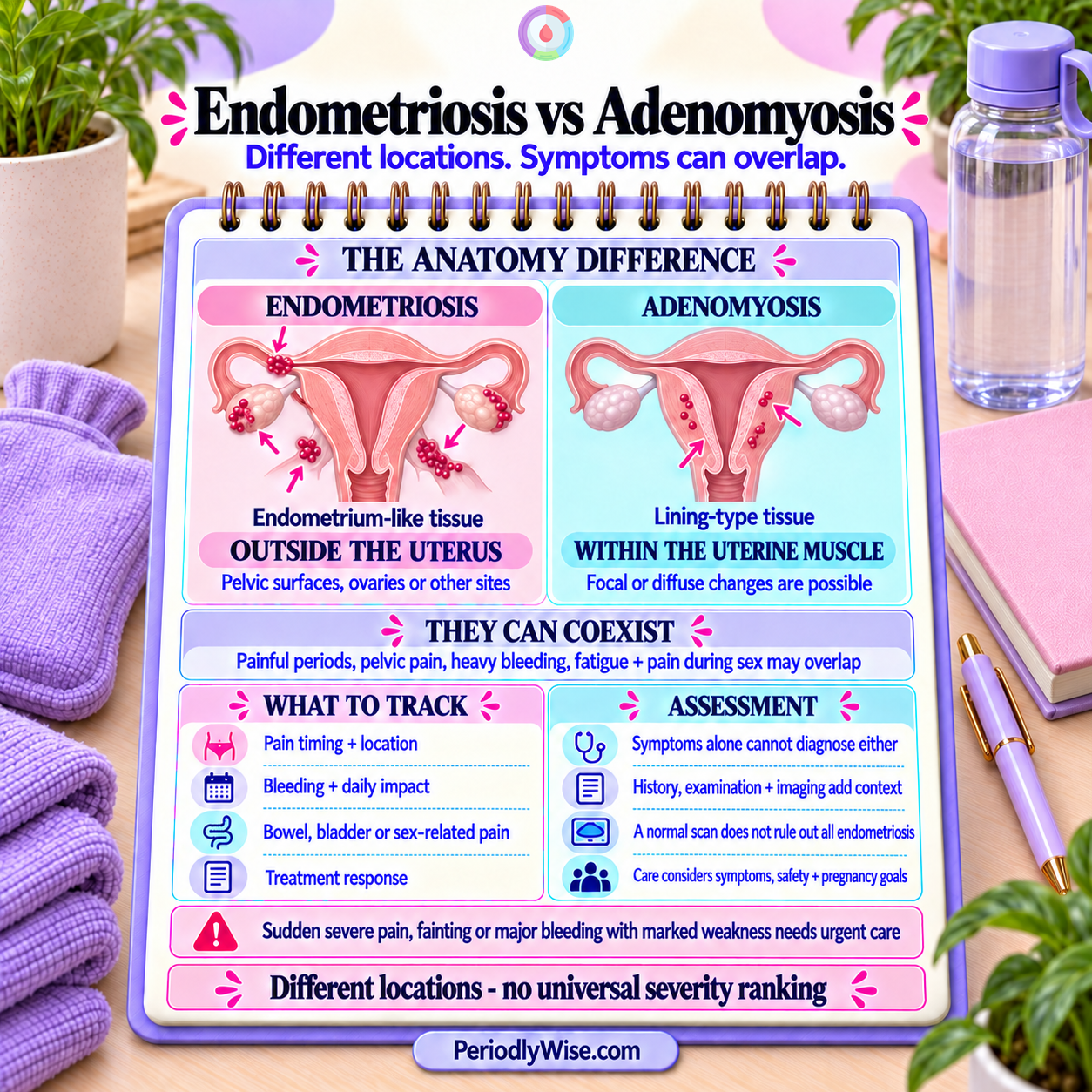
The main difference between endometriosis and adenomyosis is where the abnormal tissue is found. Endometriosis involves tissue similar to the uterine lining growing outside the uterus. Adenomyosis involves endometrial glands and supporting tissue within the uterus's muscular wall. They are distinct conditions, not two names for the same disease, and a person can have both.
That anatomical difference does not produce a neat symptom test. Painful periods, pelvic pain, heavy bleeding, tiredness and pain during sex may overlap. A scan report, the timing of symptoms and your response to treatment each add information, but none should be turned into a home diagnosis or a ranking of whose pain is worse.
This guide explains what the comparison can tell you, what it cannot, and how to prepare for an appointment. It also separates treatment for pain and bleeding from a plan for pregnancy. You do not need to endure disabling symptoms until you have the correct label, nor document several more cycles before asking for help.
The anatomical difference: outside the uterus versus within its wall
The endometrium is the lining facing the uterine cavity; the myometrium is the thick muscle surrounding it. In adenomyosis, lining-type glands and tissue are located in that muscle. Changes may be widespread, called diffuse, or more localized, called focal. The uterus may become enlarged or tender, but neither is something you need to identify yourself.
In endometriosis, lesions occur outside the uterus, often on pelvic surfaces or the ovaries, and sometimes involve the bowel, bladder or other sites. An ovarian endometrioma is one form; superficial and deep lesions are others. The WHO overview explains that inflammation and scarring can contribute to symptoms. The lesions are not just a normal period that came out in the wrong place.
Adenomyosis is sometimes called internal endometriosis in older language. That nickname can obscure the difference and does not make the disorders interchangeable. A growth in the uterine cavity, such as a polyp, and a fibroid arising from muscle are different findings again. Ask which tissue or structure a report describes rather than using the word uterus as if it meant one compartment.
Endometriosis and adenomyosis side by side
Use this table to organize a clinical conversation, not to select a diagnosis. A feature can be associated with a condition without being present in everyone or exclusive to it. The NHS adenomyosis guide and NHS endometriosis guide describe substantial overlap. Neither condition requires heavy bleeding in every case.
| Feature | Endometriosis | Adenomyosis |
|---|---|---|
| FeatureTissue location | EndometriosisOutside the uterus, including pelvic surfaces or ovaries; other sites are possible. | AdenomyosisWithin the uterine muscle wall, either focal or diffuse. |
| FeaturePossible symptoms | EndometriosisPeriod or non-period pelvic pain, painful sex, bowel or urinary symptoms, fatigue and fertility difficulty. | AdenomyosisPainful or heavy periods, pelvic discomfort, fullness, bloating or painful sex. |
| FeatureBleeding | EndometriosisHeavy bleeding can occur but does not identify lesion location. | AdenomyosisHeavy or prolonged bleeding is common, but some people have few or no symptoms. |
| FeatureAssessment | EndometriosisClinical history, examination and imaging; laparoscopy in selected situations. | AdenomyosisClinical history, examination and uterine imaging, usually ultrasound; MRI when useful. |
| FeatureWho can have it | EndometriosisAdolescents and adults; symptoms and diagnosis need not wait until later reproductive life. | AdenomyosisNot restricted to people who have given birth or to one age group. |
| FeatureMeaning of hysterectomy | EndometriosisDoes not necessarily remove lesions elsewhere or resolve all pain. | AdenomyosisRemoves the uterus containing adenomyosis, but not other coexisting causes of pain. |
Symptoms offer clues, not a reliable diagnosis
Record when pain starts, where it is, how long it lasts and what it prevents you from doing. Pain during bowel movements, urination or sex can make endometriosis part of the discussion, especially with a repeated cycle pattern. But an irritable bowel, urinary infection, pelvic floor problem or another disorder can create similar symptoms. You can also have more than one contributor.
Heavier bleeding with worsening cramps, pressure or fullness may prompt assessment for adenomyosis, fibroids and other causes. Clots, a brown discharge or the number of painful days are not a way to tell adenomyosis from endometriosis. Do not use pain intensity to infer how much disease is present, and do not dismiss an imaging finding simply because someone else's symptoms are worse.
The practical threshold is impact: missing work or school, disrupted sleep, avoiding sex because of pain, repeated flooding, or needing a plan around the next painful day deserves attention. Symptoms that persist despite treatment deserve review too. ACOG's pelvic-pain information emphasizes that the history should cover more than bleeding dates.
Can you have both, and what causes them?
Yes. Coexisting endometriosis and adenomyosis are recognized in clinical practice and in the Asian Society of Endometriosis and Adenomyosis guideline. A diagnosis of one does not rule out the other. It also does not mean every person needs every test; investigations should answer a question that can affect care.
The causes are not fully understood. Hormonal, inflammatory and other biological processes are being studied, but there is no single explanation that fits everyone. Prior pregnancy or uterine procedures can be relevant to an adenomyosis history, not an entry requirement. Being young, never having been pregnant, or taking contraception does not justify dismissing persistent symptoms.
Neither condition is evidence that you caused it through poor hygiene, sex, inadequate willpower or an imperfect lifestyle. Avoid a blame-based explanation or a product claiming to remove a root cause without appropriate evidence. Adenomyosis is a benign uterine condition, but benign does not mean painless, trivial or an excuse to ignore heavy bleeding. New or changing symptoms still need their own assessment.
What the initial assessment should establish
A useful appointment starts with symptoms, impact, medical and surgical history, medicines, contraception, pregnancy possibility and future pregnancy goals. Your clinician may suggest examination, pregnancy testing, blood tests or imaging according to that context. Examination is not a test of whether your pain is real; ask what is proposed, give or decline consent, and discuss comfort and alternatives.
For heavy bleeding, a blood count helps assess anemia. Other tests depend on the history; low iron and fatigue should not be managed only by guessing from flow. NICE's heavy-bleeding guidance recommends assessing the bleeding alongside treatment, with investigations selected for likely causes. Bleeding between periods, after sex or after menopause may require a different pathway, even if adenomyosis is already known.
Current practice does not require every patient to have surgery before symptoms can be treated. ACOG's 2026 diagnosis guidance announcement supports clinical assessment with evaluation and symptom treatment proceeding together. The next step should include a review plan: what improvement is expected, when to reassess and what should prompt earlier help.
Ultrasound, MRI and surgery answer different questions
Transvaginal ultrasound is often a useful first examination of the uterus and ovaries. With appropriate expertise it can identify features of adenomyosis, endometriomas and some deep endometriosis. An abdominal scan may be an alternative if an internal scan is unsuitable or declined, but the information may differ. NICE NG73 specifically warns against excluding endometriosis because examination and ultrasound are normal.
MRI can help clarify uncertain uterine findings or map suspected deep disease for planning; it is not automatically a better test for every person. The Taiwan adenomyosis consensus also describes MRI as a second-line option when ultrasound is inconclusive. Expertise, the question being asked and the pattern of disease matter more than simply choosing the most expensive scan.
A normal scan is not a universal all-clear for pelvic pain. Superficial endometriosis can be missed. Ask what was examined, whether specialized review is appropriate and what happens if symptoms continue. The table separates tests that are frequently confused; none should be ordered just to complete a list.
| Test or procedure | What it can help assess | Important limitation |
|---|---|---|
| Test or procedureUltrasound | What it can help assessUterine muscle features, fibroids, ovaries, endometriomas and some deep lesions. | Important limitationA normal result does not exclude all endometriosis; skill and scan technique matter. |
| Test or procedureSpecialist ultrasound or MRI | What it can help assessUnclear findings, suspected deep disease and anatomy for treatment planning. | Important limitationNot every microscopic or superficial lesion is visible; findings need clinical interpretation. |
| Test or procedureLaparoscopy | What it can help assessInspection of the pelvis and possible biopsy or treatment of external lesions. | Important limitationAn operation with risks, not a routine first step for everyone or a way to inspect every uterine-wall change. |
| Test or procedureHysteroscopy or endometrial sampling | What it can help assessQuestions about the uterine cavity or lining when clinically indicated. | Important limitationDoes not by itself exclude disease outside the uterus or diagnose every muscle-wall finding. |
| Test or procedureBlood tests | What it can help assessPregnancy, anemia or other relevant conditions according to the history. | Important limitationNo routine blood test, including CA125, reliably diagnoses or excludes either condition. |
Treatment should match the problem and your priorities
Start with the goal: less pain, less bleeding, better daily function, pregnancy, or several of these. Treatment for one goal may not achieve another. Medication that reduces symptoms does not prove the diagnosis or permanently remove disease. An incidental scan finding without symptoms does not automatically require intervention either.
Pain relief, hormonal treatments and selected procedures can be considered for either condition, but suitability is individual. A hormonal intrauterine system may help adenomyosis-related bleeding and pain; other hormonal options can help endometriosis symptoms. Specialist hormonal medicines need discussion of side effects, contraindications and monitoring. Availability and approved uses vary between countries.
The table is a conversation guide, not a prescription. Do not borrow medication, double up anti-inflammatory drugs or change an existing hormone plan on the strength of a comparison article. For example, tranexamic acid suitability depends on factors such as clotting history, kidney health and pregnancy context. A pharmacist or clinician can check your actual medicines and risks.
| Approach | Possible purpose | Question to discuss |
|---|---|---|
| ApproachAnalgesics or anti-inflammatory medicine | Possible purposeReduce pain when appropriate. | Question to discussIs it safe with my medical history, other medicines and pregnancy plans? |
| ApproachHormonal treatment | Possible purposeReduce bleeding and/or pain; several different methods exist. | Question to discussWhich symptoms is it intended to help, and what side effects or review plan apply? |
| ApproachBleeding-directed treatment | Possible purposeReduce heavy menstrual bleeding and assess or treat anemia when needed. | Question to discussWhat is causing the bleeding, and does this address pain as well? |
| ApproachSpecialist surgery or procedure | Possible purposeAddress selected lesions or persistent uterine symptoms. | Question to discussWhat is the expected benefit, recurrence risk and effect on ovaries, uterus or pregnancy? |
| ApproachMultidisciplinary support | Possible purposeHelp persistent pain, pelvic floor problems, fatigue and quality of life. | Question to discussWhich contributors need treatment alongside the gynecological condition? |
Why hysterectomy does not mean the same thing for both
Hysterectomy removes the uterus containing adenomyosis and is a definitive uterine treatment, but it is major surgery, ends the ability to carry a pregnancy and is not a requirement for everyone. UCLH's patient guide places it among options considered after discussion of symptoms and other treatments. Relief of adenomyosis does not guarantee that coexisting endometriosis, pelvic floor pain or another contributor disappears.
For endometriosis, the uterus is not necessarily where the lesions are. Removing it alone does not guarantee a cure for endometriosis or all pain. The ESHRE guideline calls for an informed discussion of persistent symptoms and the separate consequences of removing ovaries. Hysterectomy and ovary removal are not the same operation; the latter can have major hormonal consequences.
Endometrial ablation is different again: it treats the lining, not all tissue within the uterine muscle, and does not treat external endometriosis. It is not an option for someone planning a future pregnancy. Other uterine-sparing procedures require specialist advice about evidence, symptom recurrence and pregnancy safety. Keeping the uterus does not automatically mean a procedure is fertility-safe.
Fertility and pregnancy need a separate, individualized plan
Neither diagnosis means pregnancy is impossible, and neither provides a personal probability from a symptom list. Endometriosis can affect fertility; adenomyosis has also been associated with fertility and pregnancy outcomes, with variable evidence and many confounding factors. Age, other conditions, ovarian reserve, partner factors and any previous treatment matter. Do not turn a population study into a forecast for one person.
Tell the clinician whether you want pregnancy now, later, not at all, or are unsure. Hormonal symptom suppression is not the same as fertility treatment and usually does not fit attempting pregnancy at the same time. A plan may involve trying to conceive, selected surgery or assisted reproduction, but no single sequence suits everyone. Discuss assessment early when a known or suspected condition may affect fertility rather than automatically waiting a fixed year.
Surgery near an ovary can affect ovarian reserve, and uterine-sparing adenomyosis surgery can change pregnancy management. Discuss those issues before a procedure, not only after. Pregnancy is not a treatment you should undertake to cure endometriosis. If already pregnant, tell the maternity team about relevant diagnoses and procedures so advice reflects your actual situation; concerning pain or bleeding still requires prompt assessment.
Prepare an appointment record that is useful, not overwhelming
A brief private record can show the pattern without making symptom tracking a second job. Use actual bleeding dates rather than predicted ones. Note whether pain occurs before, during or outside bleeding, and include a few concrete effects on daily life. You do not need a perfect diary to deserve assessment. Start with what you remember and add details only if useful.
Keep scan reports, previous surgery details and a current medicine list accessible. Describe what helped, what did not and any side effects. A number from zero to ten is useful context, but a statement such as unable to sleep or missed two school days often conveys a different part of the burden. Do not routinely collect intimate photographs or share sensitive records more widely than necessary.
- Describe the main concern. Choose the symptom or limitation you most need help with and when it changed.
- Summarize timing and bleeding. Note actual dates, prolonged bleeding, frequent product changes or flooding without claiming a precise blood volume.
- Add associated symptoms. Include bowel, bladder, sex-related pain, fatigue and any pregnancy possibility.
- List treatment and goals. Bring medicines, relevant procedures, responses and pregnancy preferences.
- Ask for the next step. What is suspected, what can a test establish, when is review due, and when should you seek help sooner?
Comfort measures help support care; they do not replace it
A wrapped heat pack, rest, pacing activity and gentle movement when tolerable can help some people manage a difficult day. Avoid burns or sleeping on a hot pad, and stop an activity that clearly worsens symptoms. A comfortable period product and access to breaks may make heavy-bleeding days easier, but practical adjustments should not become the entire treatment for disabling symptoms.
For persistent pain, support may include pelvic-floor assessment, physiotherapy, pain management or psychological support alongside gynecological care. That is not a statement that the condition is imaginary or caused by anxiety. Support for the burden of pain belongs beside investigation and treatment, not in place of them. Ask for a plan that recognizes sleep, work, sex, mood and fatigue as relevant outcomes.
There is no universal diet, supplement, detox or tracking method that distinguishes or cures these conditions. Avoid restrictive eating or an expensive program presented as a substitute for evidence-based assessment. If you want to try a complementary approach, discuss safety and interactions and keep the clinical follow-up in place. A claimed natural cure should not delay evaluation of heavy bleeding or new pain.
When pain or bleeding needs urgent help
A familiar diagnosis must not explain away a new emergency. Sudden or severe worsening pelvic pain, fainting, significant breathing difficulty or heavy bleeding with marked weakness needs urgent assessment, and may require emergency care. Follow local emergency advice rather than waiting for a comparison chart to identify the condition. The NHS pelvic-pain guide distinguishes concerning associated symptoms from routine follow-up.
If pregnancy is possible, pain or unusual bleeding deserves prompt medical advice, even without a positive home test. One-sided pain, shoulder-tip pain, dizziness or collapse can be warning signs of ectopic pregnancy or another urgent problem. The NHS ectopic-pregnancy guidance warns not to wait for a positive test before seeking advice about a concerning combination.
Fever, unusual discharge, persistent vomiting, inability to pass urine, or blood in urine or stool also needs timely assessment. New bleeding between periods, after sex or after menopause should be evaluated rather than assigned automatically to adenomyosis. Do not wait for a fixed number of soaked products, a new scan appointment or several cycles of app records if you feel seriously unwell.
- Seek emergency help for collapse, severe worsening pain, major bleeding with concerning symptoms, or serious breathing difficulty.
- Seek prompt advice for possible pregnancy with pelvic pain or unusual bleeding, and for fever or new associated symptoms.
- Arrange a review for persistent or recurrent pain, heavy bleeding, impaired daily function or treatment that is not helping.
Frequently asked questions
Are endometriosis and adenomyosis the same condition?
No. Endometriosis is outside the uterus; adenomyosis is within its muscle wall. The conditions can coexist, and symptoms overlap. An older term such as internal endometriosis should not obscure the difference or substitute for a clear explanation of your findings.
Which is more painful or more serious?
There is no reliable universal ranking. Either may cause substantial pain and daily limitations, and either may be found with few symptoms. Bleeding, lesion location, other pain contributors, treatment response and your goals all matter. A person's pain should not be dismissed by comparing it with someone else's scan or diagnosis.
Can a normal ultrasound rule out endometriosis?
No. It may identify ovarian or deep disease and other causes, but superficial endometriosis can be missed. Persistent symptoms need a review plan. Specialist imaging or laparoscopy may be considered depending on the clinical question; a normal scan does not automatically require surgery either.
Do I need surgery to diagnose adenomyosis?
Usually not. Ultrasound and sometimes MRI support diagnosis by examining the uterine wall. Histology after hysterectomy can confirm tissue changes, but removing the uterus is not required simply to investigate symptoms. Discuss how confident the imaging assessment is and whether further testing would change care.
Can young people or people who have never been pregnant have adenomyosis?
Yes. More frequent diagnosis in certain age or pregnancy-history groups does not make those features requirements. Persistent symptoms should be assessed on their own merits. Neither age nor a lack of prior pregnancy reliably excludes the condition.
Does hysterectomy cure both conditions?
It removes uterine adenomyosis, but external endometriosis and other causes of pain may remain. Hysterectomy is major surgery and ends the ability to carry a pregnancy. Ovary removal is a separate decision with separate risks; neither procedure is an automatic requirement for a diagnosis.
Can I get pregnant with either condition?
Yes, pregnancy can be possible, but an individual fertility plan may be needed. Neither a diagnosis nor the amount of pain gives a personal pregnancy probability. Discuss pregnancy timing, other fertility factors and any proposed surgery before treatment. Pregnancy is not a recommended cure for endometriosis.
Can a period tracker tell which condition I have?
No. It can organize actual dates and symptom notes for a consultation, but cannot identify lesion location, confirm ovulation, diagnose either condition or rule out an emergency. A few helpful notes are enough; do not postpone care to collect a complete diary.
Use PeriodlyWise to record actual period dates and keep brief symptom notes if useful. Compare pain timing, bleeding and treatment response with daily impact. Predictions are estimates, not a diagnostic test, fertility assessment or substitute for timely care.
Open the period trackerThe bottom line
The essential difference is anatomical: endometriosis is outside the uterus and adenomyosis is within the uterine muscle. The symptoms are not exclusive, both can coexist, and a normal scan has limits. Understanding that difference can make questions about testing and treatment more precise without turning the comparison into self-diagnosis.
Seek a plan that addresses pain, bleeding, daily life and your pregnancy preferences. Ask what each investigation or treatment is expected to achieve, what remains uncertain and when to review it. Severe, changing or pregnancy-associated symptoms need appropriate care regardless of an existing diagnosis.