A fertile window calculator does more than circle an ovulation date. It estimates a broader span of days because conception timing depends on how long sperm may remain viable before ovulation and how briefly an egg remains available after release.
The result can be useful for cycle awareness or planning intercourse when trying to conceive. It must be used much more cautiously when avoiding pregnancy. No calendar calculator can see ovulation happen, guarantee conception, or certify that a day outside its highlighted range is free of pregnancy possibility.
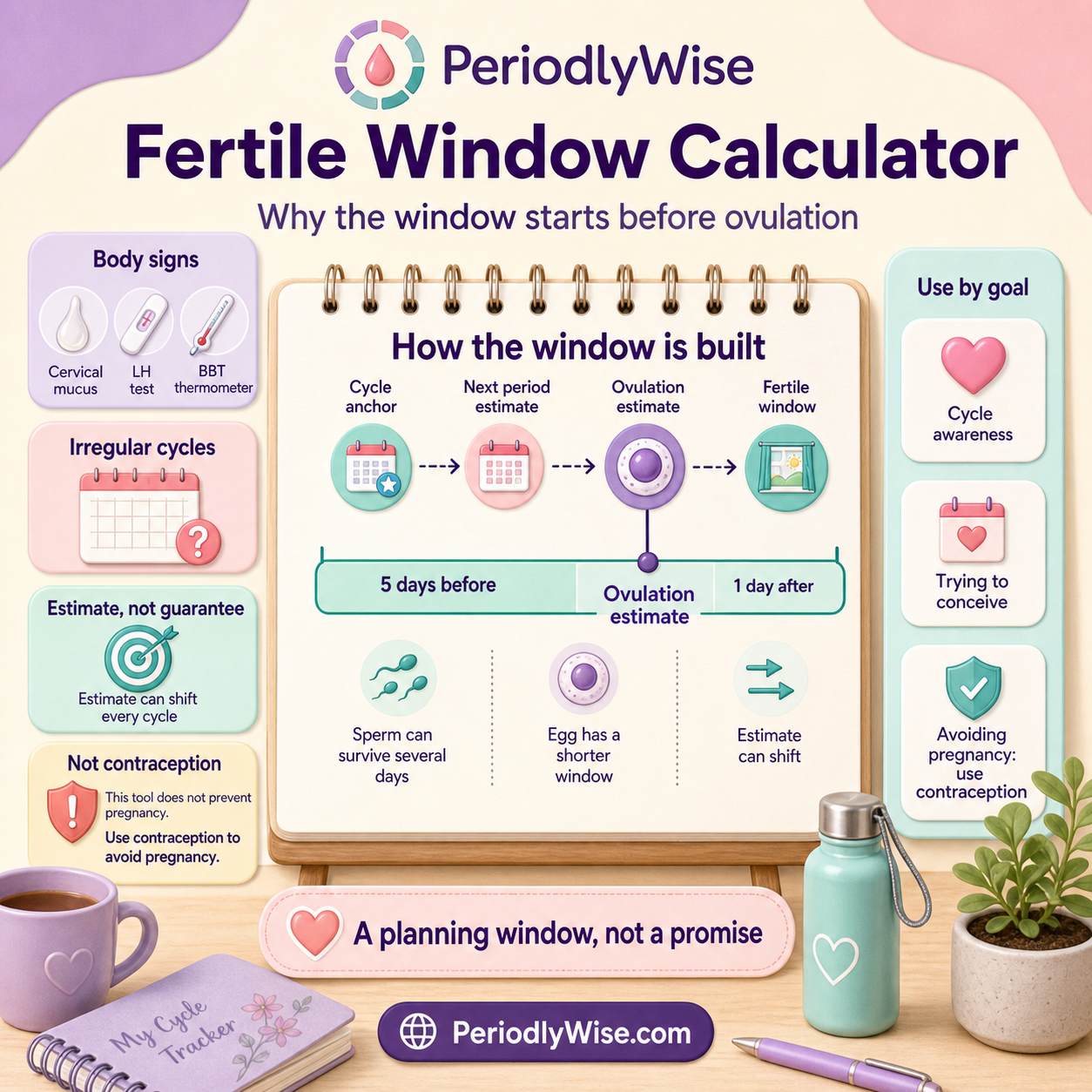
Why the fertile window starts before ovulation
Ovulation is the release of an egg. The egg is available for a relatively short time, but sperm may survive in the reproductive tract for several days. That means intercourse before ovulation can result in pregnancy if sperm are still present when the egg is released.
ACOG explains that pregnancy can occur from intercourse in the days before ovulation and around the time of egg release. This is why a fertile window is broader than one ovulation day. It is also why the dates should not be interpreted as seven identical levels of fertility: the probability can change across the window, and the actual day of ovulation may differ from the estimate.
For terminology, read Ovulation Window vs Fertile Window.
How PeriodlyWise builds the fertile window
The first day of the last period becomes cycle day 1.
The calculator adds the entered average cycle length to the last period start.
It counts back about 14 days from the expected next period.
It highlights five days before the central ovulation estimate through one day after it.
The calculator also shows a focused ovulation range and the next-period estimate so you can see how the three parts relate. The complete method is documented on How Calculations Work.
A worked 30-day cycle example
Suppose the last period began on August 1 and the average cycle length is 30 days. The next period is centrally estimated around August 31. Counting backward 14 days places the central ovulation estimate around August 17. PeriodlyWise would then place the fertile window around August 12 through August 18.
First day of the last period and cycle day 1.
Central calendar estimate for ovulation in this example.
Estimated fertile window around the central ovulation date.
Central estimate for the next period start.
If ovulation happens earlier or later, the true fertile days move with it. A neat calculation cannot prevent biological variation.
What the highlighted days mean and do not mean
- They mean: these dates may be more relevant to conception based on the calendar information entered.
- They do not mean: ovulation was observed or confirmed.
- They do not mean: pregnancy will occur during the window.
- They do not mean: pregnancy cannot occur outside the displayed window.
- They do not mean: every day in the window has an equal probability.
A useful calculator communicates uncertainty instead of turning a biological process into a countdown promise.
Choose how to use the result based on your goal
Compare the range with cervical mucus, ovulation tests, pelvic sensations, temperature trends, and the actual next period. Look for repeatable timing.
Use the window as a planning guide rather than chasing one perfect hour. ACOG notes that intercourse every day or every other day during fertile timing is a common approach.
Do not treat dates outside the window as automatically safe. A general calculator is not contraception and cannot account for every timing shift.
Bring actual period starts, cycle lengths, test results, and the time you have been trying to a healthcare professional. A calendar alone cannot assess fertility.
How to make the estimate more useful
- Use the first day of full flow. Do not accidentally enter the last day of bleeding or uncertain spotting as day 1.
- Use your own recent cycle length. If recent cycles were 29, 31, and 30 days, 30 may be a reasonable simple average. Do not default to 28 without checking.
- Record the actual next period. This shows whether the cycle was shorter or longer than expected and improves your understanding of later estimates.
- Compare body signs. Cervical mucus and ovulation tests may help identify approaching fertile timing; basal temperature may support retrospective pattern recognition.
- Add life context. Note illness, travel, disrupted sleep, major stress, postpartum changes, breastfeeding, and contraception changes.
- Think in ranges. One exact highlighted date is easier to read but less honest than a window.
A menstrual calendar can help you keep these dates in one place without making every symptom a test.
Body signs that can add context
Some people notice clearer, wetter, slippery, or stretchy cervical mucus as fertile timing approaches. Ovulation predictor kits may detect an LH surge before expected ovulation. A basal body temperature shift may appear after ovulation. Some people notice mild pelvic discomfort, spotting, libido changes, or no recognizable signs at all.
No single sign works perfectly for everyone. Medications, illness, poor sleep, intercourse, lubricants, vaginal infections, breastfeeding, PCOS, and other factors can change what you observe. Read Signs of Ovulation for a medically cautious guide.
When fertile-window estimates are less reliable
Calendar estimates need extra caution when cycles are very irregular, periods are absent, menstruation has only recently begun, you are postpartum or breastfeeding, you are approaching menopause, or you recently started, stopped, missed, or changed hormonal contraception. Acute illness, substantial stress, travel, exercise or weight changes, PCOS, thyroid conditions, and other health factors can also alter timing.
If cycles vary, do not hide the variation inside one average. Save several real start dates and read How to Track Irregular Periods Without Guessing.
When to seek professional support
Ask a healthcare professional about fertility timing if periods are repeatedly absent or unpredictable, you have a known condition that can affect ovulation, you are unsure how medication or contraception affects the calculation, or you want advice based on your age, health history, and time trying to conceive.
Seek prompt care for severe or sudden pelvic pain, heavy bleeding, fainting, fever, shoulder pain, or pain and bleeding when pregnancy is possible. A fertile-window estimate should never delay urgent assessment.
FAQ
How many days are in a fertile window?
Biologically relevant timing often includes several days before ovulation and a shorter time after it. PeriodlyWise displays five days before the central ovulation estimate through one day after it.
What is the difference between fertile days and ovulation day?
Ovulation refers to egg release. Fertile days form a broader window because sperm may remain viable before ovulation and the egg remains viable briefly afterward.
Can a fertile window calculator prevent pregnancy?
No. A general calendar calculator is not a contraceptive method and cannot reliably identify risk-free days.
Why did two calculators give me different dates?
They may use different cycle lengths, luteal-phase assumptions, window definitions, regularity rules, or saved history. Compare the method, not only the highlighted result.
Enter your cycle information to see the estimated fertile window, focused ovulation timing, and next-period range together.
Open the Fertile Window Calculator