A first period can be exciting, awkward, reassuring, confusing, or all of those at once. It may begin with a clear red flow, but it can also look like a few rusty-brown marks in underwear. The amount and timing often do not resemble the neat monthly pattern shown in diagrams.
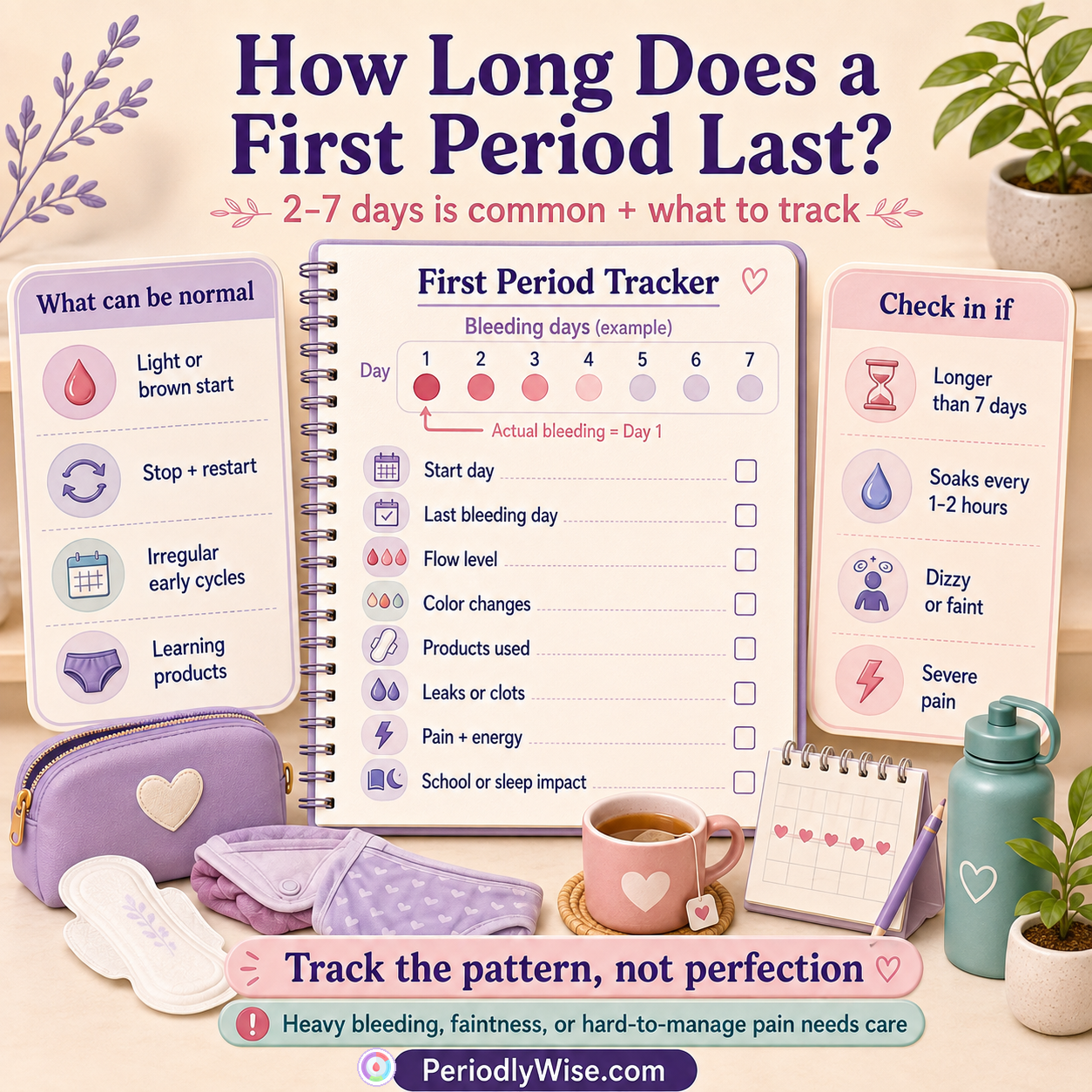
According to the American College of Obstetricians and Gynecologists (ACOG), most people bleed for 2 to 7 days during their first period. A first period may last only a few days and may be very light. That range is a guide, not a target that the body has to meet exactly.
What matters is the whole pattern: duration, how quickly products fill, whether the bleeding interrupts school or sleep, pain, dizziness, and whether there are personal or family clues to a bleeding disorder. A first period should be supported, not treated as a test someone can pass or fail.
What counts as the length of a first period?
Use the first day of visible menstrual bleeding as day 1. Keep counting the calendar days on which bleeding continues, even if the last day is much lighter or brown. Brown blood usually means blood has taken longer to leave the uterus and can be part of the same episode.
A single faint mark can be hard to classify. If there is one isolated spot and nothing more, record it as spotting or an uncertain start. If bleeding develops later that day or the next day, you can update the start date. Tracking is meant to preserve clues, not force certainty in the moment.
Some first periods seem to pause for part of a day and return. Record the overall episode and add a note about the gap. Do not add two separated days together across many weeks and call them one period; a clinician can help if bleeding is repeatedly scattered or difficult to distinguish.
The number of days does not measure blood loss by itself. Seven very light days and two days of rapid flooding are different patterns. Product changes, leaks, clots, symptoms, and the effect on normal activities provide more useful context than duration alone.
The first period also does not predict every future period. Hormone signalling between the brain and ovaries is still maturing, so early cycles often do not ovulate consistently and can be irregular. ACOG says teen cycles are usually 21 to 45 days apart, while a gap of 90 days deserves evaluation even in the early years.
First-period patterns: what they can mean
| What you notice | How to interpret it | What to do |
|---|---|---|
| A few red or brown spots for 1 to 2 days | This can be a first period, especially when puberty changes are already present. | Record the date and appearance; keep supplies available in case flow returns. |
| Bleeding for 2 to 7 days | This falls within the usual range described by ACOG. | Track each day, product changes, pain, and how you feel. |
| Light bleeding that stops briefly and restarts | Early hormone patterns can produce uneven flow. | Note the pause and total episode; seek advice if scattered bleeding keeps recurring. |
| Bleeding longer than 7 days | This is outside the usual duration and may contribute to iron deficiency. | Contact a pediatrician, family doctor, or adolescent-health clinician. |
| A pad or tampon fills every 1 to 2 hours | This is a heavy-flow warning sign, particularly if it repeats or comes with symptoms. | Tell an adult promptly and arrange medical assessment; urgent symptoms need urgent care. |
| No second period for 90 days | Irregularity is common, but a three-month gap is not something to dismiss automatically. | Arrange a non-emergency evaluation and consider pregnancy testing if relevant. |
Why a first period may be short, light, or irregular
The first menstrual period is called menarche. It happens during puberty after hormone signals have stimulated the uterine lining. A first bleed does not mean that the hormone pattern is already working like an adult cycle every month.
During the first years after menarche, the brain, pituitary gland, and ovaries are still developing a coordinated rhythm. Many early cycles are anovulatory, meaning an egg is not released. That can create lighter, longer, shorter, or less predictable bleeding without indicating that the body is dirty or that blood is trapped.
Flow colour can shift from bright red to dark red or brown as the rate changes. Small clots may occur when blood pools before leaving. Colour alone rarely tells how healthy a period is; amount, duration, pain, smell, fever, and general wellbeing matter more.
Heavy bleeding at the very first period deserves attention because it can be the first noticeable sign of a bleeding disorder. ACOG recommends considering anemia, hormone-related anovulation, and bleeding disorders when an adolescent presents with heavy menstrual bleeding. Easy bruising, frequent nosebleeds, prolonged bleeding after dental work, or relatives with a diagnosed bleeding disorder are useful clues.
Stress, illness, major weight change, very intense exercise, low energy intake, thyroid conditions, PCOS, medicines, and pregnancy can also affect later cycles. Those possibilities do not mean every irregular first year is an illness. They explain why a persistent or severe pattern should be assessed instead of guessed at online.
Common first-period variations include:
- red, pink, dark red, or reddish-brown blood
- a few spots before a clearer flow begins
- one heavier day followed by light days
- little or no cramping at first, or familiar lower-abdominal cramps
- a cycle that arrives earlier or later than a calendar prediction
- several irregular cycles while ovulation becomes more consistent
- mood, bowel, appetite, skin, sleep, or energy changes around the bleed
- needing time and practice to learn which products and routines feel comfortable
Usual adjustment or a reason to check in?
| Pattern | Often reasonable to track | Needs medical advice |
|---|---|---|
| Duration | A first bleed lasting 2 to 7 days. | More than 7 days, or repeated episodes that are difficult to separate. |
| Amount | Light spotting or manageable flow with ordinary product changes. | Flooding, double protection, frequent night changes, or saturation every 1 to 2 hours. |
| Cycle timing | Variation while cycles settle, commonly within 21 to 45 days. | More than 90 days between periods, or periods more often than every 21 days or less often than every 45 days repeatedly. |
| Symptoms | Mild cramps, temporary tiredness, and manageable mood changes. | Faintness, racing pulse, breathlessness, severe or worsening pain, fever, or inability to function. |
| Bleeding history | No unusual bruising or prolonged bleeding elsewhere. | Easy bruising, frequent nosebleeds, anemia treatment, or a personal/family bleeding-disorder history. |
| Puberty timing | Period begins after other puberty changes. | No first period by 15, no breast development by 13, or no period within about 3 years of breast development. |
What to do when a first period begins
A simple routine is enough. The goal is comfort, privacy, and useful information, not perfect tracking from the first hour.
- Tell a parent, caregiver, school nurse, clinician, or another trusted adult so you can get supplies and help if the flow becomes heavy.
- Choose a product that feels manageable. Pads are often easy for learning flow; period underwear can provide coverage or backup. Tampons can also be used from the first period when inserted comfortably and changed according to the label.
- Mark the date and call it day 1 when actual bleeding begins. If it is only one uncertain spot, record that honestly and update it later if needed.
- Check the product before it is full. Change pads when wet, full, or uncomfortable. FDA guidance says tampons should be changed every 4 to 8 hours and never worn longer than 8 hours.
- Wash the vulva externally with water or a gentle unscented cleanser if desired. Do not douche or put scented washes inside the vagina; fragrance can irritate sensitive tissue.
- For cramps, try warmth, hydration, rest, and gentle movement. Ask a caregiver, pharmacist, or clinician before using medicine and follow the age-appropriate label; never share prescriptions.
- Pack a spare product, underwear, and a small bag for used items. A practical backup can lower anxiety at school, during travel, or overnight.
What to record without obsessing over every drop
A paper calendar, private note, or period tracker can show whether the next cycles are settling into a pattern. ACOG recommends marking every bleeding day, beginning with the first day as day 1.
Use descriptions that you can repeat. Terms such as spotting, light, medium, heavy, leaked, or changed overnight are often more useful than trying to estimate millilitres. Protect privacy on shared phones and involve a trusted adult when symptoms are concerning.
- first and last day of the bleeding episode
- red, pink, dark red, or brown appearance
- spotting versus a steady flow
- product type and how often it needed changing
- leaks, flooding, or waking at night to change
- clots and their approximate size
- cramps, headache, nausea, bowel changes, or back pain
- dizziness, faintness, racing heartbeat, breathlessness, or unusual fatigue
- school, sport, sleep, and daily activities affected
- bruising, nosebleeds, family bleeding history, medicines, illness, eating, and exercise context
When a first period needs medical care
Contact a healthcare professional when bleeding lasts longer than 7 days, products need changing every 1 to 2 hours, flow repeatedly leaks through clothes or bedding, pain disrupts school or sleep, or the pattern feels impossible to manage. A clinician can assess anemia, a bleeding disorder, hormone patterns, thyroid conditions, and other causes without assuming the worst.
Heavy menstrual bleeding is defined by its effect on life as well as by amount. A blood count and ferritin may be considered when there is fatigue, pallor, dizziness, headaches, shortness of breath, or heavy flow. Do not start high-dose iron on your own; too much iron can be harmful and the right dose depends on age and test results.
Also arrange an evaluation if a first period has not happened by age 15, there is no breast development by 13, or there has been no period within about 3 years after breast development. After periods begin, a gap of more than 90 days should be checked. If any sexual contact could result in pregnancy, a confidential pregnancy test and appropriate support may be part of care.
PeriodlyWise can record dates, flow, symptoms, and private notes without pretending to diagnose a first period. Use it alongside a trusted adult and healthcare guidance when needed.
Open the period trackerFrequently asked questions
Can a first period last only one day?
It can be very brief or appear as only a few spots, so one light day may be a first period. Record it and watch what happens next. Seek advice if bleeding is repeatedly unusual, very painful, or accompanied by concerning symptoms.
Is brown blood normal for a first period?
Yes. Reddish-brown or dark blood can occur when blood leaves more slowly. Strong odor, fever, itching, unusual discharge, severe pain, or feeling unwell points to a different concern and should be assessed.
Can a first period last longer than 7 days?
It can happen, but ACOG advises talking with a doctor when a period lasts more than 7 days. Longer bleeding can contribute to iron deficiency and may need evaluation for heavy bleeding or a bleeding disorder.
When will the second period come?
Early cycles are often irregular. Teen cycles commonly fall 21 to 45 days apart, but the exact second-period date cannot be guaranteed. More than 90 days without another period deserves medical evaluation.
How heavy should a first period be?
Many first periods are light, but amount varies. Needing to change a pad or tampon every 1 to 2 hours, flooding, frequent leaks, large repeated clots, dizziness, or faintness is not something to normalize.
Does starting a period mean the body is fully grown?
No. Menarche is one stage of puberty, and growth and hormone maturation continue. Periods may stay irregular for several years while the cycle-control system matures.
The bottom line
A first period most often lasts 2 to 7 days and may be much lighter, browner, or less predictable than expected. Count actual bleeding from day 1, record uncertain spotting without forcing a label, and judge the pattern by duration, flow, symptoms, and impact on daily life.
Irregularity can be part of early cycle development, but prolonged, very heavy, painful, or symptomatic bleeding deserves care. Asking for help is not overreacting; it is exactly what good menstrual health support is for.