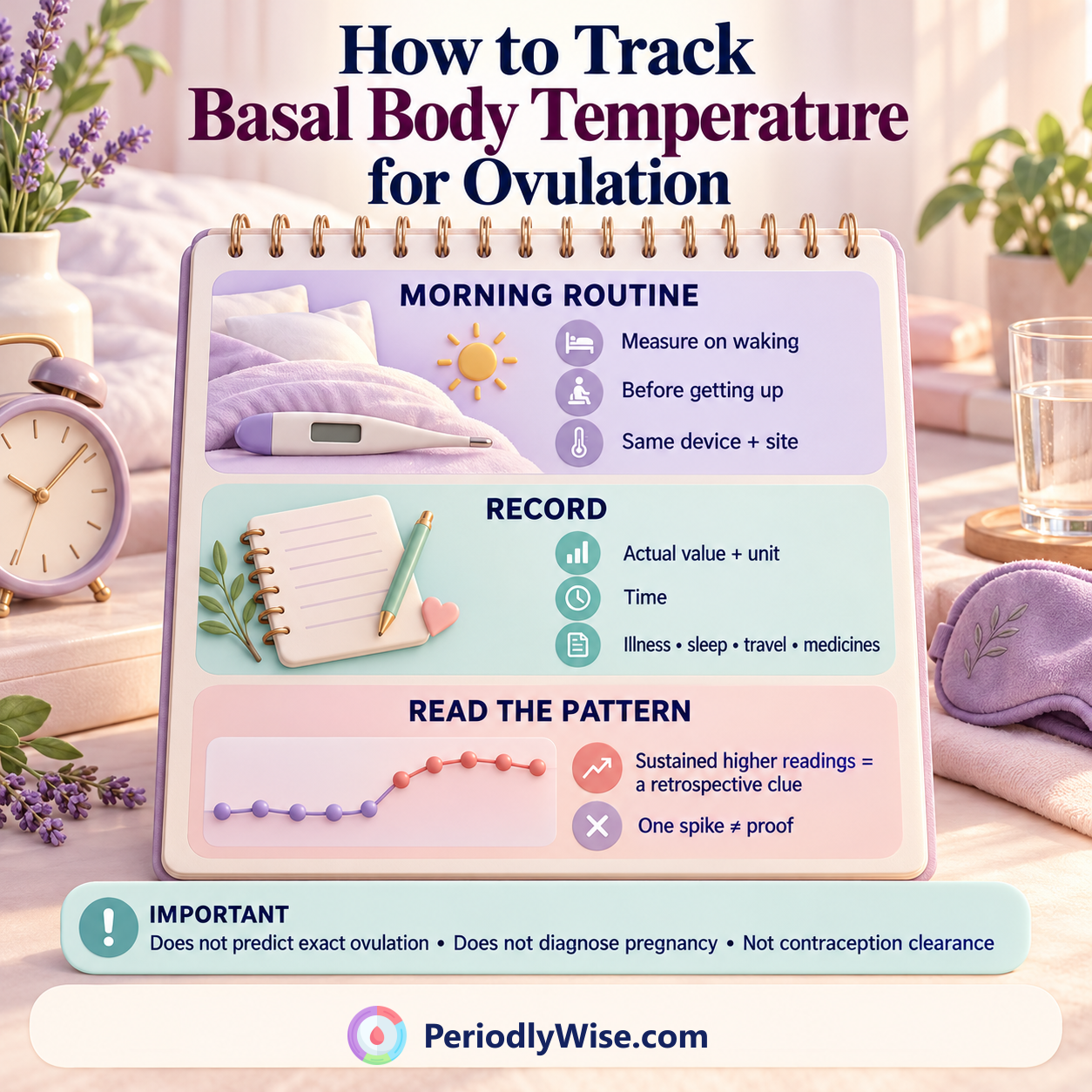
To track basal body temperature for ovulation, measure it every morning as soon as you wake, before getting out of bed, then record the value and the conditions of measurement. Over time, a sustained shift from lower to slightly higher readings may suggest that ovulation has already happened.
The useful part is not finding one perfect number. It is making readings comparable and recognizing what the chart can and cannot tell you. A late night, an illness or a changed measurement method can create a rise that has nothing to do with egg release.
This guide walks through an ordinary morning routine, an illustrative record and common confusing patterns. It is for learning about your cycle, not for declaring a day safe for unprotected sex or replacing a fertility assessment.
What basal body temperature actually measures
Basal body temperature, or BBT, is your temperature at complete rest. For home charting, the practical approximation is a reading immediately on waking, before activity. It is different from a midday measurement after commuting, exercise or a hot drink.
After ovulation, progesterone can produce a small temperature increase. Some charts therefore show a lower phase followed by a higher phase. Cleveland Clinic explains this hormone-related pattern, but its size and visibility vary. There is no single number everyone must reach.
Record a thermometer reading as an observation, then keep the interpretation separate. '36.58°C at 6:40 a.m.; slept poorly' is an observation. 'Definitely ovulated yesterday' is a stronger conclusion that the reading alone cannot support. That distinction prevents a chart from sounding more certain than the information behind it.
Set up a routine you can realistically repeat
Choose a digital thermometer suitable for basal temperature charting and follow its instructions. A basal thermometer commonly displays two decimal places in Celsius; a detailed display is useful, but does not guarantee laboratory-level accuracy. Keep the device and a paper chart or recording tool beside the bed.
Use one unit, one device and one measurement site consistently. Do not mix oral readings with skin, vaginal or rectal readings as if they were interchangeable. If a device fails mid-cycle, note the change rather than silently joining the two sets of numbers.
Decide what is manageable before you start: where to put the record, what time you usually wake, and which brief notes you will keep. A repeatable routine with honest gaps is more informative than a complicated system that encourages guessing.
- Keep the original value: do not round readings to make the line smoother.
- Label the unit: Celsius and Fahrenheit values must not share an unlabeled column.
- Keep it private: check a recording app's permissions and sharing settings before entering reproductive-health data.
How to take and record your temperature each morning
Start at the beginning of a cycle if convenient, but you can begin learning the routine on another day. A mid-cycle start simply leaves less baseline information for that cycle. Do not reconstruct earlier temperatures from memory or from the app's predicted ovulation date.
Mayo Clinic recommends measuring before getting out of bed, using the same approach and a similar time each day. Follow the device's placement and completion instructions, and clean it as directed.
- Measure on waking. Before getting up, eating, drinking or starting your normal morning activity, use the thermometer according to its instructions.
- Keep conditions comparable. Use the same site and device, around your usual waking time. Record a substantially different time instead of pretending it was the usual one.
- Save the reading immediately. Include the date, cycle day if known, temperature, unit and time. Day one is generally the first day of menstrual flow, rather than an isolated spot.
- Add a short context note. Mark fever, broken sleep, night work, alcohol, travel, medicines or a changed measurement method when relevant.
- Leave missing readings missing. An afternoon replacement is not the same as a waking reading. Mark it separately if you record it at all.
- Review the trend later. Look at several readings together rather than making a fertility decision from the newest number.
If you repeatedly check until you obtain a preferred result, you lose a consistent measurement rule. Follow the device instructions and keep an explanation of an obvious technical problem rather than choosing whichever reading fits the expected curve.
How to read a sustained rise without over-reading it
Compare later readings with your own earlier baseline. A run of slightly higher values is more meaningful than one spike. Mayo Clinic describes higher temperatures lasting at least three days as a clue that ovulation likely occurred; this is not a universal diagnostic threshold or a complete contraception rule.
A clear chart may support a retrospective interpretation, but it cannot pinpoint the exact hour an egg was released. The first higher reading is not automatically the ovulation day, and the lowest reading is not automatically the day before it. Do not force the pattern onto day 14.
ACOG emphasizes that BBT shows a change after ovulation rather than reliably predicting it. This timing is why waiting for a visible rise can miss fertile days when trying to conceive.
An illustrative record: numbers plus context
The following invented values demonstrate record keeping, not a target curve or a fertility algorithm. The readings belong to one fictional cycle. They should not be copied into your chart, used to set a coverline or used to decide when contraception is unnecessary.
| Cycle day and reading | Measurement note | Careful interpretation |
|---|---|---|
| Cycle day and readingDay 10: 36.32°C (97.38°F) | Measurement note6:30 a.m.; usual routine | Careful interpretationOne lower-phase observation, not a prediction. |
| Cycle day and readingDay 11: 36.30°C (97.34°F) | Measurement note6:35 a.m.; usual routine | Careful interpretationKeep recording rather than labeling a fertile day from temperature alone. |
| Cycle day and readingDay 12: 36.63°C (97.93°F) | Measurement note8:20 a.m.; broken sleep | Careful interpretationAn isolated high reading has a possible disturbance. |
| Cycle day and readingDay 13: 36.34°C (97.41°F) | Measurement note6:30 a.m.; usual routine | Careful interpretationThe earlier spike did not establish a sustained shift. |
| Cycle day and readingDays 14–16: 36.57, 36.59, 36.60°C (97.83, 97.86, 97.88°F) | Measurement noteSimilar waking conditions on all three days | Careful interpretationA later higher pattern may support ovulation having occurred; the exact day remains uncertain. |
The practical lesson is to preserve both the line and its footnotes. A neat chart without the late-waking note would tell a different story. If your recording tool automatically labels an ovulation date, keep the underlying observations available so a clinician or trained instructor can review them.
Common disruptions and what to do with them
Sleep changes, alcohol, travel, illness and medicines can complicate interpretation. CDC guidance specifically notes problems with temperature-based methods during fever and with some medicines. Do not stop prescribed treatment to improve a chart.
| Situation | What to record | What not to conclude |
|---|---|---|
| SituationFever or feeling ill | What to recordSymptoms, temperature and relevant treatment | What not to concludeA high value is not automatically an ovulation shift. |
| SituationBroken sleep or night work | What to recordWake time and the disrupted sleep pattern | What not to concludeA fixed correction formula cannot reliably repair the reading. |
| SituationTravel or time-zone change | What to recordLocal waking time and travel dates | What not to concludeA changed routine does not prove that ovulation moved. |
| SituationAlcohol or an unusual evening | What to recordA brief note alongside the next morning's value | What not to concludeOne unexpected point does not diagnose a hormone problem. |
| SituationNew device or measurement site | What to recordThe date and method change | What not to concludeThe difference between devices is not necessarily biological. |
| SituationMissed reading | What to recordA visible gap | What not to concludeAn invented average is not an observed temperature. |
Flag an uncertain value rather than deleting it without a trace. If you use a taught fertility-awareness method, follow that method's rules for disturbed readings. Different methods do not necessarily handle exceptions in the same way.
Combine observations instead of asking BBT to do every job
Cervical mucus can change as fertility approaches, and urine luteinizing hormone (LH) tests may detect a surge before expected ovulation. Temperature provides a different, later clue. A calendar prediction is another estimate, not an independent measurement of egg release.
Keep these observations in separate fields: 'slippery mucus', 'LH positive' and 'temperature higher for several days'. Agreement can add context, while disagreement is a reason to preserve uncertainty. A positive LH test does not prove ovulation, and an unclear temperature chart does not automatically disprove it.
If pregnancy is your goal, avoid making sex depend on one perfect chart point. The NHS describes sex every two to three days as a practical approach for people trying through intercourse. Individual fertility-treatment instructions take priority over a general tracking routine.
Irregular periods, breastfeeding and hormonal treatment
You can keep observations during irregular cycles, but a longer chart does not become reliable just because it contains more points. Long gaps, repeated uncertainty or absent periods deserve assessment when appropriate, not endless attempts to make the app identify a shift.
After childbirth, during breastfeeding, around perimenopause or after stopping hormonal contraception, cycle patterns and sleep may be changing. Hormonal medicines and fertility treatment can also change what a temperature chart means. Ask your care team how to interpret records in your particular situation.
Do not stop contraception, progesterone or another prescribed medicine to create a more 'natural' chart. If avoiding pregnancy matters, arrange a suitable method for the transition rather than relying on a temperature pattern to announce the return of fertility.
Can a chart show pregnancy or a progesterone problem?
A temperature that stays higher is not a pregnancy diagnosis, and a dip is not proof of implantation, miscarriage or an unsuccessful cycle. Home charts cannot establish progesterone deficiency, egg quality or whether a pregnancy is developing normally.
Use a pregnancy test at the appropriate time. NHS advice is to test from the first day of a missed period, or at least 21 days after the last unprotected sex if the next period date is unknown. Follow the kit instructions and repeat or seek advice if a negative result and missing period remain unexplained.
A clinician may use history and appropriately timed tests when there is a specific question about ovulation. Do not order or interpret a single 'day 21' hormone result solely because a chart looks flat; testing needs to match the clinical question and cycle timing.
Wearables, app labels and avoiding pregnancy
A wearable's overnight skin-temperature trend is not interchangeable with an oral waking temperature. Follow the device's stated purpose and limitations. A wellness app that draws a fertile window is not automatically a validated contraceptive method.
For contraception, learn a specific evidence-based method with a qualified practitioner and follow its complete rules. NHS guidance recommends trained instruction and additional protection while learning. Do not use this article's three-day explanation or invented example as permission for unprotected sex.
BBT tracking does not protect against sexually transmitted infections. If a pregnancy would carry substantial medical risk, discuss a suitable contraceptive plan rather than relying on a general-purpose tracker. A saved app label cannot override uncertain measurements.
When to ask for help rather than collect another chart
Seek advice sooner for absent or markedly irregular periods, concerning symptoms, a known reproductive-health condition or difficulty interpreting treatment-related changes. A chart does not have to look abnormal before you are allowed to ask for help.
For people trying to conceive through regular unprotected intercourse, ASRM generally recommends assessment after 12 months under age 35, after six months from age 35, and potentially sooner over 40 or with known concerns. BBT testing is not routinely recommended as a fertility-evaluation requirement because it can be burdensome and unreliable.
A manageable plan for your first cycle
For the first cycle, make consistency the goal rather than a diagnosis. Put the thermometer within reach, use the same routine, and keep short factual notes. Once a week, check for missing units, time changes or accidental entries; do not rewrite observations to fit a predicted window.
At the end, ask three questions: Are the readings comparable? Is there a sustained pattern rather than a single spike? Did symptoms or circumstances make interpretation uncertain? Bring the original chart and your questions to an appointment if needed. If tracking is harming sleep or increasing anxiety, it is reasonable to simplify or stop and discuss other options.
Frequently asked questions
What temperature proves I have ovulated?
No single value proves it. Compare your own readings over time under similar conditions. A sustained higher pattern can support a retrospective interpretation, but it cannot establish an exact ovulation date or replace clinical assessment.
Does BBT rise before or after ovulation?
The useful sustained rise generally follows ovulation. It may become recognizable only after several readings, so it is not a dependable advance warning for that cycle's fertile days.
What if I miss a morning?
Leave a gap and continue the next morning. Do not invent a value or substitute an afternoon reading as though it was taken on waking. Keep an explanatory note if the missing day affects interpretation.
Can I correct the temperature because I woke up late?
Record the actual time and value. A universal add-or-subtract rule does not reliably recreate what your temperature would have been earlier. Use a trained method's instructions if following one.
Does a flat chart mean I did not ovulate?
Not necessarily. Measurement conditions and individual variation can obscure the pattern. Repeated unclear charts or irregular periods are reasons to seek advice, not grounds for diagnosing anovulation yourself.
Can a dip confirm implantation?
No. A single dip is not a validated implantation test. Use an appropriately timed pregnancy test rather than interpreting a chart point as proof of conception or loss.
Can I use a watch instead of a basal thermometer?
It depends on the device and purpose. Skin-temperature trends and oral BBT are different measurements. Follow the specific device's instructions and do not assume a wellness feature is approved for contraception.
Do I have to track BBT to get a fertility appointment?
No. You do not need a perfect chart or months of extra measurements before asking for care. Bring whatever cycle history you have, and follow age-related and symptom-related advice about when assessment is appropriate.
Use PeriodlyWise for period dates and cycle-history context. Keep your BBT chart in a suitable separate record; a calendar estimate does not confirm ovulation or replace a taught fertility-awareness method.
Open the Period TrackerThe bottom line
A useful BBT record starts with consistent waking measurements and honest notes. Look for a sustained change in your own pattern, not a perfect number or a prescribed ovulation day.
Use the chart to support questions and retrospective learning. Use appropriate testing, qualified advice and a suitable contraception plan for decisions the chart cannot safely make.