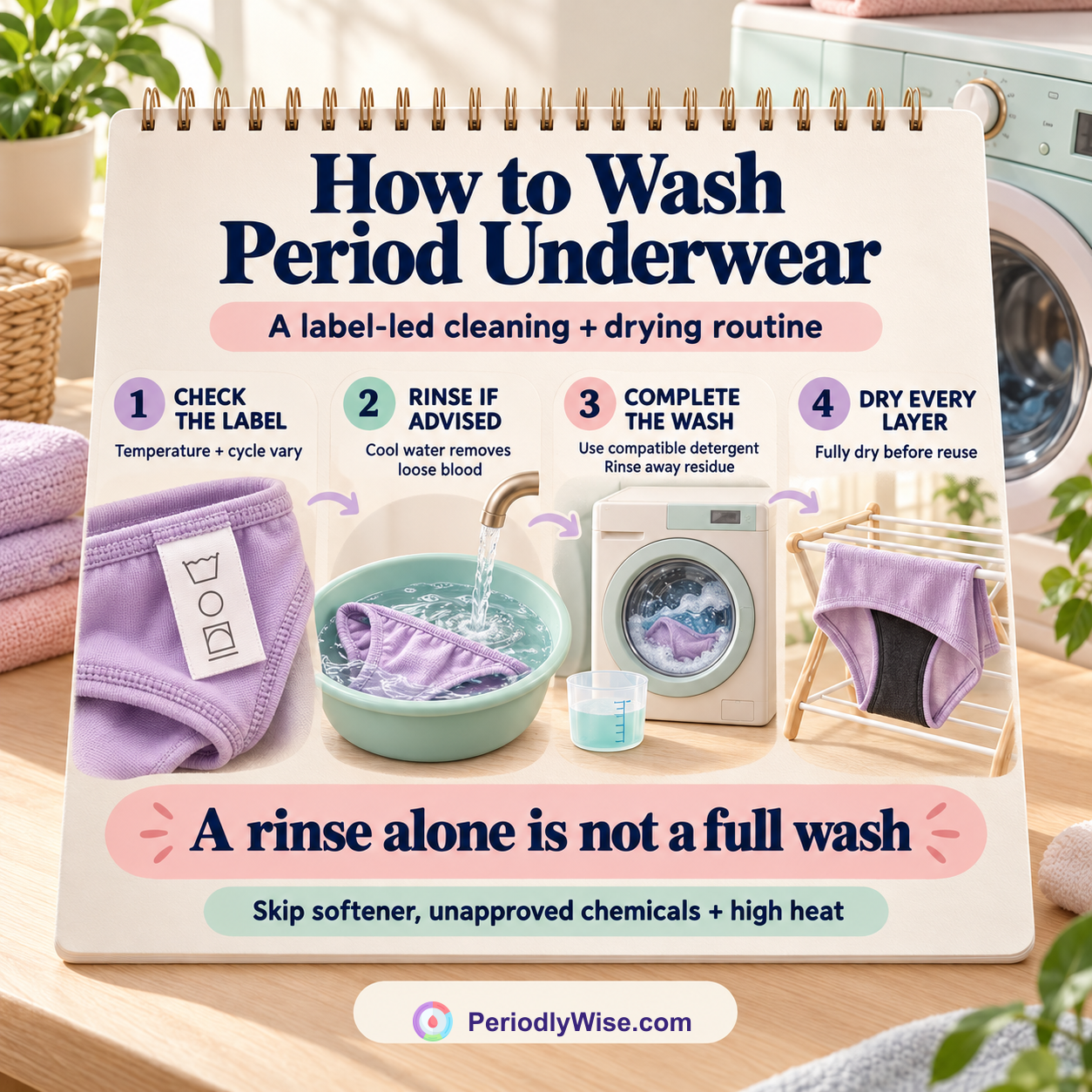
To wash period underwear, follow the label on your exact pair, use a compatible detergent, rinse thoroughly and dry the whole garment before wearing it again. Many styles suit a cold machine wash and air drying. A brief cool-water rinse after use can help remove blood, but it does not replace washing.
The confusing part is that instructions are not identical across brands, product generations or styles. Advice for ordinary cotton briefs, reusable pads, period swimwear or bladder-leak underwear may not suit the absorbent, leak-resistant layers in your period pants.
This guide gives you a practical routine, explains the decisions that need a label check, and separates a stained garment, an incompletely cleaned garment and a change in your body's symptoms. You do not need a complicated collection of cleaning products to get started.
Start with the exact garment, not a universal internet rule
Read the sewn-in care label and the current manufacturer's instructions together. Look for the permitted temperature, wash cycle, detergent restrictions, drying method and any instruction about washing before first use. If they appear to conflict, ask the brand about your specific style rather than choosing the hottest instruction you can find.
For example, Modibodi describes a cold gentle wash and hanging to dry. WUKA lists 30 to 40 degrees Celsius for many garments but specifies cold washing for some styles. That difference is a reason to check, not evidence that one rule fits every pair.
Save a photograph of the label if the printing is fading. Include the style name, not just the brand, in your laundry notes. Avoid combining pairs in one load until you know that the same settings and detergent are suitable for all of them.
What you need, and what you can leave out
Start with clean water, an appropriate laundry detergent, access to a permitted washing method and a place with enough airflow for drying. A mesh laundry bag can help protect delicate fabric when the maker recommends it. A clean basin is useful for hand washing; it does not need to be a special period-care product.
Choose detergent for the garment and your skin, then measure it for the load size, water hardness and product instructions. More liquid does not automatically mean a cleaner absorbent layer. An expensive specialist wash is not automatically necessary, while a product called natural or sensitive is not automatically suitable.
- Keep fabric conditioner and dryer sheets out of the routine unless your exact garment's maker explicitly says otherwise.
- Do not add perfume or essential oils to make the gusset smell clean. Fragrance is not a cleaning test.
- Do not assume an enzyme detergent, oxygen stain remover, disinfectant or vinegar soak is approved for every absorbent fabric.
- Use a clean drying rack and somewhere dry to store the pair after it is completely dry.
How to machine wash period underwear, step by step
Check that machine washing is allowed before starting. The aim is a complete wash suitable for the garment, not a quick splash that leaves detergent or soil in a thick gusset. If your machine's programme names are unclear, use its manual to identify the temperature and cycle rather than relying on a name such as eco or daily.
These steps are a framework. Where your own care instructions differ, follow those instructions or ask the manufacturer to resolve the uncertainty.
- Read the label, separate incompatible colours and fabrics, and check that the pair has no obvious damage.
- If the maker recommends a pre-rinse, use cold water to remove loose blood. Handle the gusset gently rather than scrubbing or twisting its layers.
- Put the pair into a mesh bag if recommended. Add compatible clothing without overpacking the drum, so water can circulate.
- Measure the permitted detergent. Leave out fabric softener and unapproved stain or sanitising additives.
- Choose the label-approved temperature and full cycle. Use an extra rinse if needed and permitted when detergent residue remains; do not routinely compensate by adding more detergent.
- Remove the pair after washing, check for remaining soil or residue, and dry it by the approved method before reuse. If it still needs cleaning, wash again within the label's limits.
How to hand wash without damaging the absorbent layers
Hand washing can be practical when travelling or when you do not have convenient machine access, provided your product allows it. Use a clean basin, water at the permitted temperature and a detergent suitable for hand washing that garment. Dissolve the measured detergent as its instructions specify before adding the underwear.
Gently move the garment through the water and work the absorbent area with your fingers. Avoid a stiff brush, vigorous rubbing or forceful wringing. Empty the water and rinse with fresh water until detergent is removed. Press out excess water gently and follow the drying instructions.
Do not turn a short, product-approved soak into an overnight or multi-day bath. Soaking is not required for every pair, and the permitted duration depends on construction. If the label does not explain hand washing or soaking, ask the maker instead of borrowing a routine for towels or cloth nappies.
What temperature should you use?
Use the temperature on the exact care label. A cold rinse for blood and the main wash are different stages; recommending a cool pre-rinse is not permission to change the main-wash instructions. Equally, the fact that another pair tolerates 40 degrees Celsius does not make that temperature suitable for yours.
Do not boil period underwear or assume a hot, steam or sanitise programme is appropriate. Its elastic, bonded areas and leak-resistant layers may have different care limits from a plain cotton cloth. A home laundry cycle also should not be described as medical sterilisation.
The examples below were checked on October 20, 2026. They illustrate variation, not a ranking or a replacement for the instructions supplied with a garment. No brand endorsement is implied.
| Manufacturer guidance example | Washing and drying approach | What to check on your pair |
|---|---|---|
| Manufacturer guidance exampleModibodi | Washing and drying approachCold gentle machine washing; hang to dry. | What to check on your pairIts instructions also restrict softeners, stain removers and high heat. |
| Manufacturer guidance exampleThinx period underwear | Washing and drying approachCold machine washing; line drying. | What to check on your pairDo not copy a dryer instruction intended for a different bladder-leak product. |
| Manufacturer guidance exampleWUKA | Washing and drying approachMany styles allow 30 to 40 degrees Celsius; air drying. | What to check on your pairThe care page names cold-wash exceptions, including some seamless and swim styles. |
| Manufacturer guidance exampleKnix care guide | Washing and drying approachCold washing with mild detergent; lay flat to dry. | What to check on your pairConfirm the specific garment's label before applying a general guide. |
Read the current Thinx, WUKA and Knix care pages alongside your label, especially if you own several product types.
Can you wash them with other clothes?
Often, yes, when the garments have compatible care instructions and colours. Thinx permits washing its period underwear with other laundry, and other brands also provide mixed-load instructions. You do not automatically need to run a nearly empty machine for one pair.
Separate pale or delicate items when colour transfer or fabric damage is a concern. Close zips and avoid a crowded load that prevents movement. A pre-rinse can remove loose blood, but the mixed load still needs a proper wash with compatible detergent and settings.
Advice for routine personal menstrual laundry is not a substitute for infection-control instructions. If a clinician has given you specific laundry advice because of an infection, immune-system concern or another medical circumstance, follow that advice and check whether the garment can tolerate it. Do not put an unsuitable item through a harsher cycle just to make the instructions match.
Drying: the outside can feel dry before the gusset is ready
The layered absorbent area can take longer to dry than the waistband or outer fabric. Spread the pair out on a clean rack or line in a well-ventilated place, using the orientation the maker recommends. Avoid folding the gusset over itself or stacking damp pairs together.
Drying time varies with thickness, room temperature, humidity and airflow. Plan around the pair being fully dry, not a promised number of hours. Before putting it away, check the thickest area from both sides. If it still feels damp, let it keep drying and use another product.
Air drying is the usual starting point when allowed. Do not use a tumble dryer, iron, radiator or other direct high-heat shortcut unless your exact care instructions permit the method. A dryer permission on one product is not permission for the rest of your collection. Sunlight or a pleasant smell is not proof of sterilisation.
What to do when you cannot wash straight away
A realistic routine matters at school, work, in shared housing or on a journey. Carry a clean spare and a separate washable wet bag or suitable leak-resistant pouch for temporary transport. Change the pair when needed rather than waiting until you reach your own bathroom.
When you can, follow the maker's rinse and storage advice and complete the wash promptly. Do not leave a used, damp pair sealed in a bag for days or put a wet pair into a drawer. If you rinse first but cannot wash immediately, use the manufacturer's recommended holding method rather than leaving it indefinitely submerged.
For a trip, check both wash access and drying space before relying entirely on reusable underwear. A spare absorbent product is a practical backup, not a failure of the routine. Wash the transport pouch according to its own label, and keep clean pairs separate from used ones.
Stains, lingering odour and residue: troubleshoot one issue at a time
Check the pair after a complete wash and again after drying. A colour mark alone cannot tell you whether laundering was adequate; assess the actual cleaning process, remaining soil, residue and the condition of the garment. Conversely, an unstained dark fabric is not proof that its inner layers are clean.
If a problem remains, first revisit the basic routine: label-compatible cycle, measured detergent, enough room in the machine, thorough rinsing and complete drying. Do not respond to every smell by adding perfume or a stronger chemical. Persistent problems deserve product-specific advice from the maker.
| What you notice | What to review | What not to assume |
|---|---|---|
| What you noticeA remaining blood-coloured mark | What to reviewWhether visible soil remains and whether the maker permits a targeted treatment. | What not to assumeThat every stain requires bleach or a hot wash. |
| What you noticeA soapy or coated feel | What to reviewDetergent dose, load size and whether rinsing was complete. | What not to assumeThat more detergent will remove the residue. |
| What you noticeA musty smell after storage | What to reviewWhether the thick gusset was completely dry and the storage place was dry. | What not to assumeThat fragrance makes the pair ready for reuse. |
| What you noticeOdour that returns after correct washing | What to reviewThe garment's condition, the actual care instructions and manufacturer support. | What not to assumeThat repeated harsh laundry stripping is safe. |
| What you noticeNew unusual vaginal odour or discharge | What to reviewWhether there are body symptoms that need clinical advice. | What not to assumeThat the washing machine can diagnose or treat the cause. |
Avoid cleaning shortcuts that can create a new problem
Do not assume advice for blood stains on sheets applies to leak-resistant underwear. Chlorine bleach, peroxide products, oxygen powders, alcohol, disinfectants, vinegar and concentrated stain treatments have different actions, and a product can be unsuitable for a particular fabric or bonded layer. Use only treatments the garment maker permits, following the cleaner's instructions too.
Never mix chlorine bleach with vinegar or other acids. Poison Control warns that the combination releases irritating chlorine gas. Do not mix cleaning products to create a stronger laundry recipe. If an exposure causes breathing difficulty or serious symptoms, move away from the fumes if safe and seek urgent medical help.
After an accidental hot wash, dryer cycle or softener use, do not assume the pair is either ruined or definitely unaffected. Stop repeating the exposure, inspect it when clean and dry, ask the manufacturer for advice and use backup protection while you assess performance. Do not attempt to reverse the mistake with an unapproved chemical soak.
When leaks mean more than a washing issue
Leaking can reflect saturation, a poor fit, gaps at the legs, shifting during movement, a product that does not suit your flow, or a damaged garment. Laundry residue may be one possibility, but it should not become the explanation for every leak. Check when the leak happens and whether the pair was washed and fully dry before wear.
Change sooner when the surface feels wet or uncomfortable, and use a suitable absorbency or backup product. Do not use a marketing capacity or wear-time claim as an instruction to stay in a saturated pair. A sudden or substantial change in your bleeding pattern is a health question as well as a product-planning question.
For replacement, follow the maker's instructions rather than a universal promise of a certain number of years. Retire pairs with damaged leak-resistant layers, failing seams or elastic, persistent cleaning problems, or continuing loss of function after approved care. Do not donate used, damaged intimate garments as though they were new.
Protect your skin without confusing laundry care and medical care
If a freshly washed pair causes itching or soreness, stop wearing it and consider residue, fragrance, dampness, friction and fit as possible contact factors, not a diagnosis. Cambridge University Hospitals advises avoiding potential laundry irritants for inflamed vulval skin and rinsing detergent out fully.
Do not scrub the vulva, douche, or use laundry chemicals on your body to remove a smell. A garment-care routine does not treat thrush, bacterial vaginosis, a sexually transmitted infection or a vulval skin condition. Do not repeatedly self-treat an assumed infection simply because symptoms appeared during your period.
Arrange medical advice for persistent itching, soreness, a rash, pain when urinating, or a change in discharge colour, smell or texture. NHS guidance explains that changed discharge with associated symptoms needs assessment. Severe or worsening pelvic pain, fever with feeling very unwell, fainting or heavy bleeding with marked weakness need prompt or urgent care rather than another laundry experiment.
Build a small rotation that fits your actual day
Count how often you change, how frequently you can wash and how long your thickest pair actually takes to dry. As a planning example, using two pairs a day with a two-day wash-and-dry turnaround means four pairs are occupied before you add a clean spare. That is an example, not a recommended purchase quantity for everyone.
Keep the routine easy to repeat: a place for used pairs, an agreed wash setting, a drying space and a clean spare in your bag. For a teenager or someone who needs practical assistance, explain the steps without shame and agree on privacy and help with laundry. Menstrual blood does not make someone dirty.
You can note heavier-flow days and product changes in a period record if useful, but there is no need to store intimate laundry details online. Choose the mix of reusable and disposable products that works for your budget, access needs, skin comfort and daily life.
Frequently asked questions
Do I need to wash period underwear before first use?
Many manufacturers say yes. Check the instructions for your exact pair, use the recommended wash and let it dry fully before wearing it. Do not assume a new garment is ready straight from its packaging.
Is rinsing in the shower enough?
No. A rinse can remove loose blood, but it does not replace a detergent wash. Avoid exposing a cold-wash garment to a hot shower, and complete the actual wash before reuse.
Can I wash period underwear at 40 degrees Celsius?
Only if the exact garment permits it. Some styles allow 30 to 40 degrees Celsius, while others specify cold washing. Do not use another brand's label as permission to increase your wash temperature.
Can I use ordinary laundry detergent?
Often, a compatible mild detergent is sufficient. Check restrictions on ingredients, enzymes, additives and dosage. If your skin is sensitive or inflamed, ask about a suitable fragrance-free option and rinse thoroughly.
Should I soak the underwear overnight?
Not as a default. Some products permit a short soak, while others limit soaking because of their construction. Follow the maker's method and duration rather than leaving used pairs in water for days.
Can period underwear go in the dryer?
Only if that specific garment's instructions explicitly allow it. Many period styles are intended to air dry. Permission for ordinary underwear or a separate bladder-leak product does not carry over automatically.
Can I wash one pair with my regular dark laundry?
Usually, if all items allow the same detergent, temperature and cycle and the load is not overfilled. Check colour compatibility, pre-rinse if recommended and follow any individual medical laundry instructions.
Why does my pair still smell after washing?
Review the wash, detergent dose, rinsing, drying and storage before adding treatments. If the problem persists after correct care, contact the manufacturer. New unusual body odour with discharge, itching or pain needs medical advice instead.
Does a blood stain mean the pair is unsafe?
A colour mark alone cannot determine cleanliness or safety. Look at how the pair was washed, whether soil or residue remains and whether it is damaged. Use only label-approved stain treatment; if you cannot clean it properly, do not wear it.
How often should I wash and replace period underwear?
Wash after each use, and change sooner when wet, saturated or uncomfortable. Replacement depends on manufacturer instructions and the garment's condition. There is no reliable lifespan rule that applies to every style and washing routine.
Use PeriodlyWise to record period dates and recognise days when you need more spare products. Calendar estimates cannot decide how long a particular pair can safely or comfortably be worn.
Open the Period TrackerThe bottom line
The best way to wash period underwear is the routine its exact label supports, completed consistently. Rinse when recommended, use compatible detergent, wash and rinse properly, then let every layer dry before reuse. Skip fabric softener, unapproved chemicals and high-heat shortcuts.
A simple rotation with clean spares makes that routine easier. If odour, leaks or skin symptoms persist, separate the garment problem from the health question: ask the manufacturer about care or damage, and a healthcare professional about ongoing irritation or unusual symptoms.