Waking up hot or sweaty a few nights before your period can feel surprisingly intense. For some people, the pattern repeats after ovulation and eases when bleeding begins. That timing makes a cycle connection plausible, but timing alone does not prove that hormones are the only cause.
In an ovulatory cycle, progesterone rises after ovulation and shifts core body temperature upward. Research reviews describe an average luteal-phase rise of about 0.3°C to 0.7°C, often most noticeable during sleep or on waking. That small physiological shift may make a warm bedroom, heavy duvet, stress, or disrupted sleep feel more uncomfortable.
True night sweats are more specific than simply feeling warm. Clinicians generally use the term for sweating that soaks sleepwear or bedding despite a cool sleeping environment. Repeated drenching sweats should not automatically be labelled PMS, especially when they occur throughout the month or come with other symptoms.
First decide whether this is warmth, sweating, or a fever
Start with what actually happened. A hot room, foam mattress, thick bedding, synthetic sleepwear, alcohol, spicy food, or a late workout can cause ordinary nighttime sweating. If adjusting the environment solves the problem, the cycle may be only part of the context.
A drenching night sweat means you need to change clothing or bedding even though the room is comfortably cool. A fever is different again: measure your temperature when you feel hot, cold, shivery, or unwell rather than estimating it from sweating alone.
Also note whether the episode resembles a hot flash: a sudden wave of heat, often in the face, neck, and chest, followed by sweating or chills. Hot flashes and night sweats become especially relevant when periods are also becoming irregular, farther apart, heavier, or lighter during perimenopause.
What the timing pattern may suggest
| Pattern | Possible context | Useful next check |
|---|---|---|
| Only after ovulation and before bleeding | Luteal-phase temperature change may be contributing. | Track at least 2 to 3 cycles and note whether it reliably stops after the period starts. |
| All month or unrelated to cycle day | Environment, medicine, anxiety, thyroid, infection, glucose, alcohol, or another cause may fit better. | Review the full symptom and medication timeline rather than assuming PMS. |
| Sudden heat waves plus changing cycles | Perimenopause becomes more plausible, particularly in the 40s, though it can begin earlier. | Record cycle changes and discuss bothersome symptoms with a clinician. |
| Started after a medicine or dose change | Some medicines, including certain antidepressants, can increase sweating. | Ask the prescriber or pharmacist; do not stop a prescription abruptly. |
| Sweats with fever, cough, diarrhoea, weight loss, or swollen glands | A non-cycle medical cause needs assessment. | Arrange prompt medical review and describe every associated symptom. |
Why you may feel warmer before a period
After ovulation, progesterone acts on temperature regulation and raises the body's thermal set point. Core temperature normally remains a little higher through much of the luteal phase and drops around menstruation if pregnancy has not occurred. The change is real, but it is usually measured in fractions of a degree rather than as a high fever.
Temperature and sleep also interact. Research has found that luteal-phase temperature can stay higher during the night and that heat dissipation may be reduced early in sleep. People with premenstrual symptoms may notice poorer subjective sleep, and waking more often can make sweating easier to notice.
This physiology explains why a repeated pre-period pattern is possible; it does not establish that every episode is hormonal. The evidence on menstrual-cycle thermoregulation is stronger than the evidence that ordinary PMS commonly causes soaking night sweats.
Think in layers: cycle phase may set the background, while another factor pushes you over the threshold into sweating. Common contributors include:
- a warm bedroom, heavy or non-breathable bedding, mattress heat retention, or tight synthetic clothing
- stress, anxiety, vivid dreams, poor sleep, or alcohol close to bedtime
- medicines such as some antidepressants, steroids, hormone treatments, or pain medicines
- perimenopausal hormone fluctuation, especially with new cycle irregularity or daytime hot flashes
- low blood sugar, particularly when using insulin or medicines that can cause hypoglycaemia
- infection, thyroid disease, hyperhidrosis, sleep apnoea, or another condition when the pattern is persistent or not cycle-linked
Cycle-linked warmth, perimenopause, or illness?
| Clue | More consistent with a cycle pattern | Reason to broaden the check |
|---|---|---|
| Timing | Appears in the same few pre-period nights and resolves after bleeding begins. | Occurs unpredictably, throughout the month, or is progressively worsening. |
| Temperature | Feels warmer but measured temperature is not a fever. | Measured fever, shaking chills, or feeling acutely unwell. |
| Bleeding pattern | Periods otherwise follow the usual pattern. | New skipped, much closer, much farther apart, heavier, or lighter periods may suggest perimenopause or another cycle change. |
| Other symptoms | Mild PMS symptoms such as bloating, breast tenderness, or sleep disruption follow the same timing. | Cough, diarrhoea, unexplained weight loss, swollen glands, persistent palpitations, tremor, or marked weakness. |
| Severity | Mild dampness that improves with a cooler sleep setup. | Clothes or sheets are repeatedly soaked despite a cool room. |
What to do tonight and over the next few cycles
The goal is not to force a diagnosis from one night. Reduce obvious heat triggers, collect useful context, and escalate when the pattern or associated symptoms warrant it.
- Cool the sleep environment. Use breathable layers, lighter bedding, airflow, and a spare shirt nearby. Change one factor at a time so you can tell what helps.
- Check for fever when relevant. Use a thermometer if you feel shivery, ill, unusually hot, or cold. Sweating itself cannot distinguish a hormone-linked temperature shift from infection.
- Track the cycle relationship. Record the first day of full flow, the nights affected, severity, awakenings, and when symptoms stop. Two or three cycles reveal more than a single episode.
- Review medicines and substances. Note any new prescription, dose change, missed doses, supplements, alcohol, or recreational drugs. Ask a clinician or pharmacist before changing medication.
- Consider pregnancy by timing, not by sweating. Night sweats are nonspecific. If a period is late and pregnancy is possible, use a pregnancy test according to its instructions.
- Book care for a persistent or disruptive pattern. Bring the record rather than waiting for the episode to happen during the appointment.
A useful night-sweat and cycle record
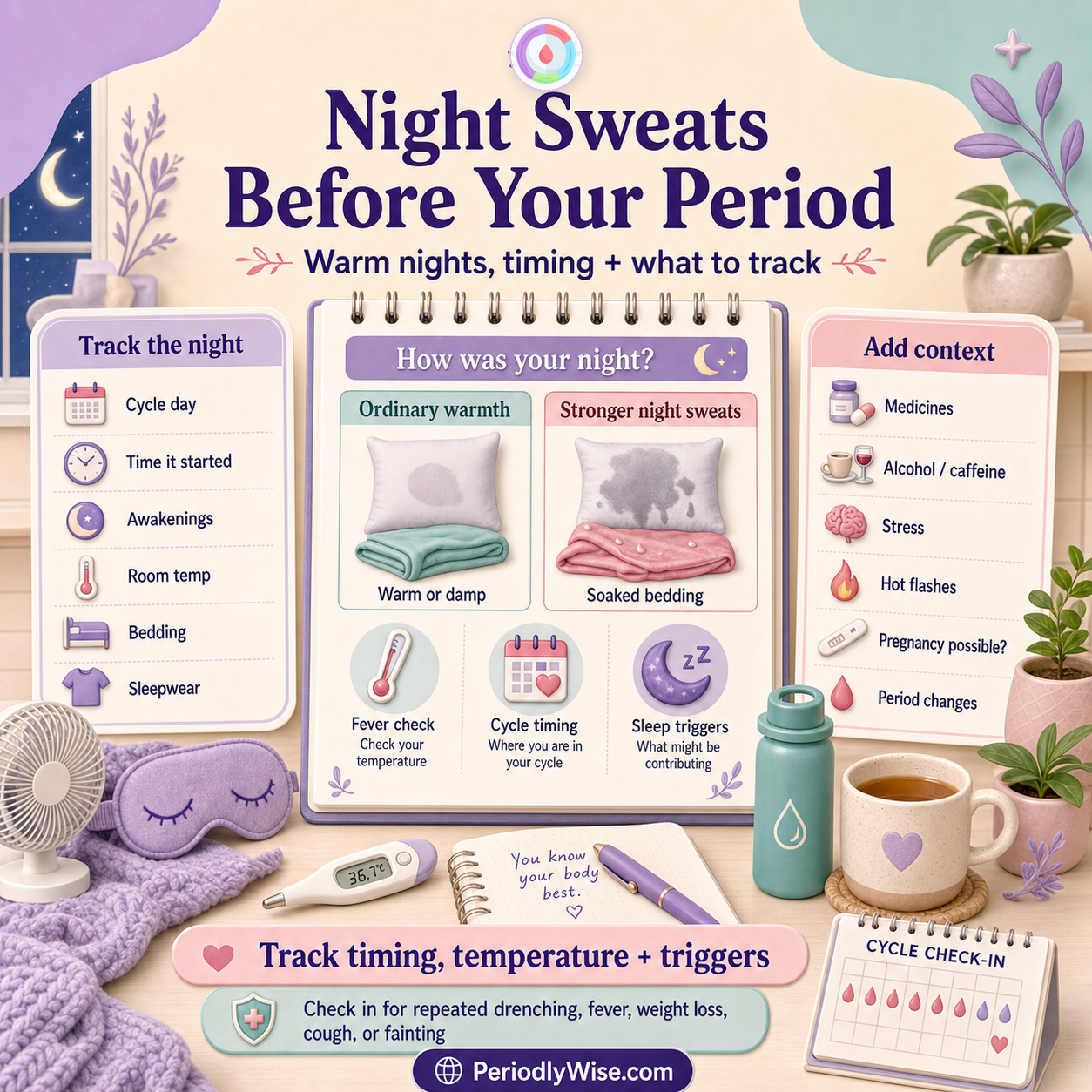
A tracker cannot diagnose the cause, but it can show whether sweating is confined to the luteal phase or is independent of your period. Record actual observations rather than only writing “bad night.”
- cycle day and expected period date
- time the sweating started and number of awakenings
- damp skin versus clothing change versus soaked bedding
- room temperature, fan or heating use, bedding, and sleepwear
- measured body temperature and any chills
- daytime hot flashes, palpitations, anxiety, or dizziness
- cough, diarrhoea, pain, swollen glands, or recent illness exposure
- medicines, dose changes, missed doses, supplements, alcohol, and caffeine
- period timing, flow, spotting, and whether cycles are changing
- pregnancy-test dates when pregnancy is possible and the period is late
When night sweats before a period need medical care
Arrange a medical appointment if night sweats regularly wake you, repeatedly soak clothing or bedding, worry you, or continue beyond the pre-period window. Seek assessment sooner when they occur with a high temperature, cough, diarrhoea, unexplained weight loss, swollen glands, persistent palpitations, tremor, or marked fatigue.
Discuss possible perimenopause when night sweats or daytime hot flashes occur alongside a clear change in cycle length or flow. Age helps with context, but symptoms before 45 also deserve discussion rather than dismissal.
If a new medicine or dose change lines up with sweating, contact the prescriber or pharmacist. Do not abruptly stop an antidepressant, steroid, hormone medicine, or other prescription to test the theory yourself.
Use PeriodlyWise to record period dates and symptom timing privately, then bring the pattern plus your medication and temperature notes to a clinician if the sweats repeat.
Open the period trackerFrequently asked questions
Are night sweats normal before a period?
Feeling warmer or sweating a little can occur in the luteal phase because core temperature rises after ovulation. Repeated soaking sweats are not something to assume is normal PMS; track the timing and seek advice if they recur, disrupt sleep, or come with other symptoms.
Why do I sweat the night before my period starts?
The late luteal phase involves changing progesterone and estrogen levels, and your temperature rhythm may still be elevated before it falls around menstruation. Room heat, stress, alcohol, medicines, or illness can add to that background.
Can night sweats be an early pregnancy sign?
Sweating is too nonspecific to confirm pregnancy. If pregnancy is possible, rely on the timing of your period and a correctly timed pregnancy test rather than symptoms alone.
Do night sweats before a period mean perimenopause?
Not necessarily. Perimenopause becomes more likely when hot flashes or night sweats occur with new irregular, skipped, heavier, or lighter periods, especially in the 40s. Earlier symptoms should also be discussed with a clinician.
Can antidepressants cause night sweats?
Yes. Sweating is listed with several antidepressant classes. Ask the prescriber or pharmacist if it began after starting, switching, or changing a dose, but do not stop the medicine suddenly.
How can I tell a pre-period temperature change from a fever?
Use a thermometer when you feel ill. A normal luteal rise is usually only a fraction of a degree; a measured fever, chills, cough, diarrhoea, rash, or worsening illness points away from a simple cycle explanation.
The bottom line
Night sweats before a period can have a cycle-linked component because progesterone raises core temperature after ovulation. A consistent, mild pattern that resolves with the period is different from recurrent drenching sweats in a cool room.
Track timing, severity, temperature, environment, medicines, cycle changes, and associated symptoms. Use that pattern to guide a medical conversation, while treating fever, unexplained weight loss, breathing problems, fainting, severe weakness, or rapidly worsening illness as reasons for faster care.