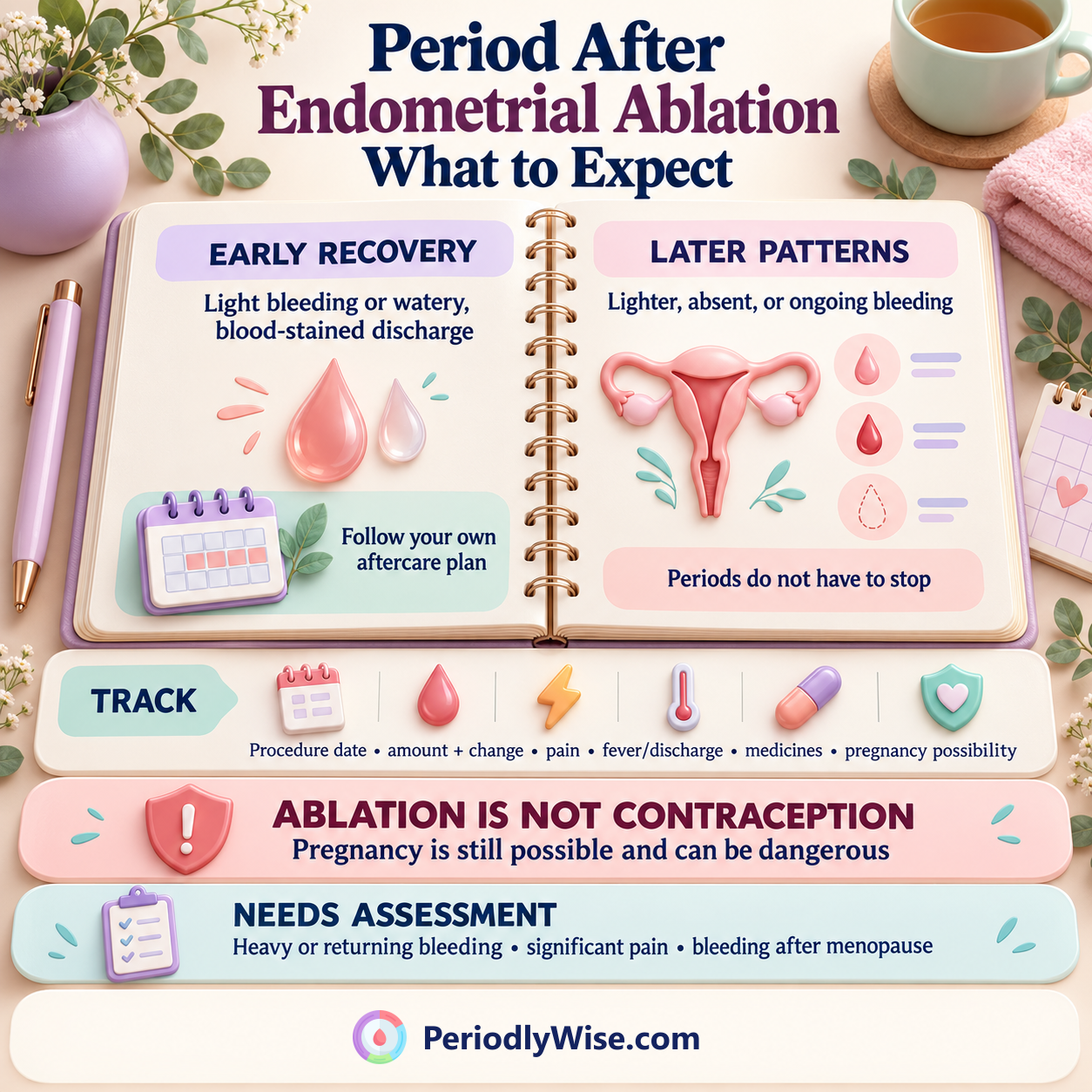
You can still have a period after endometrial ablation. The aim is to reduce heavy menstrual bleeding, not to guarantee that every future period disappears. Some people have lighter periods, some stop bleeding, and others need further assessment or treatment because symptoms persist or return.
Timing matters. Light bleeding or watery, blood-stained discharge soon after treatment can be part of healing rather than a new menstrual period. A change months or years later raises a different question. Neither situation can be judged from the date alone: the amount of bleeding, pain, fever, pregnancy possibility and your discharge instructions matter too.
This guide separates recovery from longer-term patterns and explains what to record, when to contact your treatment team and which symptoms should not wait. Keep the hospital's instructions available; advice for your particular procedure and circumstances takes priority over a general timeline.
What ablation changes, and what it leaves in place
Endometrial ablation treats the lining inside the uterus, called the endometrium. It is different from a hysterectomy, which removes the uterus, and from surgery to remove the ovaries. The particular device and technique affect recovery instructions, so the name of the procedure is worth keeping in your records.
The ovaries may continue their hormonal cycle even if there is much less lining available to bleed. ACOG distinguishes ablation from removing the uterus and explains that it does not directly switch off hormone production. Breast tenderness, bloating or other cyclical symptoms can therefore continue without a familiar monthly flow.
A small or absent bleed is not a complete report on everything happening in the pelvis. Likewise, a later bleed does not by itself tell you that the entire lining has regrown or that the procedure was performed incorrectly. Describe the change before assigning a cause.
Bleeding during the first days and weeks
Some light period-like bleeding followed by watery or darker blood-stained discharge is expected during recovery for many patients. RCOG describes discharge lasting three to four weeks for some people. That is an example of a recovery pattern, not a promise that any bleeding within four weeks is harmless.
Follow the treatment team's instructions about pads, vaginal products, sex, bathing, activity and pain relief. Pads can help you monitor the amount while healing. Do not assume a tampon or menstrual cup is appropriate simply because the discharge looks like a period; ask when you are cleared to use internal products.
Notice the direction of change: gradually improving discharge is different from bleeding that becomes much heavier, pain that intensifies, an unpleasant smell or feeling feverish and unwell. Contact the team if recovery does not match its advice. You do not have to wait for a scheduled follow-up to report a concerning change.
When will the first period happen?
There is no universal date for a first recognizable period after ablation. Recovery bleeding may overlap with the next hormonal cycle, and some people never resume a distinct menstrual flow. An app's predicted start date cannot reliably separate healing discharge from menstruation.
Newcastle Hospitals notes that the first period can be heavier or more prolonged for some patients. That does not mean heavy bleeding should automatically be dismissed as normal: use the service's safety instructions and seek advice about the actual amount and symptoms.
| When | Possible context | Useful next step |
|---|---|---|
| WhenFirst few days | Possible contextLight bleeding and cramps may accompany healing. | Useful next stepFollow discharge advice; report heavy bleeding or worsening pain. |
| WhenFollowing weeks | Possible contextWatery or blood-stained discharge may continue. | Useful next stepTrack whether it is easing and report fever, unpleasant smell or deterioration. |
| WhenFirst few months | Possible contextA longer-term bleeding pattern may still be emerging. | Useful next stepAttend or arrange the advised review rather than judging from one cycle. |
| WhenMonths or years later | Possible contextBleeding may return or become more troublesome. | Useful next stepAsk for assessment, especially after a settled or bleed-free interval. |
| WhenAfter established menopause | Possible contextA new vaginal bleed needs a separate explanation. | Useful next stepArrange medical assessment even for a small amount or one episode. |
This table describes questions to ask, not deadlines for waiting. If you feel unwell or the bleeding worries you, the amount and associated symptoms matter more than whether a calendar says recovery should be finished.
Lighter periods or no periods: what counts as improvement?
A useful outcome can be less flooding, fewer bleeding days, less disruption or improved anemia, even if you still have monthly periods. No bleeding is one possible outcome, not the only definition of success. Compare what matters in daily life with the problem the treatment was intended to address.
Mayo Clinic explains that final results may take a few months and can range from lighter periods to no periods. Device, anatomy, age and the reason for the original bleeding can affect an individual outcome; another person's experience is not your expected result.
If the original heavy bleeding is not improving, ask when the treatment team wants to reassess it. Do not use a general 'wait several months' statement to postpone care for repeated flooding, exhaustion or persistent pain. Feeling better and a safe recovery plan are more useful goals than matching a social-media success story.
Why can bleeding return months or years later?
Ablation does not guarantee a permanent end to all bleeding. Remaining or recovering lining, ongoing hormonal cycling and conditions affecting the uterus can contribute to later symptoms. Fibroids, polyps or adenomyosis may be considered depending on your history, but a symptom diary cannot establish which explanation applies.
ASRM's patient information notes that periods can become heavier or longer again after several years. A returning period is therefore possible, but new bleeding still deserves an individual review rather than an assumption that it is simply inevitable regrowth.
Tell the clinician whether bleeding never improved, gradually increased or restarted after a long quiet interval. Mention bleeding after sex or between otherwise recognizable cycles. Those descriptions help distinguish different clinical questions without deciding the diagnosis in advance.
New cramps with little or no bleeding
Pain can matter even when there is very little visible blood. After ablation, scarring or narrowing can sometimes obstruct the passage of blood. New cyclical pain in someone who has also had tubal sterilization is another recognized complication that needs assessment, often called post-ablation tubal sterilization syndrome, or PATSS.
These are possibilities, not explanations for every cramp. Record the location, severity, duration, whether the pain repeats and whether there is any spotting. New severe pain should not be managed by waiting for a period to arrive, and you should not try to make trapped blood drain yourself.
A clinician may consider a pelvic examination, imaging or other tests based on the presentation. If you have severe pain, fever, vomiting, faintness or possible pregnancy, seek prompt or emergency care as appropriate rather than trying to classify the pattern at home.
Pregnancy is still possible, including without periods
Ablation is not sterilization. Pregnancy can still occur and carries serious risks, including miscarriage, abnormal placental attachment and ectopic pregnancy. The FDA advises ongoing effective contraception until menopause and describes delayed complications, including trapped blood and PATSS.
Use the contraceptive plan agreed with your clinician. Do not stop it because bleeding has disappeared, because a period calculator shows no fertile window or because you were told pregnancy is unlikely. Hormone therapy for menopause is not a substitute for contraception.
If pregnancy is possible, take an appropriately timed pregnancy test and contact a clinician promptly for a positive result. Do not wait for the next period to confirm it. If pain or bleeding accompanies possible pregnancy, seek advice even with a negative or not-yet-positive home test; a test taken too early does not settle the question.
Menopause, HRT and bleeding after a quiet interval
Ablation itself does not remove the ovaries, so the disappearance of bleeding does not prove that menopause has happened. UCLH explains that menopause cannot be confirmed from bleeding patterns after endometrial ablation. Discuss symptoms, age, medicines and contraceptive needs rather than applying a no-period rule on your own.
If you use systemic menopausal hormone therapy, make sure the prescriber knows you still have a uterus and have had ablation. ASRM notes that endometrial protection with a progestogen remains important in this context. Do not change or stop the regimen without advice because you assume the lining has been completely removed.
After established menopause, any new vaginal bleeding should be checked, including spotting or a single small episode. NHS guidance says postmenopausal bleeding needs assessment. Many causes are not cancer, but the history of ablation is not a reason to dismiss the symptom.
When to get help after ablation
Use the hospital's contact number for postoperative concerns and local urgent or emergency services if you cannot safely wait. Bleeding that soaks through protection rapidly, especially with weakness or dizziness, is different from light discharge. Do not wait to complete a certain number of hours if you feel acutely unwell.
Ablation-related scarring can make some later investigations more difficult; it does not make an unexplained symptom unimportant. Always mention the procedure when being assessed for bleeding or pelvic pain, even many years later. Routine cervical screening also remains relevant under your local program.
- Emergency help: very heavy bleeding with fainting, severe weakness, chest pain or trouble breathing; or sudden severe pelvic pain or collapse.
- Prompt same-day advice: fever, foul-smelling discharge, increasing abdominal pain, inability to pass urine or feeling significantly unwell after the procedure.
- Prompt pregnancy assessment: a positive pregnancy test after ablation, or pain and bleeding when pregnancy is possible.
- Book a review: bleeding that persists beyond your team's advice, becomes troublesome again, occurs after sex or starts after an established bleed-free pattern.
- Do not ignore menopause-related bleeding: even a small new postmenopausal bleed needs checking.
What to track before contacting your clinician
A short factual record is enough. You do not need photographs, exact milliliters or several completed cycles before asking for help. If you feel unwell, seek care first and add details when you can. The purpose is to describe the problem, not to prove that you deserve an appointment.
| Record | Example of a useful note | Why it matters |
|---|---|---|
| RecordProcedure details | Example of a useful noteDate, device if known, and any accompanying surgery. | Why it mattersSeparates ablation from hysterectomy, sterilization or other treatment. |
| RecordBleeding pattern | Example of a useful noteDaily discharge since treatment, or a new bleed after eight quiet months. | Why it mattersDistinguishes recovery from persistent or returning symptoms. |
| RecordAmount and impact | Example of a useful notePads soaked, flooding, clots, sleep disruption or missed work. | Why it mattersDescribes severity without relying on color alone. |
| RecordPain and illness | Example of a useful noteOne-sided pain, repeated monthly cramps, fever or unpleasant smell. | Why it mattersHelps identify symptoms needing earlier assessment. |
| RecordPregnancy and medicines | Example of a useful noteContraception, test date/result, HRT and blood-thinning medicines. | Why it mattersProvides context for safe assessment and treatment. |
| RecordChange from baseline | Example of a useful notePreviously light bleeding, now prolonged or increasingly painful. | Why it mattersExplains what is new for you rather than comparing with someone else. |
Use separate labels for 'recovery discharge', 'spotting' and 'possible period' if you are unsure. A predicted calendar date is not proof that bleeding is menstrual. If you use a tracker, keep the procedure date and clinical advice alongside the record rather than asking an algorithm to identify the cause.
What happens if bleeding or pain does not improve?
The next step depends on the symptom and the likely cause. Assessment may include pregnancy testing when relevant, a blood count for significant bleeding or fatigue, examination and imaging. Your clinician may need to consider how earlier ablation affects access to the uterine cavity or tissue sampling.
Options can include appropriate medicines or surgery, including hysterectomy for selected patients. A repeat ablation is not an automatic next step: currently available FDA-approved ablation devices are not designed for repeat treatment, and risks require specialist consideration. Do not assume the same procedure can simply be repeated whenever bleeding returns.
Ask what problem each proposed treatment aims to solve, what its risks are, what recovery would involve and what happens if you choose monitoring instead. Gloucestershire Hospitals' patient guidance illustrates that early recovery and the later assessment of benefit have different timelines. Your own team should explain the review point that applies to you.
A practical next-step plan
Start with the current symptoms, not the expected date of your next period. If bleeding is light and improving and you feel well, follow the discharge plan. If it is worsening, unexpectedly returning or accompanied by concerning pain, make contact rather than extending the observation period yourself.
A useful call explains the procedure date, the change you have noticed and how you feel now. Ask for clear advice about what to do today, what would make it urgent and when the team wants to review the longer-term outcome.
- Check warning signs first. Use urgent care if your condition cannot safely wait.
- Read your discharge instructions. Find the contact number and the advice for your technique.
- Describe the pattern briefly. Include amount, pain, fever, timing and whether symptoms had previously settled.
- Keep contraception in place. Raise pregnancy possibility and any test result promptly.
- Agree follow-up. Ask what change should trigger earlier reassessment rather than waiting indefinitely.
Frequently asked questions
Is it normal to still have a period after ablation?
It can be an expected outcome. Ablation aims to reduce heavy bleeding, and complete absence of periods is not guaranteed. Persistent heavy bleeding, worsening symptoms or a new change after a settled interval should be reviewed.
Is bleeding a week after ablation my first period?
Not necessarily. Healing can cause light bleeding or watery blood-stained discharge for several weeks. Timing alone cannot distinguish that from menstruation. Follow your discharge advice and report heavy bleeding or concerning symptoms.
How long until I know whether it worked?
The longer-term pattern can take a few months to become clear, and the review plan varies. Ask your team for its expected timeline. Do not wait for that date if bleeding is very heavy, pain is increasing or you feel unwell.
Can periods return five years after ablation?
Yes, bleeding can recur years later. That possibility does not identify the cause of your symptoms. Arrange an assessment for a new or troublesome change, particularly after a long bleed-free interval or after menopause.
Can I get cramps without a period?
Yes. Hormonal cycles may continue, but new or severe pain also needs assessment for other causes, including possible obstructed bleeding. Little visible blood does not rule out a problem.
Can I get pregnant if periods stopped after ablation?
Yes. The procedure is not contraception, and pregnancy afterward can be dangerous. Continue the plan agreed with your clinician and seek prompt advice for a positive test or symptoms when pregnancy is possible.
Does no bleeding mean I have reached menopause?
No. Ablation can reduce bleeding while the ovaries continue to function. Menopause and contraceptive decisions need assessment using your broader circumstances, not the absence of a period alone.
Will I automatically need a hysterectomy if bleeding returns?
No. Treatment depends on the assessment, severity and your preferences. Some people need further surgery, but medicines or other approaches may be considered. Repeat ablation is not a routine assumption and needs specialist discussion.
Use PeriodlyWise for bleeding dates and cycle-history context. Keep the procedure date, symptoms and your clinician's instructions alongside it. A tracker cannot diagnose a postoperative complication or confirm that pregnancy is impossible.
Open the Period TrackerThe bottom line
A period after endometrial ablation can be compatible with the intended result, especially if bleeding is lighter. Early discharge, an emerging longer-term pattern and new bleeding years later are different situations.
Follow your own aftercare plan, keep effective contraception until your clinician advises otherwise, and seek assessment for heavy bleeding, new pain, possible pregnancy or bleeding after menopause.