Period cramps are hard enough during the day. At night, they can feel louder, more frustrating, and harder to ignore. You may be tired, ready to sleep, and suddenly the lower belly pain, back ache, pelvic pressure, nausea, or thigh discomfort feels stronger than it did a few hours earlier.
Nighttime cramps do not automatically mean something is wrong. Period pain commonly happens just before bleeding starts or during the first days of a period, and it can spread to the lower back or thighs. But cramps that regularly wake you up, feel severe, or are different from your usual pattern deserve careful tracking and, when needed, medical advice.
This guide explains why period cramps can feel worse at night, what details to track, what may help you rest, and when nighttime pain should not be brushed aside.
Why can period cramps feel worse at night?
There are fewer distractions
During the day, school, work, movement, meals, messages, and routine tasks can pull attention away from pain. At night, everything gets quieter. When you lie still in the dark, cramps may feel more intense because your brain has less else to focus on.
That does not mean the pain is imaginary. It means the same pain can feel bigger when your body is tired and your attention has nowhere else to go.
Cramps may peak near the start of bleeding
Menstrual cramps happen when the uterus contracts to help shed its lining. Prostaglandins, hormone-like substances involved in inflammation and pain signaling, play a role in those contractions. Cramps often start shortly before the period or during the first days of bleeding, then ease over the next few days.
If your period starts in the evening or overnight, your strongest cramp window may naturally land during sleep hours.
Lying down can change how pain feels
Some positions can make pelvic, back, hip, or thigh discomfort more noticeable. Lying flat with an unsupported lower back, curling tightly, or staying in one position for a long time may add muscle tension. A small position change can sometimes make the pain feel more manageable.
Bloating and digestion can add pressure
Period cramps often overlap with bloating, gas, loose stools, constipation, nausea, or pelvic heaviness. At night, a full stomach, trapped gas, or constipation can make lower belly discomfort feel more crowded. Track whether nighttime cramps are worse after heavy meals, low fluid intake, caffeine, constipation, or digestive changes.
Poor sleep can lower your coping room
Pain is harder to tolerate when you are exhausted. If cramps have already disrupted sleep for one or two nights, the next night may feel harder even if the pain level is similar. Sometimes the pattern is not only "my cramps are worse at night," but "my cramps feel worse when I slept badly the night before."
What nighttime period cramps can feel like
Nighttime cramps do not feel exactly the same for everyone. They may show up as:
- Lower belly cramping, tightening, or waves of pain.
- Dull pelvic heaviness or pressure.
- Lower back ache that feels worse when lying down.
- Pain spreading to the hips, thighs, or upper legs.
- Nausea, loose stools, or a restless stomach.
- Restlessness or feeling unable to get comfortable.
- Pain that wakes you after you have already fallen asleep.
The most important question is whether the pain feels familiar for your body or different from your usual period pattern.
What to try before bed
| Comfort idea | Why it may help | What to track |
|---|---|---|
| Heat before sleep | Warmth may relax the lower belly, back, or pelvic muscles. | Whether heat reduced pain and how long relief lasted. |
| Gentle evening movement | Slow walking or stretching may reduce stiffness and tension. | Whether movement helped or made cramps worse. |
| Supported sleep position | Pillows can reduce lower back, hip, or thigh strain. | Which position felt most comfortable. |
| A small night kit | Keeping supplies nearby reduces stress when pain wakes you. | What you needed during the night. |
Use heat safely
A warm bath, shower, heating pad, hot water bottle, or heat patch may help ease cramps. Use heat safely and avoid sleeping with an electric heating pad unless the product is specifically designed for overnight use and has appropriate safety features.
Try gentle movement earlier in the evening
If movement feels okay, try a slow walk, gentle hip circles, a supported child's pose, or simple stretching. This does not need to be exercise. The goal is to help your body relax before bed. If movement makes pain sharper or stronger, stop and choose rest instead.
Support your sleep position
Some people feel better lying on their side with a pillow between the knees. Others prefer lying on the back with a pillow under the knees. The best position is the one that reduces pressure and helps your body settle.
Keep supplies within reach
Keep water, period products, comfortable underwear, a safe heat option, and any pain relief you normally use within reach. Waking up in pain is already unpleasant; having to search for supplies can make the night feel more stressful.
A careful note about pain relief
Some over-the-counter medicines, such as ibuprofen or naproxen, can help some people with menstrual cramps. They are not safe for everyone, especially for people with certain stomach, kidney, bleeding, medication, allergy, or pregnancy-related considerations. Follow the label and avoid medicines a healthcare professional has told you not to use.
If you regularly need medication to sleep through cramps, or if usual pain relief no longer works, that pattern is worth discussing with a healthcare professional.
What to track for period cramps at night
Track nighttime cramps for a few cycles if symptoms are mild and familiar. If pain is severe or worrying, seek advice sooner instead of waiting several cycles.
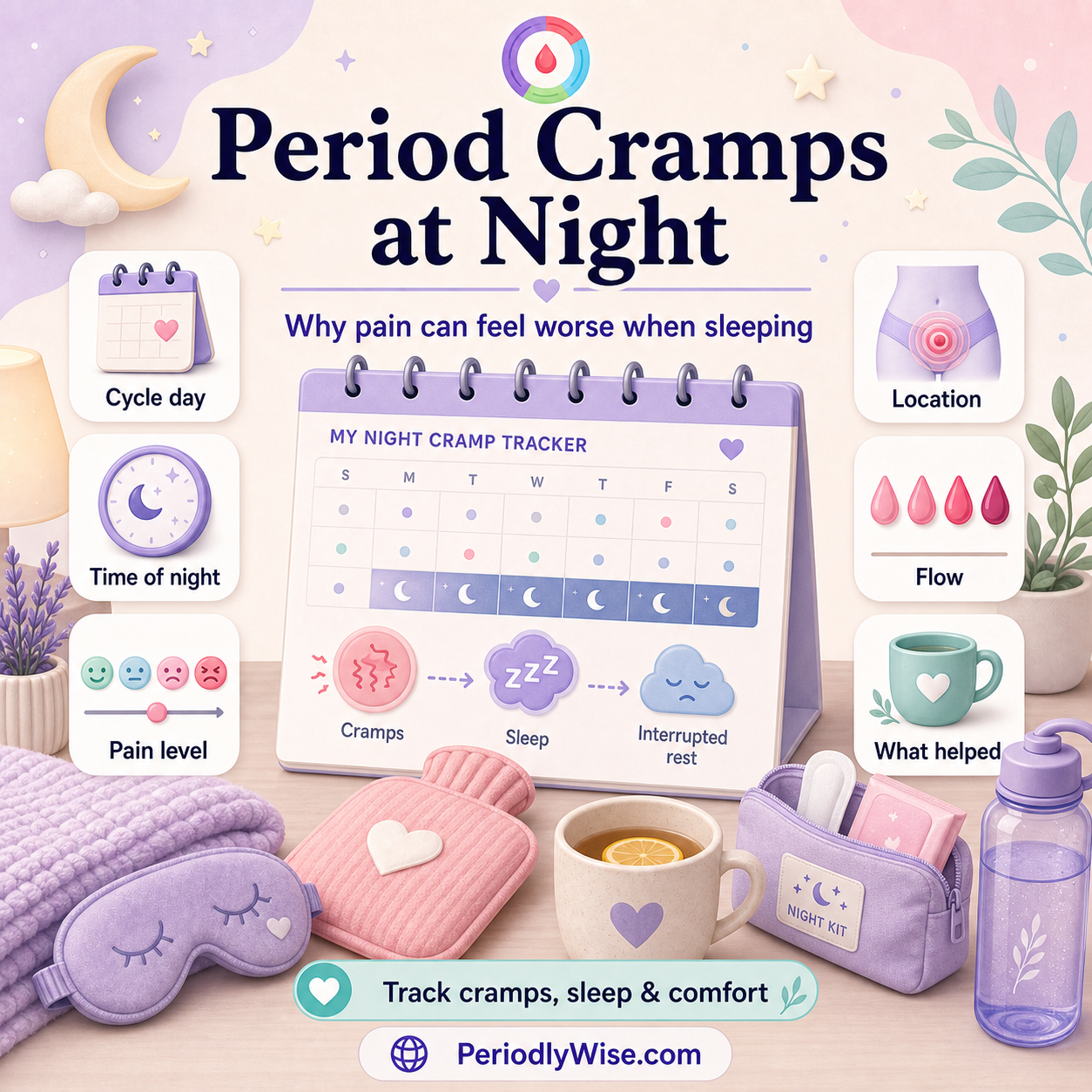
- Cycle day and period day: whether pain happens before bleeding, day 1, day 2, or later.
- Time of night: when cramps started or woke you.
- Pain level: mild, moderate, severe, or unable to sleep.
- Location: lower belly, back, hips, thighs, one side, or both sides.
- Flow: spotting, light, moderate, heavy, very heavy, or sudden flow change.
- Other symptoms: nausea, diarrhea, constipation, dizziness, headache, fatigue, fever, or unusual discharge.
- Sleep context: poor sleep the night before, stress, caffeine, late meals, or travel.
- What helped: heat, position change, bathroom, fluids, movement, medicine, or rest.
A clear note might be: "Day 1, woke at 2:30 a.m., lower belly cramps 7 out of 10, heavy flow, nausea, heat helped after 30 minutes."
Another useful note might be: "Cramps worse after poor sleep and constipation, lower back pain, no unusual bleeding, improved with pillow under knees."
When nighttime cramps may be less worrying
Nighttime cramps may be less concerning when they are mild to moderate, familiar, happen during your usual cramp window, improve with comfort measures, and do not keep disrupting your life.
For example, cramps that are strongest on day 1, ease by day 2 or day 3, and respond to heat may fit a familiar menstrual pattern for some people. Still, normal for you matters. If the timing, severity, or symptoms change, track that change carefully.
When to get medical advice
Get medical advice if nighttime cramps are severe, new, worsening, or regularly interrupting sleep, school, work, or daily life.
It is especially important to seek help if cramps come with very heavy bleeding, bleeding between periods, fever, fainting, vomiting, severe one-sided pelvic pain, unusual discharge, possible pregnancy, pain during sex, pain when peeing or having a bowel movement, or pain that feels very different from your usual period.
Also consider medical advice if cramps last beyond your usual period window, if pain relief that used to help no longer works, or if severe cramps begin for the first time after years of manageable periods.
How PeriodlyWise can help
PeriodlyWise cannot diagnose why cramps feel worse at night. What it can do is help you organize the pattern so you are not relying on memory after a painful night.
Use the Period Tracker to compare nighttime cramps with your expected period window and flow days. If your cycles shift often, use the Irregular Period Tracker to see whether cramps follow a changing period pattern. If pain spreads into the back, hips, or thighs, you may also want to read our guides to period back pain and period leg pain.
Use PeriodlyWise to record period timing, flow, pain level, sleep disruption, and what helped so nighttime cramps are easier to understand across cycles.
Open the Period TrackerFAQ
Why do my period cramps wake me up at night?
Cramps may wake you because uterine contractions, pain sensitivity, flow changes, bloating, or back tension become more noticeable when you are lying still. If this happens often or pain is severe, track the pattern and consider medical advice.
Are period cramps actually worse at night?
They can feel worse at night even when the underlying cramp pattern is similar. Stillness, tiredness, fewer distractions, sleep disruption, and body position can all make pain feel stronger.
What sleeping position helps period cramps?
There is no single best position. Some people prefer side lying with a pillow between the knees, while others prefer lying on the back with knees supported. Track what helps your body.
Can I sleep with a heating pad for cramps?
Use heat safely. Avoid sleeping with an electric heating pad unless it is designed for overnight use and has appropriate safety features. Heat before bed, a warm shower, or a heat patch used as directed may be safer options.
When are nighttime cramps not normal?
Nighttime cramps deserve attention if they are severe, new, worsening, one-sided, persistent, or regularly interrupting sleep and daily life, especially with heavy bleeding, fever, fainting, vomiting, unusual discharge, or pain with sex, urination, or bowel movements.
Final thoughts
Period cramps at night can feel especially intense because your body is tired, your environment is quiet, and pain has more room to take over your attention. Sometimes the reason is simple: cramps are peaking right when you are trying to sleep. Sometimes position, bloating, stress, digestion, or poor sleep adds to the discomfort.
Track the pattern clearly. If nighttime cramps are familiar and manageable, comfort planning may help. If they are severe, new, worsening, or repeatedly stealing sleep, it is worth getting medical advice instead of treating every painful night as something you just have to endure.