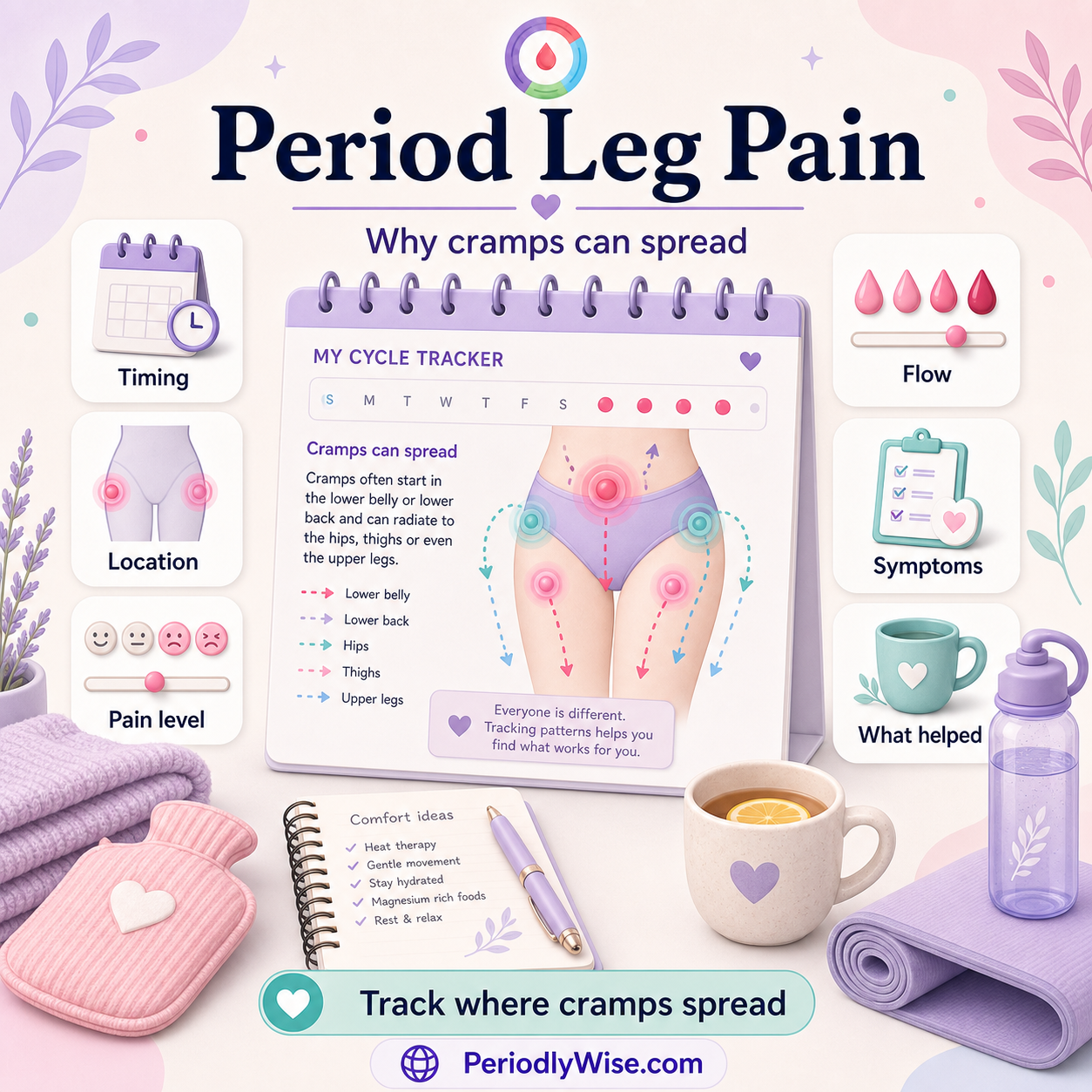
Period cramps are usually felt in the lower belly, but they do not always stay there. For some people, period pain can spread into the lower back, hips, inner thighs, or upper legs. It may feel like a dull ache, heaviness, soreness, pulling, or cramps that seem to travel downward.
Most mild leg or thigh aches around your period are related to familiar menstrual cramping patterns. Still, the details matter. Tracking the timing, location, severity, and repeat pattern can help you understand what is typical for your body and when something deserves medical advice.
This guide explains why period cramps can spread, what leg and thigh pain may feel like, what to track, what may help, and which symptoms should not be brushed aside.
Is leg pain during your period normal?
It can be. Period pain commonly starts in the lower abdomen, but it may spread to the lower back and thighs. This type of pain is often linked to menstrual cramps, especially when it appears around the start of bleeding and improves after the first few days.
The more useful question is not only "Is this normal?" but "Is this normal for me?" A mild thigh ache that happens every month on day 1 of your period is different from sudden severe leg pain that appears for the first time or keeps getting worse.
If the pain is familiar, mild, short-lived, and tied to your usual cramp window, tracking may be enough for routine awareness. If the pattern changes, the pain becomes intense, or it affects walking, sleep, school, work, or daily life, it deserves more attention.
Why can period cramps spread into the legs?
Uterine contractions can refer pain outward
During your period, the uterus contracts to help shed its lining. Hormone-like substances called prostaglandins are involved in these contractions and in pain signaling. When cramps are stronger, the discomfort may be felt beyond the lower belly.
This can make period pain feel as if it is radiating into the lower back, hips, groin, or thighs instead of staying in one neat place.
The pelvis, back, and thighs are closely connected
The muscles and nerves around the pelvis, lower back, hips, and upper thighs work together. When the pelvic area is tense or painful, nearby areas may also feel sore. That is why period cramps can sometimes feel like backache, hip pressure, or inner thigh pain rather than only belly cramps.
Muscle tension can add to the ache
When cramps are uncomfortable, you may sit differently, curl up, tense your abdomen, or avoid movement. This can make the lower back, hips, glutes, and thighs feel tighter or more tired. The result can be a heavier, achier feeling in the legs during the same days your cramps are active.
What period-related leg pain can feel like
Period leg pain does not feel the same for everyone. It may show up as:
- A dull ache in the inner thighs
- Soreness around the hips or upper legs
- Cramping that seems to move downward
- Heaviness in the thighs
- Lower back pain that spreads toward the legs
- A pulling, tired, or weak feeling during the first days of bleeding
Pain that is sharp, sudden, one-sided, associated with swelling, or very different from your usual pattern should be treated more cautiously.
Timing clues to track
Timing is one of the most useful clues when cramps seem to spread into the legs.
| Timing | What it may suggest | What to note |
|---|---|---|
| Before your period | Leg aches may appear with PMS, lower back pain, bloating, breast tenderness, mood changes, or early cramping. | How many days before bleeding it starts and whether bleeding follows. |
| Day 1 to day 2 | This is a common window for stronger cramps and radiating discomfort. | Whether thigh pain peaks with flow or cramps and then improves. |
| After your period | Mild soreness can linger briefly, but ongoing pain should be tracked carefully. | How long pain lasts after bleeding ends. |
| Mid-cycle | Pain may be closer to ovulation timing, digestion, muscle strain, or another pattern. | Whether pain is one-sided and whether there is spotting or fertile-type discharge. |
If leg pain appears in the same window for several cycles, that pattern is useful. If it is unpredictable, worsening, or unrelated to your period timing, that is useful too.
What to track in PeriodlyWise
Track these details for two or three cycles if symptoms are mild and familiar:
- Pain location: lower belly, lower back, hips, inner thighs, outer thighs, one side, or both sides.
- Pain level: mild, moderate, severe, or unable to do normal activities.
- Timing: before bleeding, first day, heaviest day, after bleeding, or mid-cycle.
- Flow level: light, moderate, heavy, or very heavy.
- Other symptoms: nausea, dizziness, fatigue, bowel changes, headache, pelvic pressure, fever, or unusual discharge.
- What helped: heat, rest, gentle walking, stretching, hydration, sleep, or pain relief if safe for you.
- Pattern: same every cycle, getting worse, new symptom, or unpredictable.
A clear note might say: "Day 1, heavy cramps, dull ache in both inner thighs, pain 5 out of 10, improved with heat and rest." Another note might say: "New sharp right leg pain, not like usual cramps, lasted after bleeding ended." Those two notes tell very different stories.
What may help with period leg aches?
Gentle comfort steps may help when leg pain feels connected to regular cramps:
- Use heat on the lower belly, lower back, hips, or thighs.
- Try gentle movement such as walking, slow stretching, or simple yoga-style poses.
- Rest in a position that supports the lower back and knees.
- Stay hydrated, especially if cramps come with fatigue or dizziness.
- Massage the lower back, hips, or thighs gently.
- Use over-the-counter pain relief only if it is safe for you and you normally tolerate it.
Avoid forcing intense exercise when pain is strong. The goal is comfort and relaxation, not pushing through pain.
When should you get medical advice?
Consider medical advice if:
- Pain is severe or stops you from normal activities.
- Period pain is getting worse over time.
- Leg pain is new, unusual, or very different from your normal cramps.
- Pain lasts beyond your usual period window.
- You have very heavy bleeding, large clots, dizziness, fainting, fever, unusual discharge, or pain during sex, peeing, or bowel movements.
- One leg is swollen, red, warm, numb, weak, or very painful.
This does not mean something serious is definitely happening. It means the pattern deserves a proper check rather than being dismissed as "just cramps."
Could something else be involved?
Sometimes leg or thigh aches are part of ordinary period cramping. Sometimes they may overlap with muscle strain, back issues, digestive discomfort, ovulation pain, or other pelvic pain patterns. Conditions such as endometriosis, fibroids, ovarian cysts, infections, or other medical concerns can also cause pelvic pain that feels more intense, persistent, or unusual.
You do not need to diagnose yourself from one symptom. A better line is this: track what happens, notice whether it is your usual pattern, and seek medical support when pain is severe, new, worsening, or disruptive.
How PeriodlyWise can help
PeriodlyWise cannot diagnose the cause of leg pain, thigh aches, or pelvic pain. What it can do is help you organize the pattern so you are not relying on memory.
Use the Period Tracker to compare leg pain with your expected period window. If pain happens around the middle of your cycle, compare it with the Ovulation Tracker. If your timing shifts from month to month, the Irregular Period Tracker can help you see whether pain follows bleeding, ovulation timing, or no clear pattern at all.
Use PeriodlyWise to record timing, pain location, flow, and what helped so period leg pain patterns are easier to understand.
Open the Period TrackerFAQ
Can period cramps really go down your legs?
Yes. Period cramps can radiate into the lower back and thighs. This is often related to uterine contractions, pelvic pain pathways, and surrounding muscle tension.
Why do my thighs ache before my period?
Thigh aches before your period may happen along with PMS, pelvic tension, lower back discomfort, and early cramping. Tracking timing can help show whether it repeats in the same pre-period window.
Is one-sided leg pain during a period normal?
Some people feel cramps more on one side, but new, severe, or persistent one-sided pain should be tracked carefully and discussed with a healthcare professional.
Can endometriosis cause leg pain during periods?
Endometriosis can be associated with significant pelvic pain and pain that may radiate, but leg pain alone does not confirm it. If pain is severe, worsening, or affecting daily life, it is worth getting medical advice.
What should I track if cramps spread to my thighs?
Track pain location, intensity, timing, flow level, related symptoms, what helped, and whether the same pattern repeats across cycles.
Final thoughts
Leg pain and thigh aches during your period can be unsettling, but they are not automatically unusual. Period cramps can spread because the uterus, pelvis, lower back, hips, and thighs are closely connected.
What matters most is the pattern. Is the pain mild and familiar? Does it arrive with your usual cramps? Does it improve after the first days of bleeding? Or is it new, severe, one-sided, persistent, or affecting daily life?
Track the details clearly. If the pattern feels outside your normal, get medical advice instead of pushing through it.