PME and PMDD can both make the days before a period much harder, but they describe different clinical patterns. Premenstrual exacerbation, or PME, means symptoms of another condition worsen before menstruation. Premenstrual dysphoric disorder, or PMDD, involves a recurring cluster of significant mood and other symptoms with a characteristic premenstrual rise and substantial improvement after the period starts.
The distinction is not a competition over whose symptoms are worse. Both can disrupt work, education, relationships and safety. It matters because care for an ongoing condition and care for PMDD may differ, even when the same person experiences low mood, anxiety, irritability or poor concentration.
A simple social-media chart cannot diagnose either pattern. This guide explains what to notice, how to record symptoms without turning tracking into another burden, and how to discuss treatment with a clinician. You deserve help before you have a perfectly completed diary.
What do PME and PMDD mean?
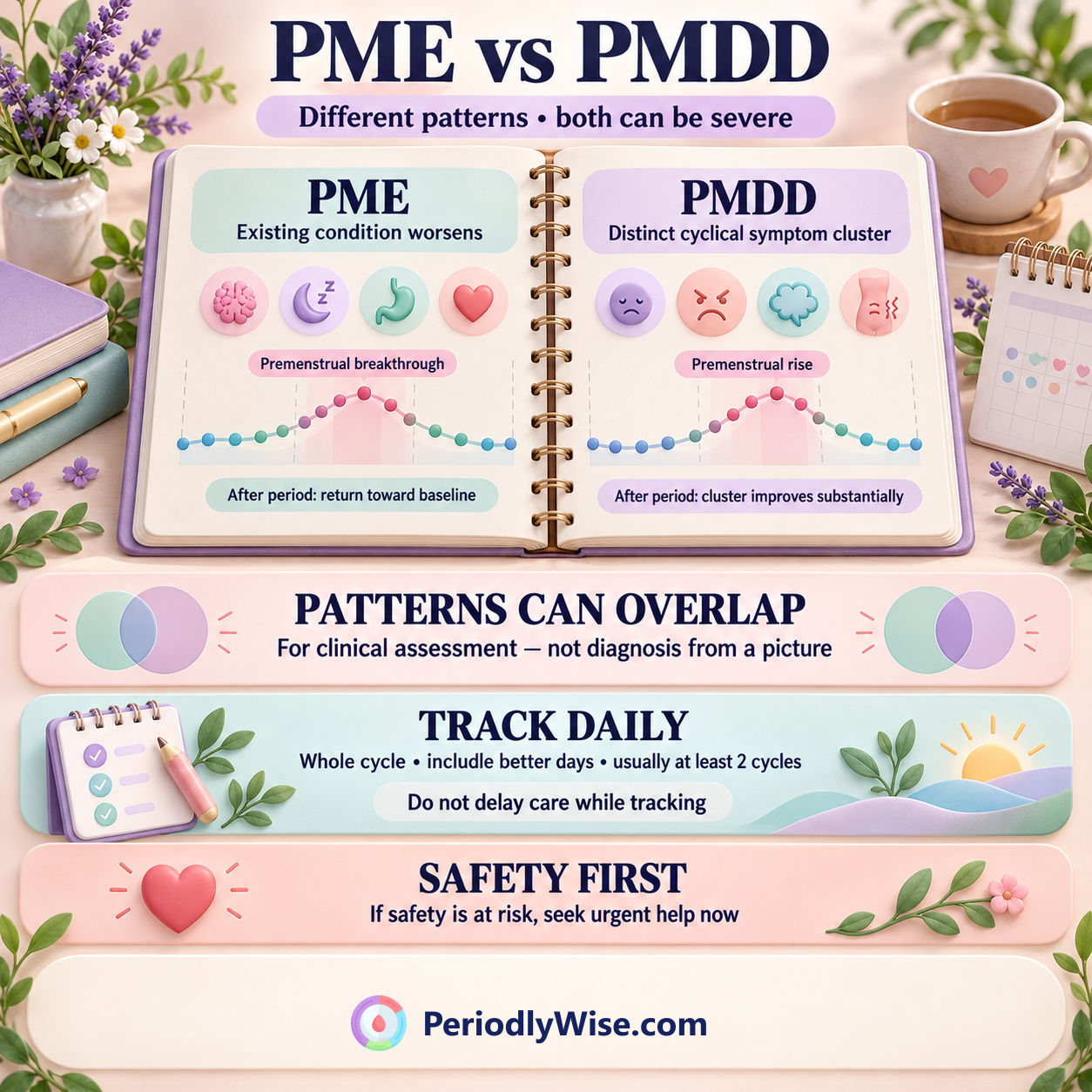
PME is a description of cycle-related worsening of an underlying condition, which may be psychiatric or physical. Depression and anxiety are common examples in mental-health discussions. The International Association for Premenstrual Disorders explains PME as worsening of pre-existing symptoms, rather than a new diagnosis established by a period app.
PMDD is a defined disorder with requirements for symptom type, timing, severity and impact. It is more than ordinary premenstrual discomfort. The question is not simply whether you feel worse before bleeding, but whether the pattern meets the criteria and is not merely the worsening of another disorder.
PME vs PMDD at a glance
The comparison below is a starting point for a conversation, not a sorting test. The same symptom word, such as anxiety, may describe an ongoing condition, a PMDD symptom, or both kinds of difficulty in different contexts.
The ISPMD consensus distinguishes core premenstrual disorders from premenstrual worsening of an underlying disorder. Its emphasis on timing and impairment helps explain why a complete-cycle record is more useful than a list of difficult premenstrual days alone.
| Question | PME | PMDD |
|---|---|---|
| QuestionWhat changes? | PMESymptoms of an existing condition worsen premenstrually. | PMDDA characteristic cluster of mood and other symptoms recurs premenstrually. |
| QuestionWhat happens afterward? | PMEThe condition may remain at baseline or become well controlled. | PMDDThe PMDD cluster improves after menstruation starts and is minimal or absent in the postmenstrual week. |
| QuestionCan it be severe? | PMEYes; worsening can substantially impair functioning. | PMDDYes; clinically significant distress or impairment is part of assessment. |
| QuestionHow is it assessed? | PMEHistory plus daily ratings of the underlying condition and cyclical change. | PMDDHistory, clinical criteria and prospective daily symptom ratings. |
| QuestionWhat guides care? | PMETreating the underlying condition and the pattern of worsening. | PMDDPMDD-focused options, with care for any other conditions too. |
These are descriptions, not rigid rules that all symptoms must be present every day in PME or that every difficulty must disappear in PMDD. Treatment, other diagnoses and changing life circumstances can complicate the picture.
What clinicians look for in PMDD
PMDD symptoms typically become prominent in the final week before menstruation, improve within a few days after bleeding begins, and are minimal or absent in the following week. The pattern is recurrent, usually in most cycles over the preceding year, and causes significant distress or interference with daily life.
The Office on Women's Health describes the requirement for at least five symptoms, including a mood-related symptom. Core mood symptoms include marked mood shifts, irritability or anger, depressed mood or hopelessness, and anxiety or tension. Other symptoms can involve interest, concentration, energy, appetite, sleep, feeling overwhelmed and physical discomfort.
Counting five familiar symptoms is not enough. A clinician also considers timing, impairment, medicines, other conditions and whether this is merely an exacerbation of an existing disorder. Daily ratings usually confirm the pattern over at least two symptomatic cycles; an initial clinical assessment and support can begin sooner.
PME can include symptoms that are controlled at other times
An existing condition does not have to feel equally intense every day. Someone may have depression or anxiety throughout the cycle with a noticeable premenstrual increase. Someone else may respond well to treatment for much of the month, then experience a premenstrual return of the same symptoms.
Kuehner and Nayman's review describes this latter pattern as premenstrual breakthrough and highlights gaps in PME research. That is why a good week does not, by itself, distinguish PME from PMDD. History and the identity of the symptoms matter alongside their severity on a particular day.
Track the symptoms of your existing condition as well as premenstrual concerns. For example, note your usual panic symptoms or depressive loss of interest separately from a newly observed cyclical irritability. These descriptions help a clinician assess a pattern; they do not establish a diagnosis on their own.
Can PMDD coexist with another condition?
Yes, another diagnosis does not automatically exclude PMDD. The important requirement is that the suspected PMDD disturbance is not simply the same condition becoming worse. Assessment may identify an ongoing condition, a separate cyclical cluster, or a more complicated mixture requiring specialist review.
Not every symptom in your life has to vanish after your period. A person with ADHD may continue to have attention difficulties while a separate premenstrual mood cluster improves substantially. Conversely, persistent depression that worsens before menstruation should not automatically be relabelled PMDD because the difficult days occur on schedule.
The MGH Center for Women's Mental Health explains why distinguishing PME from PMDD matters clinically. Bring existing diagnoses and previous treatment responses to the appointment. You do not need to decide which label is correct before asking for help.
What to track every day, including better days
Prospective tracking means recording how you feel that day rather than reconstructing a month from memory. The RCOG recommends symptom diaries over two consecutive cycles. A clinician may suggest a validated tool such as the Daily Record of Severity of Problems, or DRSP, plus ratings relevant to an underlying condition.
Use the same scale consistently and keep entries brief. A personal zero-to-three scale can support a conversation if its meanings stay fixed, but it is not a replacement for a validated assessment or a self-diagnostic cutoff. Record low-symptom days too; missing them can hide the contrast a clinician needs to see.
| Daily entry | Useful detail | Why it helps |
|---|---|---|
| Daily entryMood and anxiety | Useful detailRate low mood, irritability, anxiety and mood shifts separately. | Why it helpsShows which symptoms rise and which improve. |
| Daily entryUnderlying-condition symptoms | Useful detailRecord the familiar symptoms of any existing diagnosis. | Why it helpsHelps distinguish exacerbation from a separate cluster. |
| Daily entrySleep and energy | Useful detailNote sleep length, sleep quality and unusual energy changes. | Why it helpsAdds context and flags changes that deserve assessment. |
| Daily entryBleeding and actual dates | Useful detailMark actual period starts and spotting separately. | Why it helpsAvoids assuming a predicted date or a 28-day cycle. |
| Daily entryMedicines and context | Useful detailNote actual doses taken, missed doses, contraception changes and major stressors. | Why it helpsHelps interpret timing without assuming hormones explain everything. |
| Daily entryFunction and safety | Useful detailRecord missed tasks, relationship strain and any safety concerns. | Why it helpsShows clinical impact and when help is needed now. |
This is an illustrative recording framework, not a scoring system that diagnoses PMDD or PME. Keep sensitive notes somewhere you are comfortable storing them and share only what is useful for care.
A manageable plan for the next two cycles
Choose a regular moment for a short entry, such as after brushing your teeth. If you miss a day, mark it missing rather than filling it with a guessed score. A partial honest record is more informative than a complete-looking diary reconstructed later.
Track across the whole cycle, not just when symptoms are intense. Note when symptoms begin to increase and when each one improves after menstruation. If cycles are irregular, continue recording actual dates and let the clinician choose an appropriate observation period.
Do not postpone an appointment to finish the diary. Book care when symptoms interfere with life; you can begin recording while waiting. Severe symptoms, rapidly worsening illness or safety concerns need assessment before two cycles have passed.
- Choose a daily diary or clinician-recommended form that you can sustain.
- Record symptoms separately, actual bleeding and daily-life impact.
- Keep prescribed treatment stable unless the prescriber changes it; record changes accurately.
- Include better days and bring available records from at least two cycles when feasible.
- Review the pattern with a clinician and agree how to monitor any treatment.
Can a blood test, hormone panel or app tell the difference?
There is no single routine blood test or app result that distinguishes PME from PMDD. Sensitivity to normal cycle-related hormonal changes is different from proving an abnormal hormone level. A normal blood result does not mean the symptoms are imaginary, and a symptom diary does not identify a hormone deficiency.
Tests may still be useful for other clinical questions, such as thyroid disease, anemia or pregnancy when relevant. Assessment can also consider sleep problems, medication effects, substance use, depression, anxiety and changes around perimenopause. The point is to investigate the presentation, not order the same panel for everyone.
The NIMH describes depression as a condition affecting mood, thinking and daily functioning that deserves clinical assessment. Symptoms outside the premenstrual window need attention in their own right. A calendar explanation should not make persistent or new illness disappear from the care plan.
Why treatment may differ
PMDD care can involve psychological approaches such as CBT, selected antidepressants and, for suitable patients, hormonal options. A prescriber may use an SSRI continuously or on a planned intermittent schedule for PMDD. That is a clinician-selected regimen, not permission to take tablets only on days an app marks as difficult.
With PME, managing the underlying condition is central. The clinician may review how well ongoing treatment works and whether extra support or an individually planned adjustment is appropriate. Research specifically on PME treatment is more limited, and an option effective for PMDD cannot simply be assumed to work for every underlying condition.
Do not start, stop, double or intermittently take prescribed medicine on your own. Tell the prescriber about pregnancy plans, contraception, other medicines, supplements and adverse effects. Review benefits and harms together, using the same diary rather than expecting an instant answer from one difficult week.
- Ask which symptoms the proposed treatment is intended to improve.
- Clarify whether the plan targets PMDD, the underlying condition, or both.
- Agree when to review the response and what side effects to report sooner.
- Discuss sleep, practical support and therapy as part of care, without treating lifestyle changes as a guaranteed cure.
- Ask for a written plan if any medication timing is supposed to change across the cycle.
Bipolar symptoms need particular medication care
Mood shifts do not automatically mean bipolar disorder, and bipolar disorder should not automatically be relabelled PMDD. A clinician needs the broader history, including episodes of unusually elevated or irritable mood, increased activity, reduced need for sleep and risky behavior, not simply a count of bad days.
The NIMH warns that antidepressants used alone can trigger mania or rapid cycling in people with bipolar disorder. If you have that diagnosis or symptoms that raise the question, tell the prescriber before discussing an SSRI plan. Do not discontinue an existing mood stabilizer because symptoms appear menstrual.
New severe sleep reduction with escalating energy, agitation, impulsivity, confusion or symptoms of psychosis needs prompt assessment. A cycle connection does not make such a change safe to watch at home. Bring the full medication and contraception list, since interactions can affect treatment and contraceptive reliability.
Irregular periods, contraception and changing life stages
Not everyone has a 28-day cycle, and the premenstrual interval cannot be located reliably by assuming ovulation on day 14. Mark actual bleeding and symptom dates. A tracker can organize those observations, but predicted fertile or period windows do not confirm the hormonal phase or diagnose a mood disorder.
Hormonal contraception can alter ovulation, bleeding and mood patterns; a withdrawal bleed is not proof of a natural ovulatory cycle. Tell the clinician about the exact method, active and break days, start or stop dates and any recent changes. Do not stop contraception solely to test yourself for PMDD without discussing alternatives and pregnancy prevention.
Perimenopause, postpartum changes, breastfeeding and absence of regular bleeding can complicate interpretation. New or persistent mood symptoms still deserve care even when there is no clear monthly pattern. Assessment should fit the person's circumstances rather than force every record onto a textbook cycle.
Prepare for care, and know when not to wait
Start with primary care, a mental-health clinician or a gynecology service familiar with premenstrual disorders. Explain the main problem in concrete terms: what worsens, what remains afterward, how daily life is affected and what has or has not helped. Shared care can be useful when an established mental-health condition is involved.
You can ask: 'Could this be PME, PMDD, another condition or more than one pattern? Which symptoms should I record separately? What support can start now?' If your concerns are dismissed, seeking another qualified opinion is reasonable. A label is useful when it leads to a safer, more appropriate care plan.
Safety takes priority over diagnostic certainty. Thoughts of self-harm, feeling unable to stay safe, rapidly escalating mood symptoms or inability to manage basic needs require prompt help. Do not assume a dangerous episode will resolve just because bleeding is expected soon.
Frequently asked questions
Is PME just another name for PMDD?
No. PME describes worsening of an underlying condition before menstruation. PMDD requires a distinct pattern meeting clinical criteria. They can feel similar, so history and daily ratings matter.
Can PME be as severe as PMDD?
Yes. Either pattern can cause major impairment and safety concerns. PME is not a label for symptoms that matter less, and both deserve appropriate care.
Do better days after my period prove PMDD?
No. Treatment-responsive conditions can also have premenstrual breakthrough. Clinicians consider which symptoms return, the underlying history and records across the whole cycle.
Can I have PMDD with depression, anxiety or ADHD?
Possibly. Another condition does not automatically exclude PMDD, but the suspected PMDD cluster must not merely be worsening of that condition. Separate symptom ratings help assessment.
How long should I track symptoms?
At least two symptomatic cycles of daily ratings are usually used to confirm the pattern. Begin care sooner if symptoms are disruptive, severe or unsafe; do not treat tracking as a waiting period.
Does a normal hormone test rule out PMDD?
No. There is no routine hormone result that diagnoses or excludes it on its own. A clinician may test for other explanations while reviewing timing, symptoms and impact.
Should I take antidepressants only before my period?
Only if your prescriber has given you that specific plan. Intermittent regimens used for some PMDD patients are not automatically suitable for PME or bipolar disorder. Do not change treatment yourself.
Can PeriodlyWise tell me whether I have PME or PMDD?
No. It can help organize period dates alongside a separate symptom diary. It cannot diagnose a mental-health condition, confirm ovulation, select a medicine or provide emergency monitoring.
Record actual period dates with PeriodlyWise and keep a brief daily symptom diary for your appointment. Treat estimates as planning information, not a diagnosis or medication schedule.
Open the period trackerWhat to take to your appointment
The useful distinction is whether symptoms represent worsening of an existing condition, a separate premenstrual cluster or a combination requiring more careful assessment. Bring whole-cycle observations, treatment history and concrete examples of impact.
Both PME and PMDD deserve to be taken seriously. Tracking can make the conversation clearer, but support, safe treatment and urgent help when needed should not depend on having a perfect chart.