ADHD symptoms may feel different across the menstrual cycle, but there is no single pattern that applies to everyone. Some people notice more distraction, difficulty starting tasks, forgetfulness or emotional overwhelm before a period; others notice the hardest days during bleeding or do not see a consistent cycle link. Your experience is worth discussing without turning a calendar prediction into a diagnosis.
The useful questions are practical: what changes, when does it change, what else is happening, and how much does it affect daily life? Hormonal fluctuations may contribute, while pain, poor sleep, stress, mood symptoms and medication routines can also matter. A repeated pattern can inform care, but does not by itself prove low estrogen, treatment failure or PMDD.
This guide separates emerging research from established advice, explains ADHD, PMDD and premenstrual exacerbation, and offers a manageable diary and appointment plan. It applies to people with ADHD who menstruate, including women, trans men and nonbinary people. Research has often studied limited female samples, so its findings should not be assumed to describe every person or hormonal situation.
Can the menstrual cycle affect ADHD symptoms?
It may. Estrogen and progesterone change across an ovulatory cycle and can influence brain systems involved in attention and mood. This provides a plausible explanation for some reported symptom changes, not a measurement of what your brain is doing on a particular day. A symptom diary cannot tell you your estrogen or dopamine level. The biology is more complex than estrogen being good and progesterone being bad.
Bleeding begins when ovarian hormone levels are low; estrogen generally rises during the follicular phase, while progesterone rises after ovulation and both hormones fall before the next period if pregnancy does not occur. That broad sequence is not a fixed 28-day schedule. Ovulation timing, contraception and irregular cycles change how useful those labels are for an individual.
A difficult premenstrual week is one possible experience, not a rule. You may need extra support during bleeding, another interval or throughout the month. Pain and disrupted sleep can make concentration harder without proving a hormone-specific ADHD mechanism. Treat the cycle as useful context and your actual functioning as the main information.
What the research shows, and where the evidence stops
A 2025 systematic review included 11 studies and found suggestive links between sex hormones and ADHD symptoms, with small samples and varied methods. A 2026 scoping review mapped 20 studies covering cycle timing, menstrual difficulties and early treatment approaches. Together they show a developing field, not a settled personalized treatment formula.
The 2026 daily-rating pilot followed 30 participants treated with amphetamine salts across 35 daily surveys. ADHD symptoms were highest during menstruation and milder in the mid-follicular phase, with a relationship to negative mood. That matters because it challenges the idea that symptoms must peak only before bleeding. It does not show that every stimulant or every person follows that pattern.
Observational findings do not prove a cause or identify the best dose. Small uncontrolled treatment reports can generate hypotheses, but cannot establish long-term safety, a standard regimen or benefit for all patients. Claims that most people must change medication on specific cycle days go beyond what these studies establish.
| Evidence | Useful finding | Limit |
|---|---|---|
| Evidence2025 systematic review: 11 studies | Useful findingHormonal context may relate to ADHD symptom changes. | LimitSmall, diverse studies; no universal symptom timetable. |
| Evidence2026 pilot: 30 stimulant-treated participants | Useful findingDaily ratings were worse during menstruation in this sample. | LimitOne small medication-specific sample; not proof of causation. |
| Evidence2023 clinician-led case series: nine patients | Useful findingReported improvement after individualized premenstrual stimulant adjustment. | LimitNo control group; not a self-dosing recommendation or established standard. |
What changes are worth noticing?
Look for differences from your own baseline, not a list you are supposed to match. The same workload may feel harder because starting, sequencing or returning to a task takes more effort. Emotional overwhelm may also increase. These observations are useful even if you cannot identify a precise hormone phase.
Describe the impact, not only a symptom score. Missing an appointment, struggling to eat regularly or needing much longer to finish ordinary work communicates something different from feeling a little distracted. Record improvements too. A better day does not mean ADHD has disappeared, and a difficult day is not evidence that you are lazy or failing.
- Attention and memory: losing the thread of a conversation, forgetting steps or needing more reminders than usual.
- Task initiation and organization: difficulty beginning a familiar task, prioritizing or moving between activities.
- Emotional load: more irritability, anxiety, frustration or overwhelm; these can also reflect a separate mood condition.
- Body and routine context: cramps, sleep disruption, fatigue, appetite changes, missed doses or unusually demanding days.
ADHD, PMS, PMDD and premenstrual exacerbation are not interchangeable
ADHD is a neurodevelopmental condition with a history of symptoms beginning in childhood and affecting more than one setting. According to NIMH, sleep disorders, anxiety, depression and other conditions can resemble it. Brain fog only around a period does not establish ADHD; a proper assessment considers the wider history.
Premenstrual exacerbation, or PME, means an existing condition becomes worse before menstruation rather than appearing only then. PMDD involves a marked cyclical mood-symptom pattern with major impairment, with substantial improvement after menstruation and a relatively symptom-free interval for that premenstrual symptom cluster. Someone can have ADHD and PMDD together; their baseline ADHD does not have to vanish after the period.
A clinician distinguishes these patterns through history and prospective daily ratings, usually across at least two cycles, rather than a retrospective impression or one online quiz. Record mood separately from attention so a severe mood disorder is not dismissed as ADHD. You do not need to complete two cycles before asking for help, especially if symptoms are severe or safety is affected.
| Pattern | What may help distinguish it | What not to assume |
|---|---|---|
| PatternADHD | What may help distinguish itLongstanding symptoms and impairment across settings, with possible fluctuations. | What not to assumeA difficult period week alone proves ADHD. |
| PatternPMS | What may help distinguish itRecurring premenstrual physical or emotional symptoms affecting daily life. | What not to assumeEvery premenstrual symptom is PMDD. |
| PatternPME | What may help distinguish itA baseline condition remains present and intensifies before menstruation. | What not to assumeSymptoms disappear completely outside that interval. |
| PatternPMDD | What may help distinguish itA severe cyclical mood pattern, functional impairment and clear post-period improvement. | What not to assumeAn app or an ADHD diagnosis confirms it without assessment. |
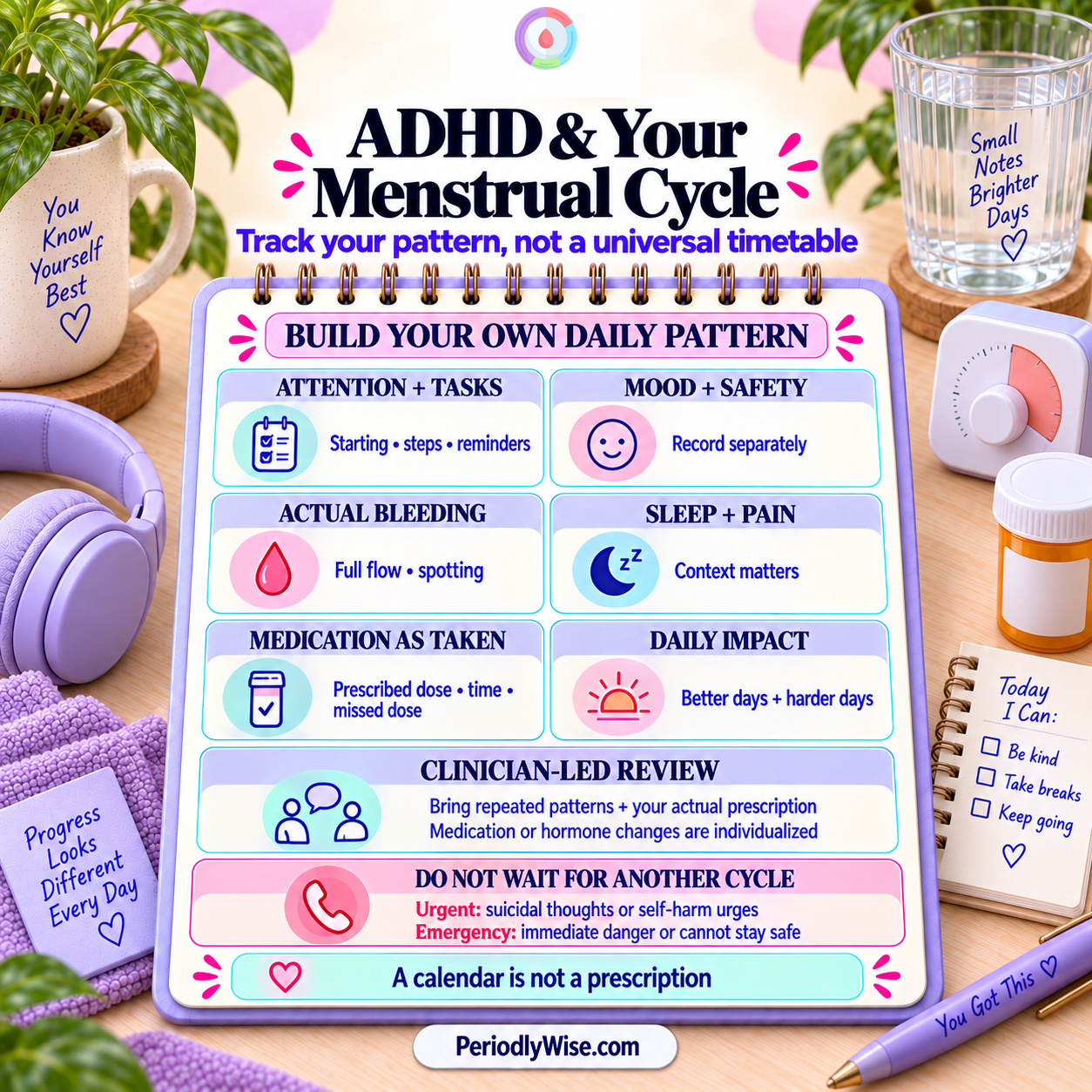
Build a small daily diary that you can actually keep
The best record is one you can sustain. Use one short note at roughly the same time each day, rather than a complicated dashboard. RCOG recommends a diary over two consecutive cycles when assessing premenstrual symptoms. A clinician may suggest a validated mood-rating form, such as the Daily Record of Severity of Problems, if PMDD is suspected.
Include ordinary days, not just crises, so the comparison is meaningful. If you miss entries, leave them missing instead of inventing scores afterward. A brief, imperfect record is more useful than a detailed record you cannot maintain. If recording worsens anxiety or becomes a burden, simplify it and ask your clinician what information is most important.
| Record | Simple example | Why it helps |
|---|---|---|
| RecordDate and bleeding | Simple exampleOctober 5; no bleeding, or first full-flow day. | Why it helpsAnchors symptoms to actual events. |
| RecordAttention and tasks | Simple exampleTask initiation: moderate; forgot two steps. | Why it helpsSeparates ADHD difficulties from general mood. |
| RecordMood and safety | Simple exampleIrritability: mild; felt safe today. | Why it helpsMakes important mood changes visible. |
| RecordSleep, pain and stress | Simple examplePoor sleep; cramps; unusually busy shift. | Why it helpsProvides competing explanations and support needs. |
| RecordMedication as taken | Simple exampleUsual prescribed dose at usual time; or missed dose noted. | Why it helpsHelps the prescriber interpret perceived benefit. |
| RecordDaily impact | Simple exampleNeeded a written checklist to finish an ordinary task. | Why it helpsShows functioning rather than only a number. |
- Start with the date and actual bleeding. Mark the first day of your usual full menstrual flow, and label spotting separately. Do not treat a predicted period or ovulation date as an observed event.
- Choose two ADHD difficulties. For example, starting tasks and keeping track of steps. Use the same simple scale each day, such as none, mild, moderate or severe.
- Record mood separately. Note sadness, anxiety, irritability or overwhelm, plus whether you felt safe. Do not hide a serious mood change inside a single focus score.
- Add a few context notes. Sleep, pain, illness, stress and actual medication timing or missed doses can explain part of the picture.
- Write one real-life example. Record a task completed, a missed appointment or support needed, including examples on easier days.
- Review with a professional. Bring repeated patterns to the prescriber or clinician. Use the diary to guide questions, not to choose a new dose or diagnose yourself.
Practical support without rigid cycle-syncing rules
Plan around observed needs, not a rule that one phase must be productive and another must be restful. You may be unable to move work, care or study commitments. Small environmental changes can still reduce friction: fewer competing prompts, a written next step or support from someone you trust. These are support options, not a cure or a test of willpower.
Protect sleep and regular meals as much as your circumstances allow, and seek advice for pain that interferes with life. If a stimulant affects appetite or sleep, discuss that with the prescriber rather than compensating with extra caffeine or changing the dose. Persistent fatigue or heavy bleeding also deserves assessment rather than being automatically assigned to ADHD.
- Make the first step visible: write one concrete action rather than an entire demanding task list.
- Externalize reminders: use a single calendar, a checklist or an alarm for an existing prescribed routine.
- Reduce avoidable decisions: prepare familiar meals or needed period products when it is convenient.
- Allow a buffer if possible: avoid stacking optional deadlines on repeatedly difficult days, without assuming the same dates every month.
- Ask for specific support: a written instruction, quieter workspace, check-in or flexible deadline may help more than a general request to focus.
- Keep strengths in view: notice what helped and what went well instead of using the diary only to document mistakes.
If ADHD medication seems less helpful around your period
Take the observation seriously, but keep the description precise: less helpful for which task, at what time and under what conditions? A perceived change in effect does not prove that the medicine stopped working or that hormones changed its metabolism. Sleep, pain, mood, missed doses, appetite and demands may change the experience of the same prescription.
NICE ADHD guidance emphasizes individualized treatment, review of benefit and adverse effects, and monitoring relevant physical and sleep changes. Bring the diary and your actual prescription details to that conversation. The prescriber can consider whether the plan is optimized, whether another condition needs treatment and whether any change is appropriate for you.
The nine-patient case series explored clinician-led premenstrual stimulant adjustments with monitoring. It was not a randomized trial and does not supply a standard dose increase. Do not apply a percentage from a paper, add an extra tablet, borrow medication or stop abruptly based on a predicted phase. Pregnancy plans, other medicines and side effects also belong in the discussion.
Contraception, irregular cycles and changing hormonal stages
Hormonal contraception can alter bleeding and ovarian activity, so a withdrawal bleed or absent bleeding is not a reliable map of a natural ovulatory cycle. Do not force your observations into follicular and luteal labels when they may not fit. Note the product, start or stop dates and schedule, including any medication-free interval, and discuss changes with the prescribing clinician.
Some hormonal options may be considered for a diagnosed premenstrual disorder, but that is not proof that birth control treats ADHD or will improve every person's mood. Suitability depends on your medical history, preferences, contraindications and response. Do not start, stop or switch hormones as a self-directed estrogen boost, and do not assume supplements can recreate a safe treatment plan.
With irregular cycles, track actual dates and symptoms without pretending you know ovulation. Puberty, postpartum changes and perimenopause can add complexity; new or substantial changes deserve review. Evidence from a small naturally cycling adult sample may not apply to these situations or to people using gender-affirming hormones. Tell the clinician about your hormonal context rather than guessing the cause.
What to bring and ask at an appointment
Book a review if a repeated pattern disrupts work, study, relationships, eating, sleep or ordinary care tasks, or if your current treatment is not meeting your needs. You can seek help before collecting a perfect diary. If ADHD has not been assessed, describe the childhood and cross-setting history as well as the cycle-related change; do not let a premenstrual pattern stand in for that assessment.
Bring your medication list, contraception or hormone details, recent changes and a few dated examples. Ask whether pain, sleep problems, a mood disorder or another medical condition could contribute. Tests should address a clinical question, not an assumption that a random hormone panel can diagnose a cycle-related ADHD problem. Agree on what will be monitored and when the plan will be reviewed.
- Pattern: Do these notes suggest premenstrual worsening, symptoms during bleeding or a non-cyclical problem?
- Diagnosis: Could PMDD, PME, depression, anxiety or sleep disruption coexist with my ADHD?
- Treatment: Is my current plan appropriate, and how would we assess the benefit and risks of any change?
- Support: What practical accommodations, follow-up and safety plan would help on the hardest days?
When not to wait for another cycle
Suicidal thoughts, self-harm urges or a rapidly worsening mental state need urgent professional help. If you have acted on them, taken an overdose, are in immediate danger or cannot keep yourself safe, contact local emergency services or go to emergency care now. Do not wait for bleeding to begin, a diary to be complete or a routine ADHD appointment. If possible, ask someone you trust to stay with you while help is arranged.
A crisis is not less serious because it seems hormonal or has happened before. The NHS urgent-help guidance treats inability to remain safe as an emergency. Use the services appropriate to your country; an online article or a period tracker cannot assess immediate risk.
You also deserve prompt review for marked deterioration, severe sleep disruption, new symptoms, troublesome medication effects or significant menstrual pain and bleeding. Do not increase a stimulant to cover symptoms you have not discussed. Getting support earlier is appropriate even when the exact diagnosis or cycle relationship is still uncertain.
Frequently asked questions
Is ADHD always worse before a period?
No. Some people notice premenstrual worsening, others find bleeding days harder, and some see no consistent pattern. A 2026 pilot found worse ratings during menstruation in one small stimulant-treated sample. Track your own experience rather than assuming a universal timetable.
Does low estrogen cause ADHD?
ADHD is a neurodevelopmental condition, not a diagnosis made from a low estrogen result. Hormonal changes may influence symptom expression, but a difficult day cannot reveal hormone or dopamine levels. Assessment considers longstanding symptoms, daily impairment and other possible explanations.
Can ADHD and PMDD happen together?
Yes, they can coexist, but ADHD or severe premenstrual irritability alone does not confirm PMDD. Track mood and attention separately and discuss the timing, improvement after menstruation and impact with a clinician. Baseline ADHD symptoms can remain when the PMDD mood cluster improves.
Should I take more ADHD medication before my period?
Not without an individualized prescriber plan. Small case reports explored monitored changes, but do not establish a standard regimen. Do not copy a percentage increase, add tablets or change timing yourself. Bring actual dose, adherence, sleep, mood and symptom records to a review.
Will hormonal birth control fix the problem?
There is no guarantee. Some hormonal treatments may help a diagnosed premenstrual disorder, but evidence does not establish contraception as a general ADHD treatment. Medical suitability and mood response vary. Discuss options and risks rather than starting or stopping hormones on your own.
How long should I track symptoms?
Daily notes across at least two consecutive cycles are commonly used for premenstrual assessment, with a validated form if recommended. Include easier days and leave missing entries blank. Do not delay care for serious impairment, suicidal thoughts or inability to stay safe while collecting data.
What if my periods are irregular or I do not bleed on contraception?
Record actual dates, symptoms, medication and hormone schedules without assigning a phase you cannot confirm. Bleeding or its absence does not always reflect ovarian activity. A clinician can interpret the diary in your context; predicted ovulation is not proof.
Can period brain fog mean I have ADHD?
Brain fog is not specific to ADHD. Sleep, pain, anxiety, depression and other conditions can affect focus. If symptoms are longstanding or interfere across settings, ask for a proper assessment; if they are new, seek review rather than assuming the menstrual cycle explains them.
PeriodlyWise can help you record actual period dates. Keep a brief separate record of ADHD difficulties, mood, sleep, pain, actual medication use and daily impact for your appointment. A period estimate cannot diagnose ADHD or PMDD, confirm ovulation or decide medication doses.
Open the period trackerThe takeaway
Cycle-related ADHD changes are worth taking seriously without assuming everyone follows the same pattern. Use a small prospective diary, practical supports and a clinician-led treatment conversation. Keep mood symptoms visible, avoid self-adjusting medicines or hormones, and seek urgent help when safety is affected rather than waiting for the next cycle.