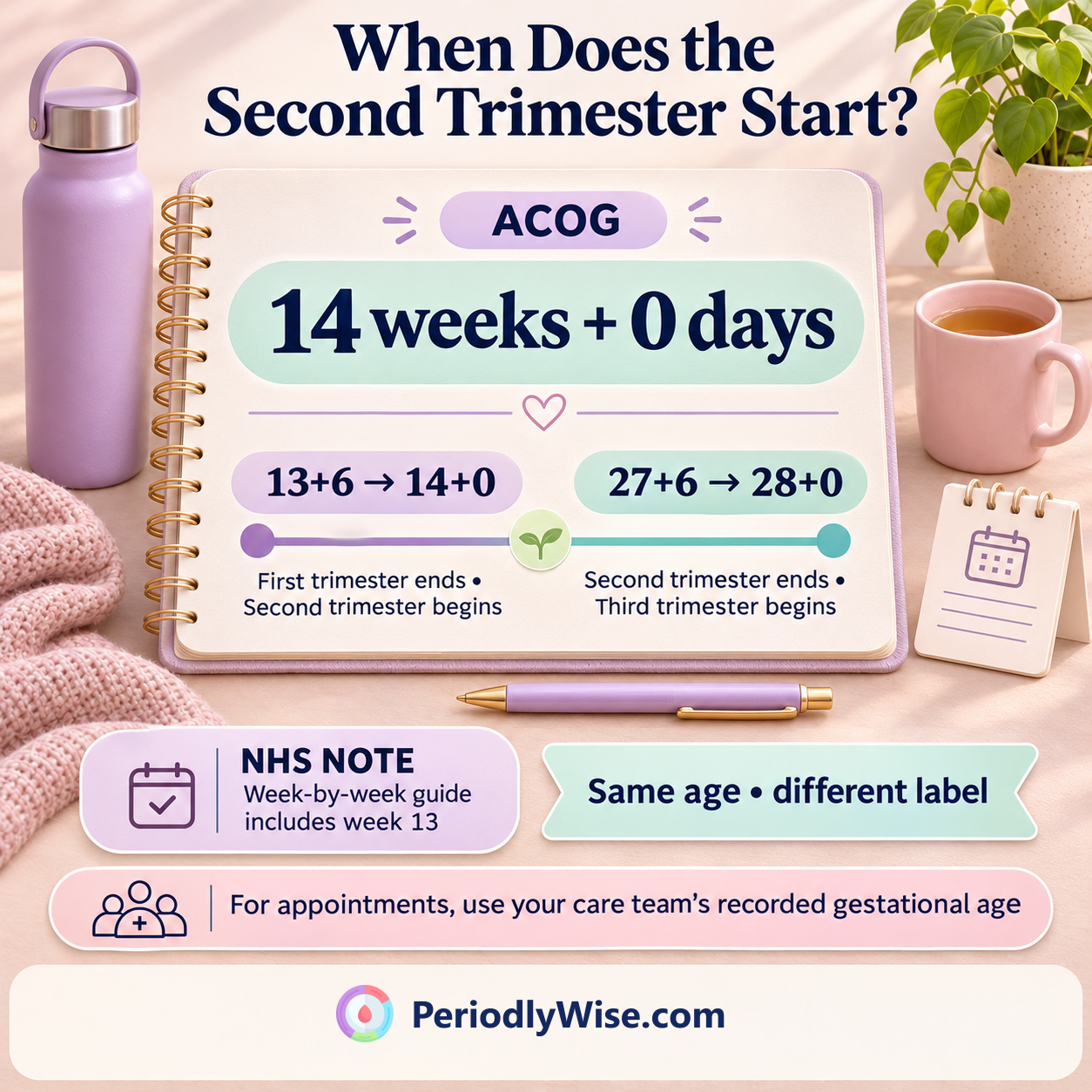
The second trimester starts at 14 weeks and 0 days (14+0) under the ACOG definition. It lasts through 27 weeks and 6 days (27+6), and the third trimester begins at 28+0. If your app says you’ve reached the second trimester at 13 weeks, it may be using a different convention. The NHS week-by-week guide, for example, puts week 13 in the second trimester. PeriodlyWise uses the 14+0 boundary.
Is the second trimester week 13 or week 14?
These guides group the weeks differently. ACOG defines a boundary in completed weeks and days. The NHS guide groups weeks 13 through 27 together for its second-trimester reading. A 13+4 entry in your chart still means 13 completed weeks and 4 days, whichever label you see on a website. There’s also a wording trap: at 13+0, you have finished 13 weeks and are beginning your 14th week. You reach 14 weeks pregnant seven days later.
| Gestational age | ACOG trimester |
|---|---|
| Gestational age13+6 | ACOG trimesterLast day of the first trimester |
| Gestational age14+0 | ACOG trimesterFirst day of the second trimester |
| Gestational age27+6 | ACOG trimesterLast day of the second trimester |
| Gestational age28+0 | ACOG trimesterFirst day of the third trimester |
A switch in the label doesn’t change your due date or create a deadline for symptoms to change. If an appointment or test has a time window, ask for the window in weeks and days.
How to find your second-trimester start date
- Start with the date in your maternity record. Ask your midwife or obstetric team which estimated due date they’re using if your app and scan report give different dates. A scan report can list several dates. Use the one your team has adopted.
- Check your age on a known date. If your team tells you you’re 13+4 today, you’re three days away from 14+0. The plus sign separates weeks and days. The day number goes from 0 to 6 before the next week starts.
- Use the calculator for a calendar estimate. Select the option for a known due date if your team has given you one. If all you know is the first day of your last period, a period-based estimate can help you orient yourself. A dating scan may be more useful when periods are irregular or the date is uncertain. After IVF, use the dating your fertility clinic gave you. The calculator treats a due date as 40+0. If your care team uses a different reference for that date, count from your recorded age in weeks and days instead.
Worked example: Suppose your care team dates your pregnancy as 13+4 on Friday, April 10. Saturday, April 11 is 13+5, Sunday, April 12 is 13+6, and Monday, April 13 is 14+0. If your due date is already recorded as 40+0 on the same timeline, counting back 26 weeks reaches 14+0. Use the due date from your own record for that calculation.
What you might notice around the change
You may feel better as the early weeks pass, but nausea and tiredness can continue into the second trimester. You don’t have to feel different on the day you reach 14+0. If nausea is interfering with eating, drinking or daily life, tell your care team. Seek care right away if you can’t keep fluids down or feel faint.
- The anatomy scan usually comes later. ACOG places the standard ultrasound around 18 to 22 weeks. The local schedule and your own care plan determine when it’s offered.
- Feeling movement takes time. The NHS gives a typical range of 16 to 24 weeks for first feeling movement. If you haven’t felt any by 24 weeks, tell your midwife or maternity team. If movements you normally feel slow down, stop or change, call your maternity team immediately.
- Symptoms can need attention at any week. Call your care team promptly for spotting. Seek urgent medical care for heavier bleeding, fluid leaking from the vagina, severe ongoing belly pain or fainting. Use your local emergency service for severe symptoms or if you can’t get urgent help.
Frequently asked questions
Is 13 weeks and 6 days the second trimester?
Under ACOG’s definition, 13+6 is the final day of the first trimester. You reach the second trimester the next day, at 14+0. A week-by-week guide that groups week 13 differently can use a different heading for the same day.
What month does the second trimester start?
People often describe it as the start of month four. Calendar months have different lengths, so weeks and days are more precise. Use the date in your maternity record when scheduling care.
Does the second trimester include week 28?
ACOG puts 28+0 at the beginning of the third trimester. Its second trimester ends the day before, at 27+6.
Will my nausea stop when the second trimester starts?
It may ease, but there’s no exact day for it to stop. Tell your care team if it’s hard to eat, drink or get through your day. Get urgent help if you can’t keep liquids down.
My app and ultrasound disagree. Which date should I use?
Use the estimated due date your care team has established. If you’re unsure which date was chosen, ask the team to check your record. A later scan can show a different size-based estimate without replacing the established due date.
Look up your pregnancy age in weeks and days and explore the timeline.
Use the Pregnancy Calculator