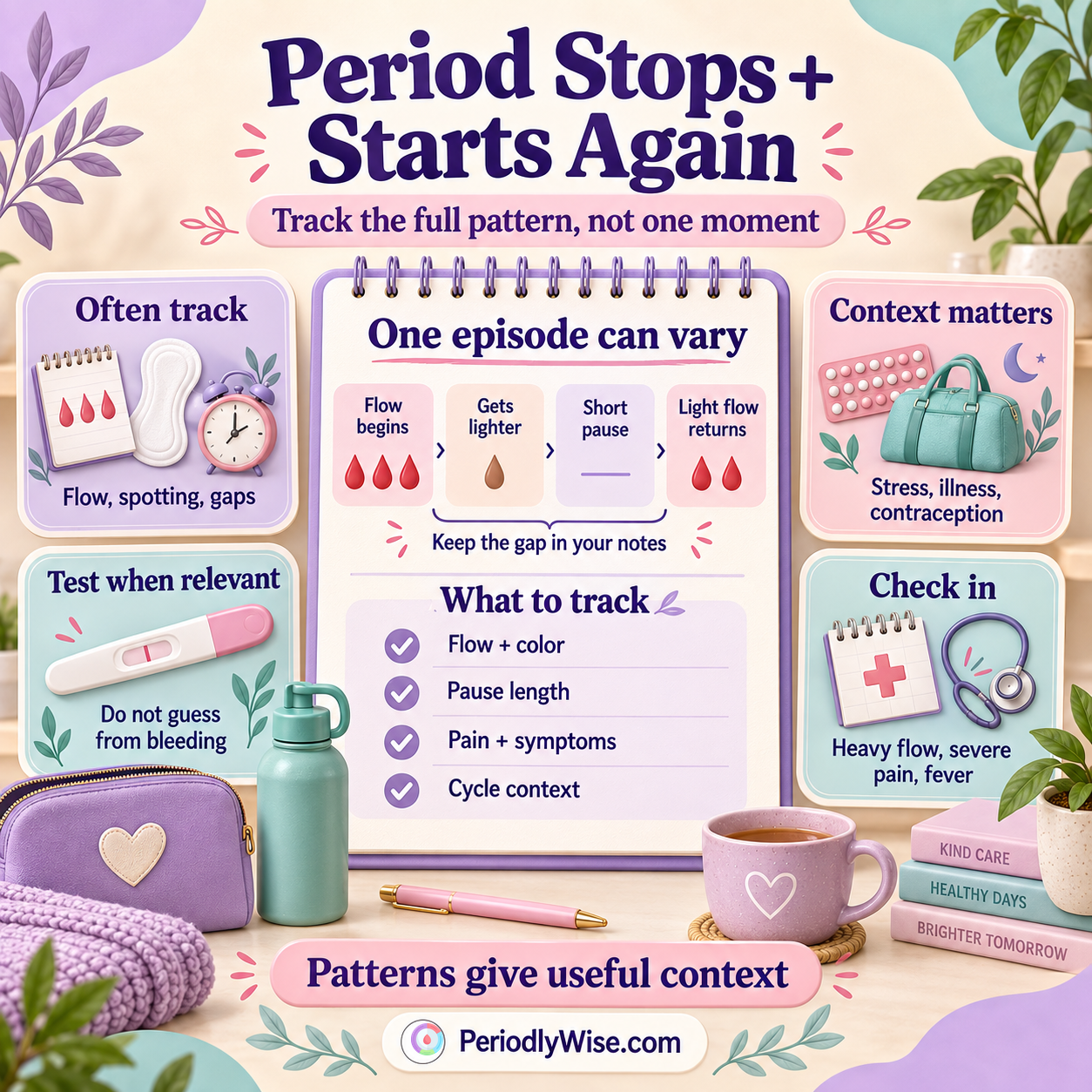
A period does not always run at one steady rate. It may be moderate for two days, fade to brown spotting, seem absent for part of a day, and return lightly. A short pause within the same bleeding episode can be a normal variation, particularly when the overall period stays close to your usual length and there are no warning symptoms.
But 'stop and start' can describe several different patterns: flow that varies hour to hour, a full blood-free day before bleeding returns, spotting several days after a period seemed finished, bleeding after sex, or two separate episodes in one cycle. Those patterns do not all have the same explanation.
The useful question is not only 'Why did it restart?' It is 'How long was the gap, what did the bleeding look like, what changed this cycle, and are pregnancy, contraception, pain, or illness part of the picture?' Record the pattern first; diagnose it only with the right clinical context.
Is a period that stops and restarts still one period?
It may be. For tracking, count from the first day of actual menstrual flow and mark each following day honestly as heavy, medium, light, spotting, or no bleeding. If flow returns after a short gap while still within the usual 2-to-7-day window, many people treat it as the same episode and preserve the gap in their notes.
There is no universal number of hours that medically separates a 'paused period' from a new bleed. Timing, amount, source, and context matter more than the label. A few brown marks after a light day can be the tail end of menstruation; fresh red bleeding a week later or repeatedly after sex is a different pattern to discuss with a clinician.
Menstrual flow is not a tap that remains fully open. The amount of endometrial tissue and blood leaving the uterus changes across the episode, and what appears on a pad, tampon, cup, underwear, or toilet paper also depends on flow rate and how long blood has taken to exit. Brown colour often reflects older blood, not trapped or contaminated blood.
A pause cannot be used to confirm that a period is over, that ovulation has happened, or that pregnancy is impossible. If sex, contraception failure, a late period, or pregnancy symptoms make pregnancy possible, use a properly timed pregnancy test rather than the stop-start pattern as evidence.
Your baseline is important. One unusual cycle after illness, travel, stress, or a contraception change may settle. A recurring change, a pattern outside your usual duration or volume, or symptoms such as pain, dizziness, fever, or bleeding after sex deserves a closer look.
What kind of stop-start pattern are you seeing?
| Pattern | What it may represent | Best next step |
|---|---|---|
| Flow fades for hours and returns the same day | Normal variation in flow may be more noticeable with activity, sleep, or a product change. | Track the day by amount and symptoms; do not infer a diagnosis from timing alone. |
| One light or blood-free day, then light/brown flow | This can be the end phase of the same period if total duration remains near your usual. | Keep the gap in the record and compare with the next 2 to 3 cycles. |
| Bleeding returns several days after a clear finish | This may be spotting between periods rather than one continuous period. | Note sex, ovulation clues, contraception, pregnancy possibility, pain, and recurrence. |
| Bleeding repeatedly follows sex | Friction, cervical changes, polyps, infection, pregnancy, or other causes are possible. | Arrange a medical or sexual-health assessment even if the amount is small. |
| Pattern began after starting or changing contraception | Breakthrough or irregular bleeding is common with several hormonal methods and early IUD use. | Check correct use and expected side effects; contact the prescriber for heavy, persistent, painful, or concerning bleeding. |
| Bleeding after 12 months without periods | This is postmenopausal bleeding, not a restarted menstrual cycle. | Seek prompt medical evaluation for any amount of postmenopausal bleeding. |
Why flow can pause, restart, or look separated
In an ovulatory cycle, estrogen helps the uterine lining grow, ovulation is followed by progesterone, and falling hormone levels eventually trigger shedding. The lining does not always leave at a constant visible rate. As the amount becomes small, blood may appear intermittently or only when wiping.
A cycle without ovulation can be less orderly. The lining may build and shed unevenly, producing irregular, prolonged, heavy, or stop-start bleeding. Anovulation is more common in the first years after periods begin and during perimenopause, and can also occur with PCOS, thyroid conditions, major stress, low energy availability, substantial weight change, intense exercise, chronic illness, or some medicines.
Hormonal contraception changes the endometrium and ovulation. Pills, injections, implants, and hormonal IUDs can cause spotting or irregular bleeding, especially after starting, missing doses, taking pills late, or switching methods. CDC guidance notes that light bleeding and spotting are expected in the first 3 to 6 months with a hormonal IUD and are generally not harmful, though new symptoms still need context.
Structural causes include fibroids, polyps, and adenomyosis. They are more likely to matter when bleeding becomes heavier, longer, more painful, occurs between periods, or repeatedly changes an established pattern. Cervical or vaginal irritation, dryness, infection, and some STIs can cause bleeding after sex that may be mistaken for a period restarting.
Pregnancy-related bleeding must remain on the list whenever conception is possible. Early pregnancy, miscarriage, and ectopic pregnancy can cause bleeding that starts and stops. A bleeding pattern cannot locate a pregnancy or prove that it is healthy, so testing and symptom-based care are more reliable than colour or timing guesses.
Possible contexts include:
- ordinary variation as menstrual flow becomes light near the end
- puberty or perimenopause, when ovulation is less consistent
- a cycle affected by stress, illness, travel, sleep, nutrition, weight, or exercise
- PCOS, thyroid dysfunction, elevated prolactin, or another ovulation-related condition
- starting, stopping, switching, missing, or taking hormonal contraception late
- an IUD, implant, injection, pill, patch, ring, anticoagulant, or another medicine
- fibroids, uterine or cervical polyps, adenomyosis, or endometrial conditions
- vaginal or cervical irritation, bleeding after sex, cervicitis, or an STI
- pregnancy-related bleeding, miscarriage, or ectopic pregnancy
- a bleeding disorder, especially with lifelong heavy flow, bruising, nosebleeds, or family history
- postpartum bleeding or recovery after pregnancy loss, abortion, or a uterine procedure
- postmenopausal bleeding, which always needs evaluation
More likely to monitor or more important to assess?
| Feature | Often reasonable to monitor | Needs medical advice |
|---|---|---|
| Gap | Several hours or one light day near the end of an otherwise familiar period. | Repeated multi-day gaps, separate episodes, or bleeding between periods. |
| Duration | The complete episode remains within about 7 days and near your baseline. | Bleeding lasts longer than 7 days or keeps extending over much of the month. |
| Amount | Light or moderate flow managed with usual products. | Soaking protection hourly, flooding, repeated night changes, or large clots with symptoms. |
| Pain | Usual mild-to-moderate cramps that improve with ordinary care. | New, severe, one-sided, worsening, post-sex, or pregnancy-associated pain. |
| Context | A one-off change after stress, illness, travel, or an expected contraception adjustment. | Pregnancy possibility, missed contraceptive doses, infection symptoms, anticoagulants, or a persistent change. |
| Life stage | Some irregularity during puberty or perimenopause while still reporting changes. | Any bleeding after menopause, or heavy/prolonged bleeding at any age. |
| Other symptoms | No fever, faintness, breathlessness, unusual discharge, or major daily disruption. | Dizziness, fainting, racing heart, fever, foul discharge, weakness, or inability to function. |
What to do when your period stops and starts
Use the next cycle or two to collect clear evidence, but shorten that timeline whenever pregnancy or warning symptoms are present.
- Mark every day from the first true flow: heavy, medium, light, spotting, or none. Do not erase a blood-free day when flow returns.
- Record whether the returning blood is brown spotting, fresh red flow, bleeding only when wiping, or enough to require a product.
- Check pregnancy possibility. Test from the first day of a missed period or at least 21 days after the last unprotected sex if the expected date is unknown.
- Review contraception exactly: method, start or removal date, missed or late doses, vomiting or diarrhea, drug interactions, IUD strings or symptoms, and recent emergency contraception.
- Note whether bleeding followed vaginal penetration, a pelvic examination, exercise, or a product change. Repeated bleeding after sex should be evaluated rather than assigned to menstruation.
- Track pain, clots, leaks, product-change frequency, dizziness, fatigue, fever, discharge, urinary symptoms, and effect on work, school, sleep, or exercise.
- Do not double hormonal doses, take leftover hormones, remove an IUD, or start herbs or supplements to stop the bleeding without professional guidance.
- Arrange a routine appointment if the pattern repeats for 2 to 3 cycles, is a clear change from your baseline, lasts longer than 7 days, or occurs between periods.
- Seek earlier care with pregnancy possibility, pelvic pain, bleeding after sex, new medication, anemia symptoms, postmenopausal bleeding, or a recent pregnancy or procedure.
- Bring the record and product-use estimate to the visit. A clinician may consider pregnancy testing, blood count, thyroid tests, STI testing, examination, ultrasound, or other evaluation based on age and symptoms.
A stop-start bleeding record that a clinician can use
A useful record captures both bleeding and context. Product counts are imperfect measures of volume because absorbency and changing habits differ, but they help show whether the pattern is manageable or rapidly heavy.
Protect sensitive information. Dates of sex, pregnancy tests, and contraception can matter medically, yet you can store them privately, use coded notes, or keep them off a shared account.
- first day of true flow and the date bleeding seemed to finish
- every pause: hours, a full day, or several days
- flow on each day: heavy, medium, light, spotting, or none
- colour and consistency, including clots without using colour as a diagnosis
- pads, tampons, cups, discs, or underwear used and how quickly they filled
- leaks, flooding, overnight changes, and whether activity was interrupted
- pain location and intensity, including one-sided or post-sex pain
- sex, contraception use or failure, and properly timed pregnancy tests
- fever, discharge, odor, itching, burning, urinary symptoms, dizziness, or breathlessness
- medicines, supplements, anticoagulants, contraception changes, and recent emergency contraception
- stress, illness, travel, sleep, exercise, nutrition, and weight changes
- puberty, breastfeeding, postpartum recovery, perimenopause, or a recent procedure
When stop-start bleeding needs medical evaluation
Contact a healthcare professional for bleeding longer than 7 days, recurrent bleeding between periods, repeated bleeding after sex, cycles that become persistently irregular, or a meaningful new change. Evaluation is especially important with fatigue, pallor, breathlessness, infertility concerns, new facial hair or acne, weight change, thyroid symptoms, or a family or personal bleeding history.
Any bleeding after menopause should be assessed promptly, even if it is light, brown, or happens once. During perimenopause, changes are common, but ACOG still advises discussing abnormal bleeding because polyps, hyperplasia, cancer, and other treatable causes must be considered.
If pregnancy is possible, test rather than waiting to see whether flow becomes period-like. Abnormal bleeding with pelvic pain should be reported. Sudden severe pain, shoulder pain, weakness, dizziness, or fainting can signal a ruptured ectopic pregnancy and requires emergency care.
PeriodlyWise lets you record flow and no-flow days, symptoms, tests, and context without forcing a stop-start episode into a perfect calendar. It cannot determine the cause or rule out pregnancy.
Open the period trackerFrequently asked questions
Is it normal for a period to stop for a day and come back?
It can happen, especially as flow becomes light near the end. Track the no-flow day and total duration. Seek advice if it is new and recurring, lasts beyond 7 days, becomes heavy, occurs between periods, or comes with pain or other symptoms.
Does a brown restart mean old blood?
Brown blood often means it took longer to leave the uterus or vagina and can appear at the end of a period. Colour alone cannot identify the cause. Odor, pain, fever, amount, timing, and pregnancy possibility matter more.
Can stress make a period stop and start?
Stress can affect ovulation and cycle timing, which may change bleeding. It should not be used as the automatic explanation for heavy, painful, repeated, pregnancy-related, post-sex, or postmenopausal bleeding.
Can birth control cause stop-start bleeding?
Yes. Spotting and irregular bleeding can occur after starting or changing pills, injections, implants, or hormonal IUDs and after missed or late doses. Check method instructions and contact a clinician if bleeding is heavy, persistent, painful, or concerning.
Could stop-start bleeding be pregnancy?
Pregnancy-related bleeding can be intermittent and cannot be distinguished from a period by appearance alone. Use a properly timed test. Pregnancy possibility plus one-sided pain, shoulder pain, dizziness, fainting, or heavy bleeding requires urgent care.
Does exercise or standing up restart a period?
Movement can make blood that was already in the vagina more noticeable, but it does not provide a diagnosis and does not mean the uterus turned off and on. Track the full pattern and focus on amount, timing, and symptoms.
Bottom line
A short pause followed by light or brown flow can belong to the same period. Preserve the gap in your record and compare the total duration, amount, symptoms, and cycle context with your own baseline rather than trying to force every episode into a single label.
When the pattern is new, repeated, heavy, painful, after sex, outside the expected period, associated with pregnancy, or after menopause, medical evaluation matters. Urgent symptoms should never wait for another cycle to clarify the pattern.