Period cramps after your period can feel unfair. You waited for bleeding to finish, then the lower-belly ache, pelvic pressure, back pain, or one-sided twinge shows up anyway.
Some mild cramping just after bleeding ends can be a short-lived tail of the same period pattern. But cramps after a period are not automatically just leftover cramps. The cause depends on timing, whether bleeding truly stopped, where the pain is, whether discharge or fever is present, and whether pregnancy is possible.
This guide separates less worrying patterns from symptoms that should be checked, so your tracker becomes a clear note instead of a guessing game.
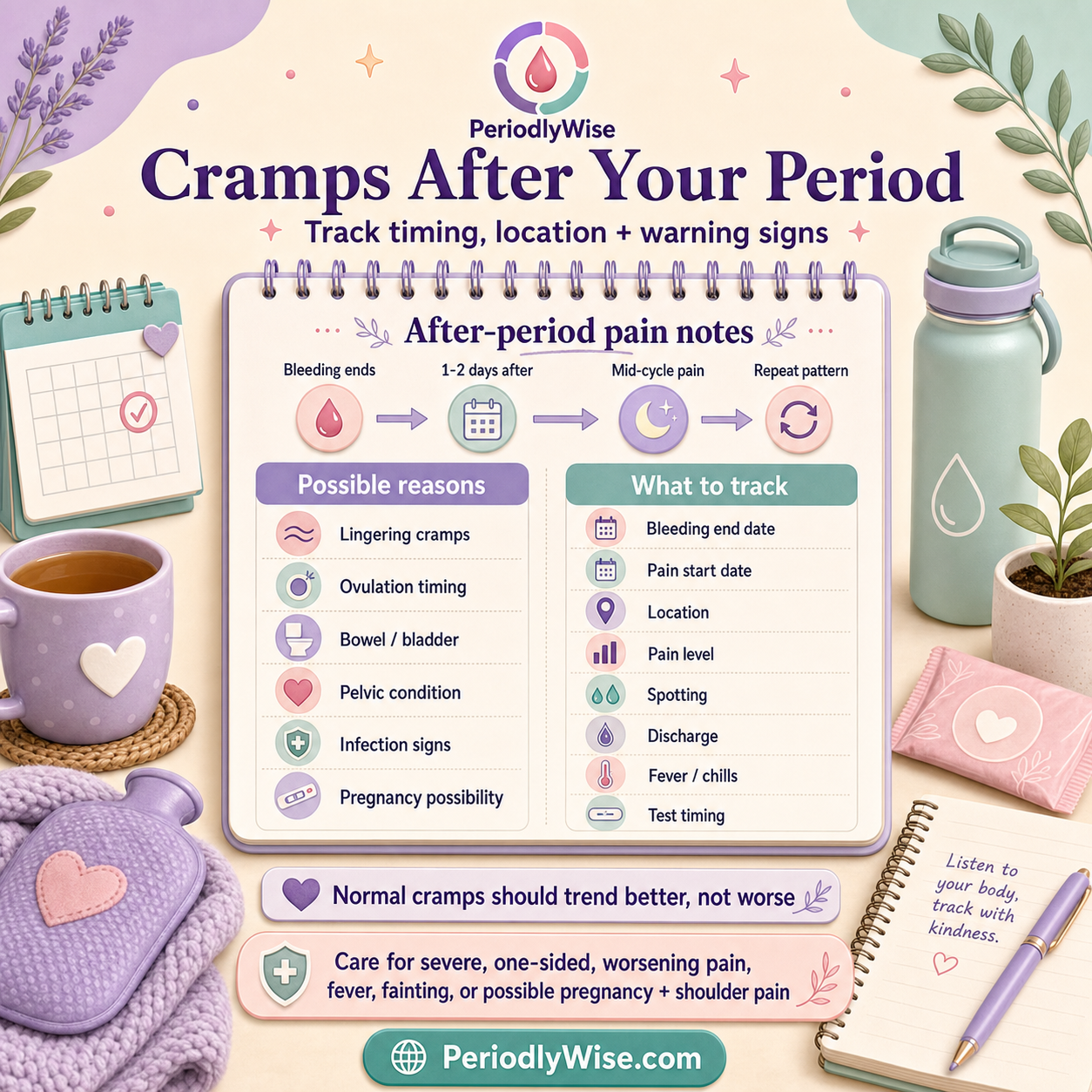
Start with timing: how many days after bleeding?
Mayo Clinic describes typical menstrual cramps as pain that starts before a period, peaks around the start of bleeding, and improves within a few days. If mild cramps continue for a day or two after bleeding ends, they may still be part of that same episode.
Pain that appears several days later deserves a wider lens. It may be digestion, constipation, urinary irritation, muscle tension, ovulation timing in a shorter cycle, or a pelvic condition that flares around hormone changes.
The pattern matters more than one isolated day. If cramps after every period last longer, feel stronger, interrupt life, or come with bleeding between periods, painful sex, unusual discharge, fever, or bowel or bladder pain, it is time to bring the pattern to a clinician.
Cramps after period: timing clues
| Pattern | What it may suggest | What to track |
|---|---|---|
| Mild cramps 1 to 2 days after bleeding stops | Lingering period cramps or pelvic muscle tension may be possible. | Pain level, flow end date, what helped, and whether it fades. |
| Pain returns mid-cycle or on one side | Ovulation pain, cyst pain, or another one-sided pelvic pattern may be possible. | Cycle day, side, duration, spotting, discharge, and repeat pattern. |
| Cramps with unusual discharge, fever, or pain during sex | PID or another infection needs consideration. | Discharge color or smell, fever, pelvic pain, sex timing, and urgent symptoms. |
| Cramps with possible pregnancy, spotting, shoulder pain, dizziness, or fainting | Ectopic pregnancy or another urgent problem must be ruled out. | Take a pregnancy test when appropriate and seek urgent care for warning signs. |
Possible causes
Primary period cramps are usually linked to uterine contractions and prostaglandins. They tend to follow a familiar rhythm: before or during bleeding, then easing. After-period cramps that do not follow this rhythm can be secondary pelvic pain.
Mayo Clinic lists endometriosis, uterine fibroids, adenomyosis, pelvic inflammatory disease, and cervical stenosis as possible causes of menstrual-cramp-like pain. NHS guidance for PID highlights pelvic pain, painful sex, unusual discharge, unusual heavy or painful periods, and bleeding between periods as important symptoms.
Pain can also come from outside the uterus. Ovarian cysts, bowel changes, constipation, urinary tract irritation, muscle strain, and pregnancy-related concerns can feel like cramps. A tracker cannot diagnose the source, but it can show whether the pain is linked to bleeding, ovulation estimates, sex, bowel symptoms, urinary symptoms, or repeated cycle timing.
What to track
Write short notes as the pain happens. The details are more useful than trying to remember later.
- Bleeding end date: the first day after your period fully stopped.
- Pain start date: how many days after bleeding the cramps began.
- Location: center, left, right, lower back, hips, thighs, bowel area, or bladder area.
- Pain type: dull, cramping, stabbing, sharp, pressure, burning, or waves.
- Pain level: mild, moderate, severe, worsening, or stopping daily activities.
- Bleeding or spotting: none, brown spotting, fresh bleeding, clots, or bleeding after sex.
- Discharge: odor, color, itching, burning, or change from usual.
- Pregnancy possibility: sex timing, contraception, missed period, and test timing.
- Other symptoms: fever, chills, nausea, vomiting, dizziness, fainting, bowel pain, or urinary pain.
- Pattern: first time, repeated after every period, getting better, or getting worse.
What to do next
Use a calm sequence for mild familiar pain, but skip straight to care for urgent symptoms.
- Mark where you are in the cycle. Count from the first day of bleeding and the day bleeding stopped.
- Check whether pregnancy is possible. If it is, use pregnancy-test timing rather than assuming the pain is menstrual.
- Look for infection signs. Fever, chills, unusual discharge, pelvic pain with sex, or feeling unwell should be checked.
- Compare with your usual pattern. New, stronger, longer, or life-disrupting pain deserves medical advice.
- Bring a concise note. A clinician can use timing, side, bleeding, discharge, fever, and test results more easily than a vague memory.
When cramps after a period need care
Seek urgent care for sudden severe pelvic or abdominal pain, one-sided pain that is intense or worsening, pain with fever or vomiting, fainting, severe dizziness, shoulder-tip pain with possible pregnancy, heavy bleeding, or pain that feels unsafe.
Make a non-urgent appointment if cramps after your period repeat, worsen over cycles, interfere with school or work, happen with painful sex, bowel or bladder pain, bleeding between periods, or discharge that looks, smells, or feels unusual.
Do not wait several cycles if the pain is severe or new. Tracking is useful for patterns, but it is not a substitute for care when warning signs are present.
Use PeriodlyWise to record bleeding end date, pain location, severity, spotting, discharge, pregnancy-test timing, and repeat patterns.
Open the Period TrackerFAQ
Is it normal to have cramps after your period ends?
Mild cramps for a short time can happen, but cramps that are severe, new, worsening, one-sided, persistent, or paired with fever, unusual discharge, heavy bleeding, or possible pregnancy should be checked.
Can endometriosis cause cramps after a period?
Yes. Endometriosis can cause pelvic pain that starts before a period and continues after it, or pain outside the bleeding days. Pain with sex, bowel movements, urination, or fatigue can add context.
Could cramps after my period be ovulation?
Sometimes, especially in shorter cycles or if the pain is one-sided and closer to the middle of the cycle. Track cycle day, side, duration, spotting, and discharge.
Should I take a pregnancy test?
If pregnancy is possible, yes. Pregnancy tests are not affected by hormonal contraception, and pain with spotting, shoulder pain, fainting, or severe one-sided pain needs urgent advice.
How many cycles should I track before getting help?
For mild familiar pain, two or three cycles can show a pattern. For severe, new, worsening, persistent, or worrying pain, do not wait to seek care.
Final thoughts
Cramps after a period can be a small leftover pattern, but they can also be a signal from another pelvic, urinary, digestive, or pregnancy-related issue.
The safest approach is to track timing and symptoms without minimizing pain. If cramps are severe, unusual, repeated, or paired with warning signs, let a healthcare professional help sort it out.