A short luteal phase means the interval between ovulation and the next period appears shorter than expected. Around ten days or less is a commonly used threshold, but the number is not a diagnosis by itself. The accuracy of the ovulation date, the definition of period onset and the counting method all matter. One unexpectedly short interval cannot tell you that you have low progesterone, cannot conceive or will miscarry.
It is understandable to worry when a chart gives you only eight or nine days after an estimated ovulation date. Before treating the label as a medical finding, check what the chart actually measured. A predicted date is different from an observed hormonal clue, and neither automatically establishes the exact day an egg was released. Spotting entered as a period can also change the apparent interval.
This guide separates a tracking observation from luteal phase deficiency, explains a consistent counting approach and discusses what testing and treatment can reasonably establish. It also gives you a practical record to bring to a clinician. The aim is better information and appropriate care, not another cycle number to optimize or a reason to blame yourself.
What is the luteal phase, and how short is short?
The luteal phase is the part of an ovulatory cycle after the egg is released. The remaining follicle forms the corpus luteum, which produces progesterone. The next menstrual period marks the start of a new cycle if pregnancy has not occurred. A cycle without ovulation does not have a normal ovulatory luteal phase, even if an app divides it into two colored halves.
ASRM guidance describes a typical length of 12-14 days, with a range of 11-17, and commonly discusses ten days or fewer as short. These are clinical reference points, not pass-or-fail scores. A short phase and diagnosed luteal phase deficiency are not interchangeable. No available diagnostic test reliably separates fertile from infertile people on that basis.
| Term | What it describes | What it does not prove |
|---|---|---|
| Total cycle length | The interval from one actual period start to the next. | Which part of the cycle is short. |
| Estimated luteal length | An interval calculated from an estimated ovulation date to the next period. | The exact ovulation date or progesterone adequacy. |
| Short luteal phase | A brief post-ovulation interval under a stated counting convention. | Infertility or a guaranteed pregnancy outcome. |
| Luteal phase deficiency | A proposed clinical problem with luteal function requiring contextual assessment. | A condition that can be confirmed from an app label alone. |
How to count without losing or adding a day
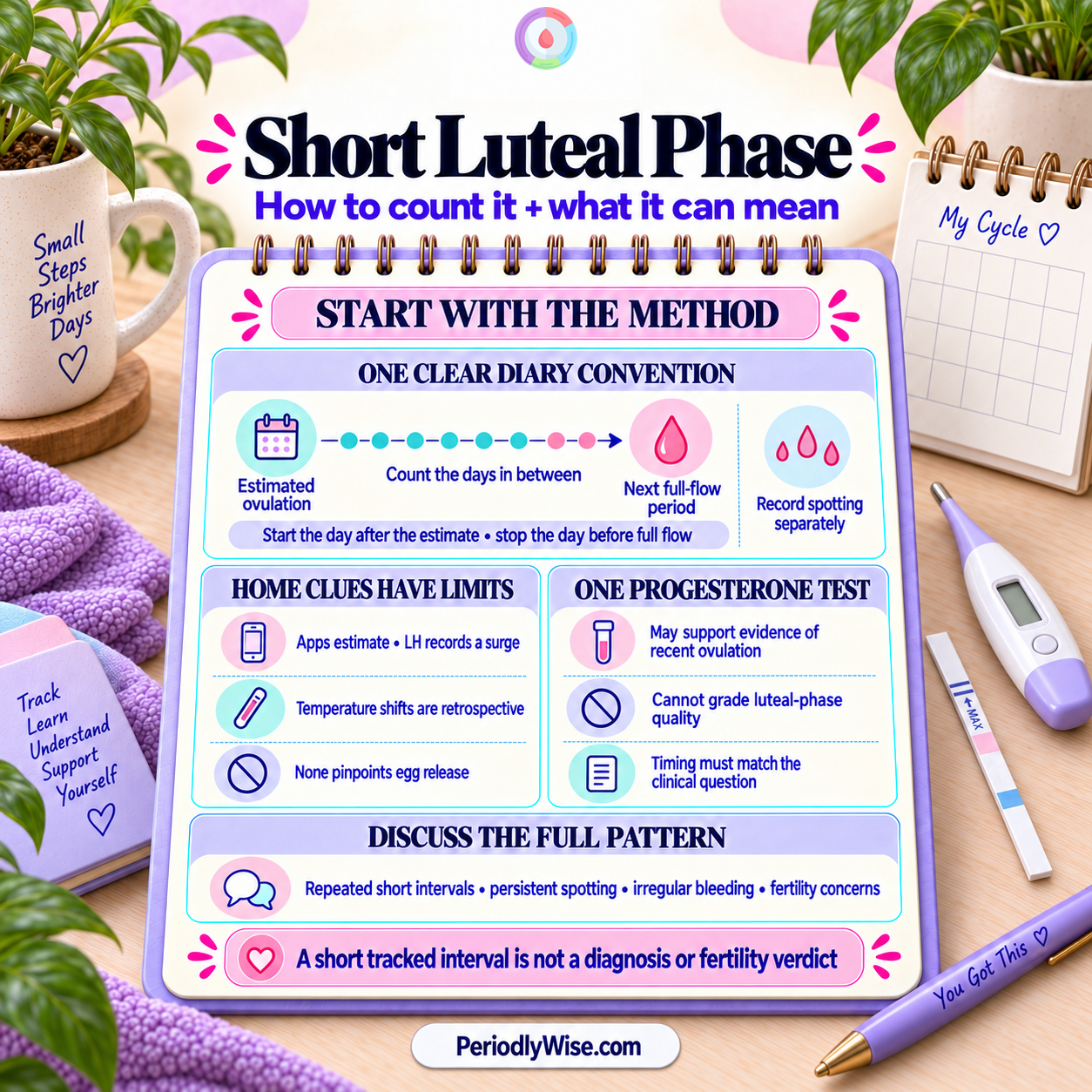
For a practical diary, use one clearly stated convention: count from the day after estimated ovulation through the day before the next actual period. Keep the estimated ovulation date itself in the record. Other charts or studies may include the ovulation day or count from the LH peak, so compare the underlying dates before comparing the displayed number.
For example, if estimated ovulation is October 10 and ordinary menstrual flow starts October 22, this convention counts October 11-21: eleven days. Including October 10 would produce twelve. If light spotting began October 19, keep that separate instead of silently moving the period start three days earlier. The example illustrates arithmetic, not a method of confirming ovulation or a fertility diagnosis.
If a fertility clinic has given you a specific definition of cycle day one, follow that for its tests and report the separate spotting dates. When the ovulation date is uncertain by several days, label the interval uncertain too. A precise-looking total should not hide imprecise information.
| Recorded event | Example date | How to use it |
|---|---|---|
| Estimated ovulation | October 10 | Record the date and how it was estimated; exclude it under this diary convention. |
| Post-ovulation interval | October 11-21 | Eleven counted days if the estimate is correct. |
| Light spotting | October 19 | Record separately, with amount and symptoms. |
| Next actual period | October 22 | Starts the new cycle; not part of the preceding luteal interval. |
How certain is your ovulation date?
Calendar predictions work with previous dates and assumptions. They do not observe an egg being released. If an app predicted ovulation late and your period arrived on its usual date, the apparent short luteal phase may be a prediction error. Preserve the prediction as a prediction instead of replacing it with a claim that ovulation definitely happened then.
Urinary LH tests identify a hormonal surge that often precedes ovulation by one or two days, but are indirect clues. Basal body temperature can show a retrospective shift, yet readings and interpretation have limitations. No home clue should be treated as a stopwatch for egg release. Use a consistent method and bring the original results, rather than only the app's final label, when asking about a repeated pattern.
| Method | Useful information | Important limit |
|---|---|---|
| App or calendar | Organizes recorded cycle dates and estimates a window. | Cannot confirm ovulation or diagnose a luteal problem. |
| Urinary LH strip | Records a surge that may precede ovulation. | Positive and negative results can mislead; a positive does not confirm egg release. |
| Basal temperature | May show a sustained shift after ovulation. | Illness, sleep disruption and inconsistent readings complicate interpretation. |
| Clinician-selected tests | Can investigate ovulation or another suspected problem. | The test, timing and clinical question must be matched; not every test is needed. |
Symptoms and spotting are clues, not hormone measurements
Premenstrual spotting, breast tenderness, cramps and mood changes do not provide a progesterone level. They can be recorded alongside the dates, but cannot identify a specific hormone problem on their own. A shorter total cycle also does not reveal whether ovulation occurred earlier or the interval afterward was shorter. These are different questions.
Describe bleeding instead of diagnosing it from its color. Note whether it was a smear on wiping, occasional spots or sustained flow, whether it followed sex, and whether there was pain. Brown discharge is not automatically a luteal defect, and bleeding before an expected period is not automatically implantation. Persistent bleeding between periods deserves its own assessment, rather than being absorbed into a chart label.
An informative note might read: LH positive October 9; estimated ovulation October 10; light spotting October 19; usual flow October 22. It leaves room for uncertainty and gives a clinician something concrete to review. 'Progesterone failed on day nine' would add a conclusion the diary has not established.
What context might a clinician look for?
The useful question is not simply how to lengthen the number, but whether an underlying condition or a recording issue explains the pattern. A clinician may review the whole cycle, thyroid symptoms, medicines, pregnancy history, changes in weight or nutrition, activity, and other signs of ovulatory dysfunction. Thyroid problems or elevated prolactin are examples of conditions that may warrant targeted investigation, not automatic diagnoses from a short chart.
Insufficient energy intake relative to activity can disturb reproductive function. The Endocrine Society guideline supports addressing an energy imbalance when functional hypothalamic amenorrhea is diagnosed. This does not mean everyone with a short estimate has that condition or needs the same diet. Seek qualified support for restrictive eating, substantial weight change or training that is difficult to recover from.
Hormonal contraception changes the interpretation. Withdrawal bleeding or breakthrough bleeding should not automatically be counted as a natural ovulatory cycle. Tell the clinician the method and any recent change. Breastfeeding and the transition toward menopause also provide important context for changed bleeding; use the actual history rather than forcing every situation into a standard 28-day model.
Does a short luteal phase mean you cannot get pregnant?
No. A tracked interval alone cannot predict your individual chance of pregnancy. In a 2017 prospective study, short phases were observed in people trying to conceive. The study found lower early cumulative pregnancy probability in the group with a short initial phase, but no statistically significant difference by twelve months. Repeated short phases were uncommon, limiting conclusions about persistent patterns.
The study used its own definition and an estimated ovulation date based on LH testing. It was observational, not a trial showing that treatment would help. It is neither proof that every short phase is harmless nor proof that it causes infertility. Your age, how long you have been trying, cycle regularity and the rest of the fertility assessment matter more than translating one chart into a prognosis.
If you have experienced pregnancy loss, do not assume the length of a non-pregnant cycle explains it or that you caused it. A cycle that results in ongoing pregnancy has no next menstrual onset from which to calculate its finished luteal length. Discuss your actual pregnancy history with the clinician instead of trying to infer the cause from later period charts.
What can a progesterone test actually tell you?
A properly timed progesterone blood test can provide evidence of recent ovulation. One result cannot grade luteal-phase quality. Levels fluctuate, and the meaning depends on when the sample was taken. ASRM advises timing assessment approximately a week before the expected next period rather than automatically choosing cycle day 21. With an irregular or apparently short interval, ask how the timing should be individualized.
Before paying for a hormone panel, ask what question the result would answer and how it would change the plan. 'Was there evidence of ovulation?' differs from 'Why is there bleeding between periods?' A reference range on a laboratory report does not turn an incorrectly timed sample into a useful diagnosis. Home hormone products also need their own evidence and cannot be assumed equivalent to a clinical evaluation.
Endometrial biopsy is not recommended for routine dating of the luteal phase. That is different from a biopsy a clinician recommends to investigate abnormal bleeding or another separate concern. Avoid interpreting 'not recommended for this purpose' as 'never medically needed.' Tests should be chosen for the problem you actually have, not to validate a label generated by a chart.
Treatment: investigate the cause rather than buying a fix
Treatment should follow an identified problem and your goals. A thyroid disorder, an energy deficit or another diagnosed condition may require its own care. For isolated presumed luteal phase deficiency, treatment has not been shown to improve pregnancy rates in natural, unstimulated cycles. Progesterone is not a universal remedy for a short app estimate. Do not start a cream, hormone or ovulation medicine on your own.
This is not a reason to stop prescribed progesterone. Fertility-treatment protocols and certain early-pregnancy situations are different clinical contexts. For example, NICE guidance recommends it for specific scan-confirmed intrauterine pregnancies with bleeding and a previous miscarriage. Those eligibility criteria cannot be transferred to everyone whose diary shows a short interval. Ask the prescriber what your treatment is intended to do.
Be cautious about vitamin megadoses, herbal blends and products advertised to boost progesterone. A testimonial showing more days on a chart does not demonstrate better pregnancy outcomes or safety. Bring the full ingredient list to a pharmacist or clinician, especially when trying to conceive. Adequate meals, manageable activity and sleep support general health, but should not be sold as a guaranteed way to add a prescribed number of luteal days.
A practical record to bring to an appointment
If there are no warning symptoms or reasons for earlier assessment, a consistent record across several cycles may help explain whether this is a repeated observation. You do not have to finish a tracking experiment before seeking help. Keep enough detail to show the method and uncertainty without making measurement a source of constant anxiety.
A small table or diary is more useful than a folder of unlabelled screenshots. Include the original test dates, not only a calculated total. If a day was missed, say so. If the estimated ovulation date changed after an app update, preserve that fact rather than presenting the revised date as a direct observation.
- Record actual periods. Note the start of your usual menstrual flow and keep spotting separate, following any clinic-specific instructions.
- State the ovulation method. Write prediction, LH result, temperature pattern or clinician assessment, with dates and uncertainty.
- Choose one counting rule. Keep the same start and end convention; retain the original dates so someone else can check it.
- Describe associated symptoms. Include pain, bleeding after sex, flow changes and symptoms affecting everyday life.
- Add relevant context. Medicines, contraception, breastfeeding, illness, sleep, nutrition, weight change and exercise can inform the discussion.
- Bring your goal and questions. Explain pregnancy plans, how long you have been trying and what you want assessment to clarify.
When to seek assessment, and when it is urgent
Arrange a routine appointment for a repeated short estimated interval, persistent spotting, a change in your usual pattern or fertility concerns. Earlier evaluation is appropriate when cycles are irregular or there are other known concerns; you do not have to wait for the usual fertility time thresholds. In otherwise uncomplicated circumstances, ASRM uses twelve months of trying below age 35 and six months at 35 or older, with more immediate discussion above 40.
If a period is late and pregnancy is possible, follow the test instructions and timing guidance: test from the missed period, or at least 21 days after the last unprotected sex if the due date is unclear. A negative taken too early does not settle the question. Repeat as directed and seek advice if the period remains absent.
- Urgent assessment: possible pregnancy with pelvic pain or unusual bleeding, even without a positive home test.
- Emergency help: sudden severe abdominal pain, fainting or collapse, or shoulder-tip pain with possible pregnancy; use local emergency services.
- Prompt care: heavy bleeding with dizziness or feeling unwell, or pain that is severe or worsening. Do not wait to complete a chart.
Frequently asked questions
Is a ten-day luteal phase always abnormal?
Ten days is around a commonly used boundary, but definitions and counting methods differ. Check whether ovulation was estimated and whether spotting was counted as period onset. One total is not a diagnosis; a repeated pattern is a reason to discuss the full record with a clinician.
Can I get pregnant with a short luteal phase?
Yes, a short tracked interval does not mean pregnancy is impossible. It also cannot provide an individual success rate. Consider the whole fertility history and seek assessment based on your age, cycle pattern and time trying, rather than using the chart as a prediction of the outcome.
Does spotting mean my progesterone is low?
Not by itself. Spotting has multiple possible explanations and does not measure a hormone. Record its timing and amount separately from normal flow. Persistent bleeding between periods or after sex should be assessed for its own cause.
Should I get a day-21 progesterone test?
Not automatically. The useful timing depends on ovulation and the expected next period, not one cycle day for everyone. A clinician can decide whether the test is needed and when to take it. A single result cannot judge the quality of the luteal phase.
Will progesterone cream lengthen the phase and improve fertility?
Do not assume that changing bleeding timing improves pregnancy outcomes. Self-treatment based on an app estimate is not supported. Discuss any hormone product with a clinician and do not stop progesterone prescribed for a specific fertility or pregnancy indication without advice.
Can stress or exercise be the explanation?
They are relevant context, particularly with inadequate energy intake or major changes, but are not diagnoses from a chart. Review the whole pattern with a clinician. Avoid blaming yourself, stopping all movement or following a restrictive diet to fix an unconfirmed hormone problem.
Can I calculate a luteal phase while taking hormonal birth control?
Not reliably from bleeding dates alone. Some methods suppress ovulation and can cause withdrawal or breakthrough bleeding. Record the method and bleeding, but do not assume the intervals represent natural ovulatory phases. Ask about unexpected changes and pregnancy possibility when relevant.
How many cycles should I track before asking for help?
There is no mandatory waiting period. A consistent multi-cycle record can help if you are otherwise well, but repeated concerns, irregular bleeding, fertility difficulties or worrying symptoms justify earlier advice. Urgent symptoms require care now, not another month of tracking.
Use PeriodlyWise to record actual period starts and compare your cycle history. Keep LH results, temperature notes and spotting dates alongside the record. Predictions are estimates, not proof of ovulation or a diagnosis of luteal phase deficiency.
Open the period trackerThe takeaway
A short luteal-phase estimate is a starting point for checking the method and, when appropriate, discussing a persistent pattern. Record the original dates, separate spotting from flow and avoid treating one number as a fertility verdict. The most useful next step is care matched to your symptoms and goals, not an unverified hormone fix.