Confidence does not always arrive loudly. Sometimes it is quiet. It is the small internal shift that says, "I know what I need." It is carrying period supplies before you are desperate. It is choosing rest before burnout. It is wearing what feels comfortable. It is saying no without writing a speech. It is noticing that your body has a pattern and deciding to support it instead of arguing with it.
This kind of confidence is not about being certain all the time. It is about being familiar with yourself. You learn your signals, your limits, your rhythms, your comforts, your stress signs, and your recovery needs. You stop treating every need as an inconvenience and start seeing needs as information.
PeriodlyWise exists for that gentle self-knowledge. Periods, moods, energy, rest, flow, cramps, appetite, sleep, and body comfort are not things to hide in shame. They are part of real life, and they can be met with calm preparation.
Quiet confidence is not the same as control
Control says, "I must make everything go exactly as planned." Quiet confidence says, "If things change, I know how to respond." That difference matters. Bodies change. Cycles shift. Energy rises and falls. People disappoint us. Plans get interrupted. Weather, work, family, sleep, money, pain, and stress all change what a day asks from us.
Knowing your needs does not guarantee an easy day. It gives you a better relationship with the day you are actually in. You can bring a product pouch. You can choose a slower start. You can eat something simple. You can step away from noise. You can ask for support. You can say, "This is what helps me."
Need, preference, or boundary?
One reason needs feel confusing is that they get mixed with preferences and boundaries. All three matter, but they are not identical.
| Type | What it means | Example |
|---|---|---|
| Need | Something that supports your body, safety, wellbeing, or ability to function. | "I need food before this long meeting because my energy drops fast." |
| Preference | Something that makes life more pleasant or easier, but may have flexibility. | "I prefer a quiet table because noise drains me." |
| Boundary | A limit that protects your wellbeing, time, privacy, body, or values. | "I am not discussing my period details at work." |
Quiet confidence grows when you can name these without apology. A need does not have to be dramatic to be real. A preference does not have to be ignored because someone else finds it small. A boundary does not have to come with a long defense.
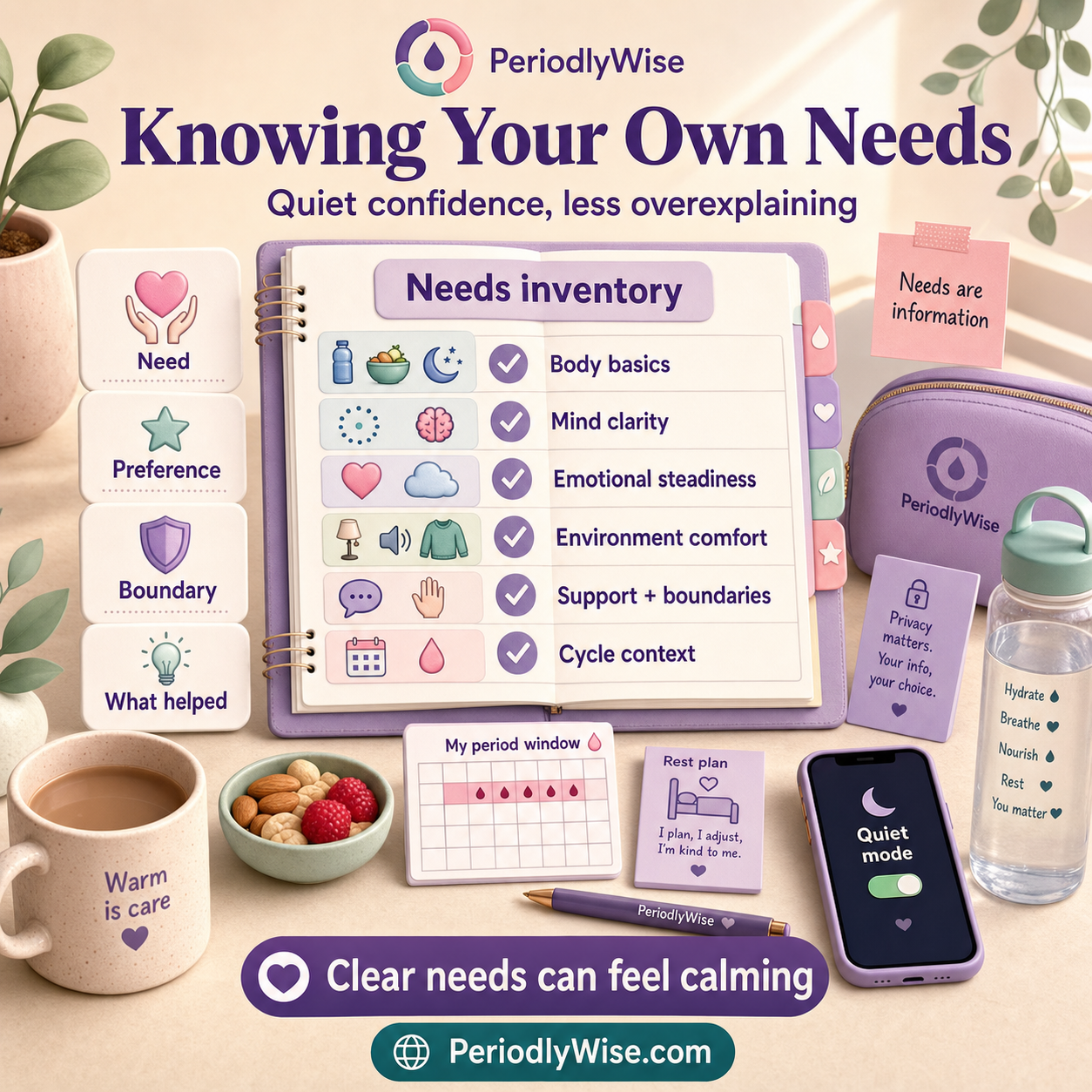
The needs inventory: six areas to notice
Knowing your needs becomes easier when you look at life in categories. You do not need to track all of them every day. Use this as a map when you feel unclear.
| Need area | What to notice | Support question |
|---|---|---|
| Body | Sleep, hunger, thirst, pain, flow, digestion, temperature, movement, rest, and medication needs. | What would make my body easier to live in today? |
| Mind | Focus, overstimulation, worry, decision fatigue, and mental clutter. | What can I simplify or postpone? |
| Emotion | Sensitivity, loneliness, irritability, sadness, anxiety, or need for reassurance. | What would help me feel steadier? |
| Environment | Noise, light, clothing, privacy, cleanliness, products, and access to bathrooms or supplies. | What small change would lower friction? |
| Relationships | Support, space, honesty, privacy, affection, help, or clearer limits. | Who feels safe, and what do I need to say less or more clearly? |
| Cycle | Period window, PMS timing, flow, cramps, fatigue, appetite, sleep, mood, and what helped before. | What has this part of my cycle asked for before? |
Your body often knows before your words do
Sometimes the body identifies a need before the mind has language for it. Tight shoulders may show stress. Low appetite may show pain, nausea, anxiety, or fatigue. Irritation may show overstimulation. Heavy eyelids may show sleep debt. A stronger need for privacy may show emotional overload. Leak worry may show that your product plan needs updating.
The point is not to analyze every sensation. The point is to respect useful signals. If the same cue appears often, it may be worth tracking. A single note can be enough: "Noise drained me," "needed food earlier," "period due, more sensitive," "day 2 flow, needed backup," or "rest helped mood."
For body-focused self-trust, read Little Ways to Feel More at Home in Your Body.
Cycle awareness can make needs feel less random
The Office on Women's Health notes that menstrual-cycle hormone changes can affect emotional, mental, and physical health. PMS can include symptoms such as tiredness, sleep changes, appetite changes, mood changes, anxiety, bloating, headache, digestive changes, and trouble concentrating. For some people, these changes are mild. For others, they shape real needs.
Cycle awareness can turn "Why am I like this?" into "What context is my body giving me?" Maybe you need simpler food before your period. Maybe day 1 needs looser clothes. Maybe heavy-flow nights need better sleep preparation. Maybe mood sensitivity needs fewer social demands. Maybe cramps mean rest is not optional.
This is not about reducing your whole personality to hormones. It is about giving your needs a map. For a caring tracking frame, read When Period Tracking Feels Like Self-Care. For public or travel days, read Period Confidence: Small Ways to Feel Prepared Anywhere.
The confidence of being prepared
Preparedness can feel emotional, not just practical. A product in your bag can reduce background worry. A water bottle can make a long day feel less fragile. A saved note can remind you that you have handled this before. A rest plan can soften the fear of running out of energy. A boundary sentence can protect you when you do not have the energy to explain.
That is why the article on The Emotional Safety of Having Period Supplies Ready matters. Readiness is not paranoia. It can be a way of telling yourself, "I am allowed to need things, and I am allowed to prepare for them."
Small sentences that protect your needs
Knowing your needs is easier when you have words ready. You do not need to overexplain.
- For rest: "I need a slower evening so I can function tomorrow."
- For food: "I need to eat before we continue."
- For period care: "I need a quick bathroom break."
- For privacy: "I am not getting into the details, but I need to take care of something."
- For sensory overload: "I need a quieter spot for a few minutes."
- For emotional bandwidth: "I care, but I do not have capacity for this conversation right now."
- For support: "Can you help me with one practical thing today?"
These sentences are not rude. They are clear. The quiet confidence is in the clarity.
What PeriodlyWise can help you remember
Self-knowledge becomes easier when you do not have to hold every detail in memory. PeriodlyWise can help you save the practical pattern: period window, start dates, flow, pain, product needs, fatigue, mood, sleep, appetite, body comfort, stress, and what helped.
Over time, those notes can answer questions like:
- Do I need more rest before my period or during heavy-flow days?
- Which products make me feel most secure on long days?
- Does poor sleep make cramps or mood feel harder?
- Which foods feel easiest when appetite is low?
- What kind of support helps me feel calmer?
- When do I need privacy, reassurance, quiet, or fewer plans?
For a wider pattern view, read How Cycle Awareness Can Make Daily Life Feel Less Random.
Confidence without overexplaining
A big part of knowing your needs is learning that not everyone needs full access to them. You can be honest without being exposed. You can say you need a break without giving a medical history. You can carry supplies without announcing your period. You can change plans without proving that your discomfort is bad enough.
This matters especially for people who have been taught to minimize their needs, apologize for their bodies, or stay convenient at all costs. Needs are not an inconvenience to your life. They are part of the terms on which your life can be lived well.
If you struggle with self-blame around cycle changes, read Feeling More Patient With Yourself Around Your Period.
When your needs change
Your needs will not be the same every day. That is not inconsistency. It is responsiveness. You may need movement on one day and rest on another. You may want company in the morning and quiet in the evening. You may feel independent most of the month and need more support before your period. You may be fine with a full schedule one week and need space the next.
Quiet confidence leaves room for change. It says, "I can check in again." That is different from being flaky. It is being honest with new information.
When knowing your needs is not enough
Self-knowledge is powerful, but it does not replace care. Seek medical advice if pain is severe, bleeding is very heavy, fatigue is persistent, you feel dizzy or short of breath, symptoms are sudden or worsening, or daily life is repeatedly disrupted. Seek mental health support if low mood, anxiety, panic, body distress, eating concerns, dissociation, hopelessness, or thoughts of self-harm feel intense, persistent, unsafe, or hard to manage.
Knowing your needs may help you describe what is happening. It should also help you recognize when you deserve more support than self-care can provide.
FAQ
What does it mean to know your own needs?
It means noticing what supports your body, mind, emotions, schedule, relationships, and cycle, then making choices that respect those signals.
How can I start identifying my needs?
Start with body basics: sleep, food, water, bathroom, pain, rest, comfort, and stress. Then note what helped you feel steadier.
Can period tracking help me know my needs?
Yes. Tracking can show repeated needs around flow, cramps, fatigue, sleep, appetite, mood, product comfort, and daily impact.
Do I have to explain my needs to everyone?
No. You can be clear without sharing private details. A simple sentence such as "I need a quick break" or "I need a slower evening" is enough in many situations.
What if my needs feel inconvenient?
Needs can be inconvenient and still real. The goal is not to have no needs. The goal is to understand them early enough to care for yourself with less shame.
Use PeriodlyWise to notice cycle timing, comfort needs, mood, energy, products, rest, and what helps you move through daily life with more quiet confidence.
Open the Period Tracker