Some days around your period ask for a different kind of patience. Not because you are weak. Not because your period makes you less capable. But because the body can carry more at certain points in the cycle: cramps, poor sleep, heavy flow, lower energy, bloating, appetite changes, leak worries, tender emotions, or the simple effort of moving through the day while bleeding.
Patience with yourself does not mean giving up. It means giving yourself context before criticism. It means pausing before deciding that a hard day says something permanent about you. It means noticing that your body may be doing real work, even if the world around you expects the same speed, the same brightness, and the same output.
Periods are natural. They should not be treated as shameful, dramatic, or something you must power through silently. PeriodlyWise stands with everyone in this natural journey by making cycle awareness calmer, more respectful, and easier to use as everyday support.
Patience is not passivity
Many people misunderstand patience. They imagine doing nothing, lowering standards forever, or letting the day fall apart. But period patience is more active than that. It is the decision to respond to your body accurately.
If your cramps are strong, patience may mean using heat before the pain becomes harder to manage. If you slept badly, patience may mean starting the morning more slowly. If your mood feels raw, patience may mean not having a serious conversation while hungry, exhausted, and in pain. If your flow is heavy, patience may mean carrying backup and giving yourself more bathroom time.
Patience is not an excuse. It is a strategy. It helps you spend your energy where it matters instead of using all of it to criticize yourself for having a body.
The context-before-criticism check
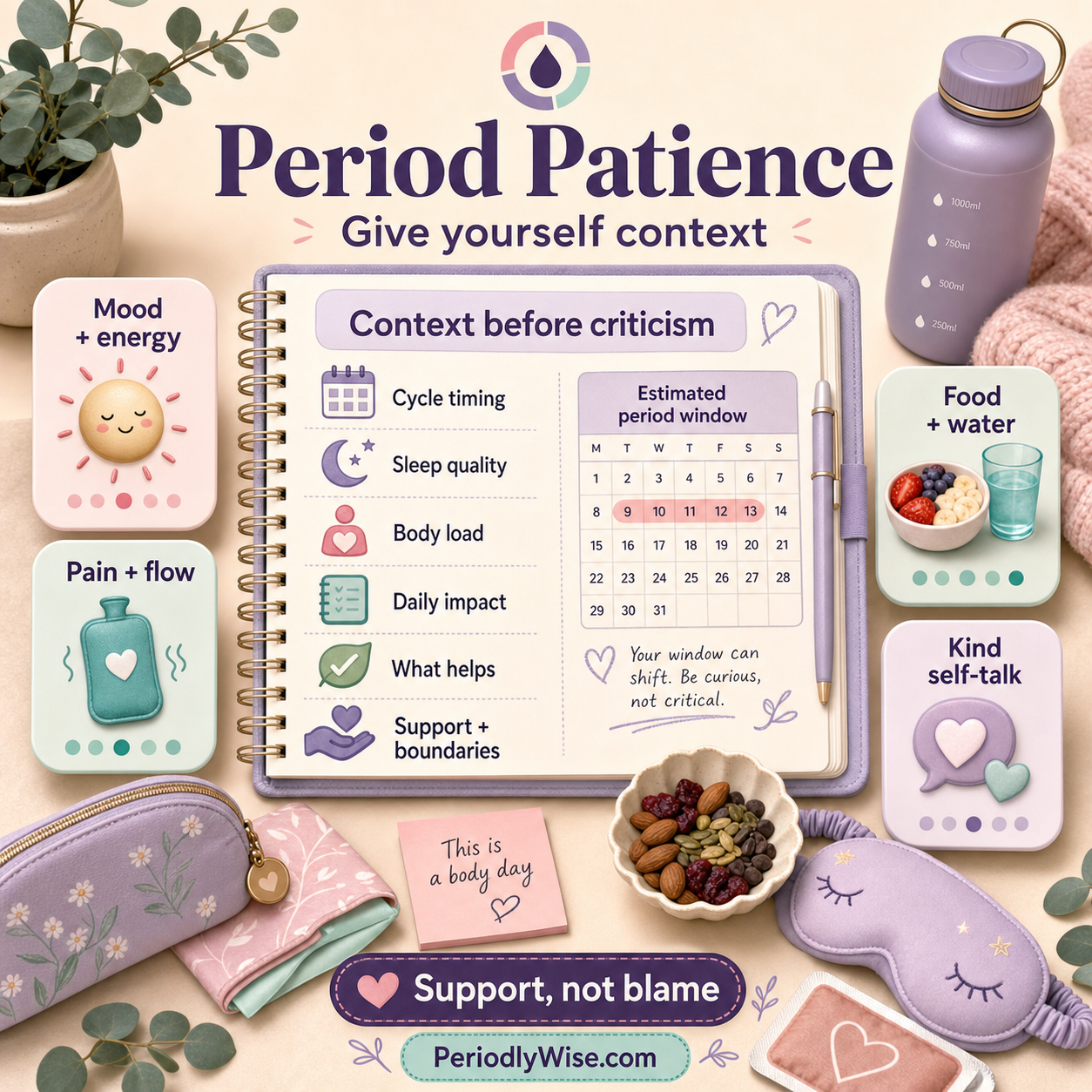
When you catch yourself thinking, "I should be handling this better," pause and ask a few context questions. This is not to dismiss your feelings. It is to understand the conditions you are operating under.
| Question | What it may reveal | What to track |
|---|---|---|
| Where am I in my cycle? | A pre-period or period-day pattern may be adding emotional or physical load. | Cycle day, expected period window, bleeding day, or spotting. |
| How did I sleep? | Poor sleep can make pain, mood, focus, and patience harder. | Bedtime, wake-ups, sleep quality, cramps, leaks, and worry. |
| What is my body carrying? | Cramps, heavy flow, bloating, nausea, headache, or fatigue can change capacity. | Pain, flow, product changes, clots, appetite, dizziness, and energy. |
| What else is happening? | Stress, deadlines, conflict, travel, caregiving, or illness may be overlapping with cycle symptoms. | Stress context, schedule load, support, and daily impact. |
| What would help one step? | A tiny adjustment may reduce strain enough to get through the next part of the day. | Heat, rest, food, water, movement, quiet, medication if safe, or support. |
Why the period window can change your capacity
The menstrual cycle can affect more than bleeding. The Office on Women's Health notes that hormonal changes across the cycle can affect physical, mental, and emotional health. PMS may include symptoms such as irritability, anxiety, sleep problems, appetite changes, bloating, headache, fatigue, digestive changes, and trouble concentrating. Pain and heavy bleeding can also make the body work harder.
That does not mean you are controlled by your cycle. It means your cycle can be part of the context. Capacity is not fixed. A task that feels easy mid-cycle may feel heavier during poor sleep, cramps, heavy bleeding, and a high-stress day. The task did not change. The load around it did.
This is why cycle awareness can be emotionally useful. If you know certain days tend to feel more sensitive or slower, you can plan with less surprise. You can also avoid turning a predictable body pattern into a negative story about yourself.
Self-talk that does not minimize or dramatize
Good period self-talk does not say, "Everything is fine," when everything is not fine. It also does not say, "I cannot do anything," when you may still have options. It stays honest and kind.
- Instead of: "I am so lazy today." Try: "My energy is lower today. What is the next realistic step?"
- Instead of: "I am overreacting." Try: "This feeling is real. I can respond before I decide what it means."
- Instead of: "I should push through." Try: "Can I support my body and still do the important part?"
- Instead of: "My body is a problem." Try: "My body has a pattern. I can learn it without shame."
- Instead of: "I failed my plan." Try: "My plan met a real body day. I can adjust."
If you often feel unlike yourself before your period, read Not Feeling Like Yourself Before Your Period. It can help separate real feelings from the harsh stories that sometimes attach to them.
Practical patience: small choices that protect your day
Self-compassion becomes stronger when it has practical shape. These choices are small enough for real life, but they can change the tone of the day.
Choose a slower start when possible
A slower start might mean sitting before you rush, choosing an easier breakfast, showering warm, wearing comfortable clothes, or doing one quiet task first. It is not laziness. It is pacing. If mornings are especially hard, read When Your Body Needs Slower Mornings During Your Period.
Lower the friction around products
Keep products where you need them. Pack backup before the period window. Choose absorbency and comfort based on your real flow, not what you think you should need. If irritation or leaks have been part of the stress, save those details too.
Make food less complicated
Low appetite, cravings, nausea, or fatigue can make meals feel harder. Patience may mean choosing simple, familiar food and fluids rather than forcing a perfect meal. The goal is support, not performance.
Protect one boundary
A boundary can be small: leaving a little earlier, saying no to a non-urgent plan, asking for a break, postponing a heavy conversation, or telling someone, "I need a quieter evening." Your period does not make you difficult. It may simply make your limits clearer.
Save the care clue
When something helps, record it. "Heat helped." "Lunch before the meeting helped." "Loose pants helped." "Less scrolling helped sleep." "Telling someone I needed support helped." These notes are evidence that care works.
What PeriodlyWise can help you notice
Use PeriodlyWise as a calm memory, not a judge. The most useful notes are the ones that help you prepare with more patience next time.
- Cycle timing: expected window, actual start date, bleeding day, spotting, or late period.
- Emotional tone: sensitive, steady, irritable, anxious, teary, withdrawn, reflective, or supported.
- Body load: cramps, back pain, headache, nausea, bloating, breast tenderness, fatigue, dizziness, or flow level.
- Daily impact: work, school, commute, social plans, food, sleep, clothing, movement, or focus.
- What helped: comfort, rest, support, product change, food, hydration, movement, medication if safe, or boundaries.
Over time, those notes can show patterns that are hard to remember in the moment. Maybe your patience drops most when poor sleep and cramps happen together. Maybe your heaviest day needs a lighter schedule. Maybe emotional sensitivity comes before bleeding and passes after day 2. Seeing that pattern can make it easier to speak to yourself kindly.
Patience without normalizing severe symptoms
There is an important difference between being patient with yourself and accepting suffering as normal. Mild, familiar changes may be part of your cycle pattern. Severe symptoms deserve care.
The NHS recommends seeking advice when period pain is severe, worsening, or stops normal activities, especially if it comes with other symptoms such as bleeding between periods, pain during sex, pain when peeing or pooing, or unexplained changes. Heavy bleeding that affects daily life, causes frequent product changes, leaks through clothes or bedding, includes large clots, or leaves you very tired or short of breath also deserves medical advice.
For mood symptoms, get support urgently if you feel unsafe, at risk of harming yourself, or unable to cope. If emotional symptoms repeatedly disrupt relationships, work, school, eating, sleep, or basic care, professional support can help. You do not have to earn help by struggling longer.
A patient period plan
You can turn all of this into a simple plan for the next cycle. Keep it flexible. The goal is not to become perfect at periods. The goal is to become less harsh with yourself while staying attentive to your health.
- Before the window: check your estimated dates once, place products, and choose one support item.
- When symptoms start: note the strongest signal and ask what context it has.
- On bleeding days: track flow, pain, energy, sleep, product needs, and what helped.
- On emotional days: delay harsh conclusions, eat or rest if needed, and use a kinder script.
- After the period: save one thing your future self will be glad to know.
For a broader self-care approach, read When Period Tracking Feels Like Self-Care. If you want to reduce the feeling that your month is random, read How Cycle Awareness Can Make Daily Life Feel Less Random.
FAQ
Is it normal to feel less patient before or during my period?
It can happen, especially if mood changes, poor sleep, cramps, fatigue, appetite changes, or stress overlap. If irritability or emotional distress is severe or disruptive, seek professional support.
How can I stop blaming myself around my period?
Start by adding context. Track cycle timing, sleep, pain, flow, energy, stress, and what helped. A pattern can remind you that the day has body context, not just personal failure.
Does being patient mean lowering all expectations?
No. It means choosing realistic expectations for the body day you are actually having. You can still do important things while adjusting pace, support, and self-talk.
What should I track if my mood changes before my period?
Track mood, timing, sleep, stress, appetite, pain, energy, daily impact, support, and when symptoms improve. This can help you and a clinician understand repeated patterns.
When should I seek help for period-related mood changes?
Seek help if mood symptoms feel unsafe, severe, persistent, or interfere with work, school, relationships, sleep, eating, or daily care. Urgent support is important if you may harm yourself or cannot stay safe.
Use PeriodlyWise to notice cycle timing, save what helped, and build a gentler pattern of support around your period.
Open the Period Tracker