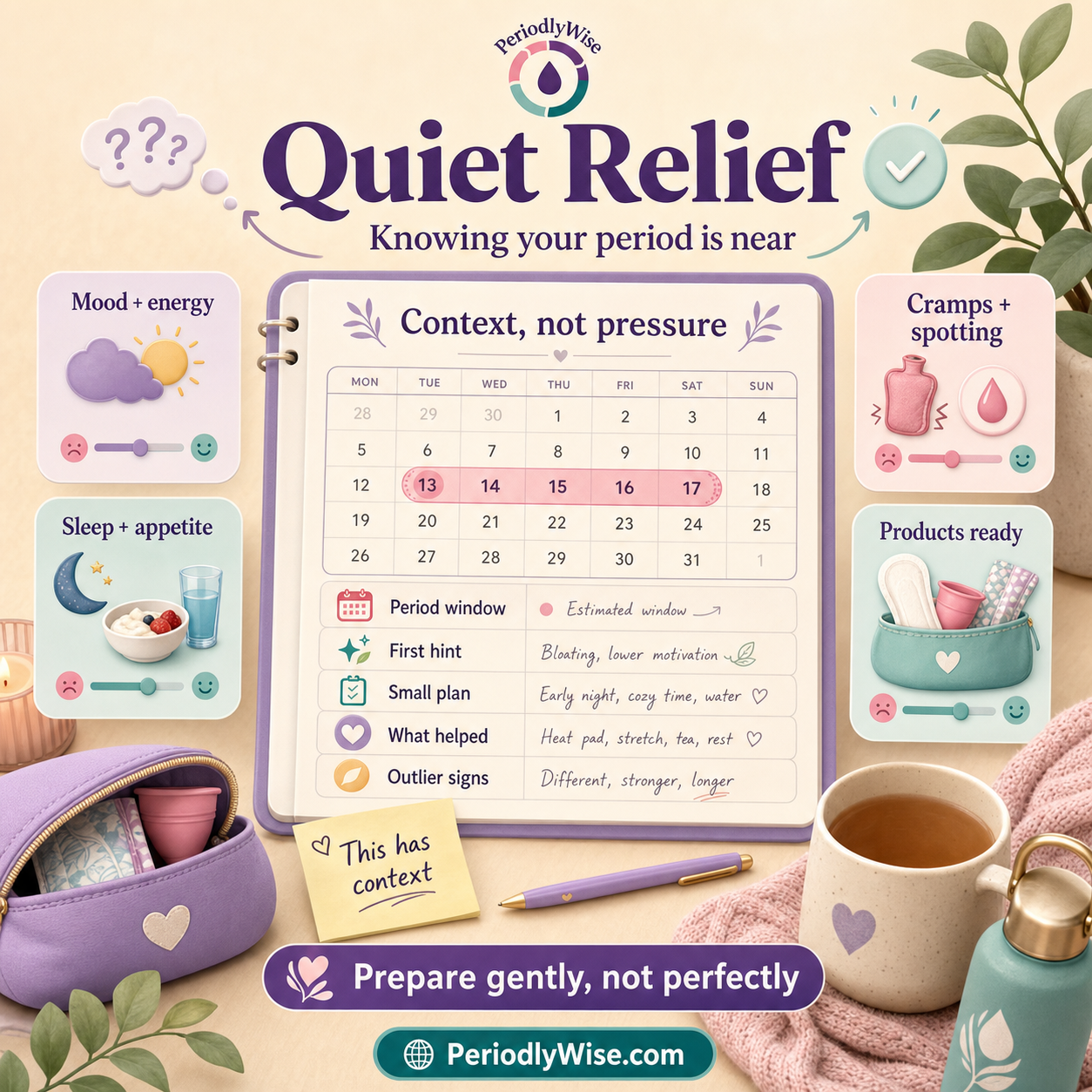
There is a particular kind of relief that does not announce itself loudly. It is the quiet exhale of realizing, "Oh, my period is probably coming." The tiredness, the sensitive mood, the heavier feeling in your body, the sudden need for softer clothing, the small craving, the lower patience, the strange sleep, the mild cramps that were making you wonder if something was wrong - suddenly they have context.
Knowing your period is coming does not make every symptom easy. It does not make cramps disappear, stop a heavy day, or make an inconvenient start date convenient. But it can soften the confusion. It can turn a vague worry into a practical plan. It can help you move from "Why do I feel like this?" to "My body may be moving toward my period, and I can respond with care."
That shift matters. PeriodlyWise is built around this kind of calm cycle awareness: not shame, not over-monitoring, not panic when dates move, but gentle information that helps you understand your body and prepare for a natural part of life.
Why knowing can feel like relief
Uncertainty is often heavier than information. When your body feels different and you do not know why, the mind tends to fill in the space. Maybe you wonder if you are getting sick. Maybe you blame yourself for being tired. Maybe you think your mood says something about your personality instead of your context. Maybe you push through a day that actually needed a little more softness.
A period window can interrupt that spiral. It can remind you that the menstrual cycle is not only the days of bleeding. The weeks before bleeding can also carry body changes. The Office on Women's Health notes that hormone changes across the cycle can affect physical, mental, and emotional health. For some people, that includes mood, sleep, energy, appetite, pain, digestive changes, and symptoms that become more noticeable before bleeding starts.
This does not mean every feeling is caused by your cycle. Stress, illness, medication changes, sleep, food, travel, workload, relationships, mental health, and life events all matter too. But the cycle is one important layer of context. When you see that layer, you can stop treating every change as a personal failure.
The relief map: what changes when you know
The relief of knowing is practical and emotional at the same time. It can change how you plan, how you speak to yourself, and how much surprise the day carries.
| Before you know | After you notice the period window | What PeriodlyWise can help you save |
|---|---|---|
| "Why am I so tired?" | "This may be my pre-period low-energy pattern." | Cycle day, sleep, energy, flow history, and what helped. |
| "Why am I so sensitive today?" | "My emotional tone may be closer to the surface before bleeding." | Mood, stress context, sleep, pain, and support notes. |
| "What if it starts while I am out?" | "I can carry a product and a backup without overthinking." | Expected window, product needs, spotting, and start dates. |
| "Why does food feel odd?" | "Appetite and cravings can shift around PMS or period days." | Appetite, nausea, food, fluids, bloating, and energy. |
| "Is my cycle changing?" | "I can compare this month with my usual pattern." | Start date, cycle length, bleeding days, spotting, and irregularity notes. |
Knowing is not the same as controlling
One of the most important things to say clearly is this: tracking should not become another way to demand perfection from your body. A period estimate is not a promise. A cycle can shift. Bleeding can start earlier or later. A month can feel different because sleep, stress, illness, travel, medication, exercise, or life pressure changed.
The Office on Women's Health explains that cycles are often described as 28 days, but real cycles vary between people and can vary month to month. The NHS also notes that irregular periods can happen for different reasons, and tracking can help you see whether your pattern has changed.
So the point is not: "I know exactly what will happen." The point is: "I have a likely window, I know what my body often does, and I can prepare without panic." That is a much kinder kind of control. For a fuller approach to this, read Learning Your Cycle Without Obsessing Over It.
Small signs that can make sense near your period
Many pre-period signs are ordinary, but they can feel confusing when they arrive without context. PMS can include physical and emotional symptoms such as mood changes, irritability, anxiety, sleep problems, appetite changes, bloating, fatigue, headaches, digestive changes, and breast tenderness. Not everyone has PMS, and not every pre-period change is PMS, but repeated timing is useful information.
These signs are worth noticing gently:
- Energy: feeling slower, heavier, more tired, or less motivated than usual.
- Mood: feeling more sensitive, teary, irritated, reflective, anxious, or easily overwhelmed.
- Sleep: lighter sleep, waking more often, bedtime worry, or needing more rest.
- Appetite: cravings, low appetite, nausea, bloating, or food feeling less appealing.
- Body comfort: cramps, backache, headaches, breast tenderness, skin changes, or pelvic heaviness.
- Spotting or discharge changes: light spotting before bleeding, or changes that help you recognize your start window.
If these changes are mild and familiar, a note can be enough. If they are severe, sudden, frightening, or disruptive, tracking can help you explain the pattern to a healthcare professional.
A soft preparation list for the days before
Preparation does not have to be dramatic. It can be quiet, ordinary, and private. It can look like making tomorrow slightly easier for yourself.
- Check your window once: review your estimated period window in PeriodlyWise without repeatedly refreshing it.
- Place products where life actually happens: bag, bathroom, desk drawer, car, school pouch, travel kit, or bedside table.
- Choose one comfort option: heat, water, loose clothing, a warm drink, gentle stretching, rest, or pain relief if it is safe for you.
- Lower one unnecessary demand: if possible, simplify a task, move a non-urgent errand, or protect a little more sleep.
- Save what helped last time: a product choice, food idea, sleep setup, clothing choice, or supportive reminder.
If preparing helps you feel more confident away from home, read Period Confidence: Small Ways to Feel Prepared Anywhere. If you like practical routines, Small Period Habits That Make You Feel More in Control expands this into a full care rhythm.
What to track when relief is the goal
If your goal is relief, track details that reduce uncertainty. You do not need to track every sensation. You need enough information to say, "This has context."
1. Track the window, not just one date
A date range is usually kinder than one exact day. PeriodlyWise can estimate a window, and you can compare that window with your actual start date over time. If your start date moves, it is information, not failure.
2. Track the first hint
Some people notice a first clue before bleeding: spotting, cramps, mood sensitivity, fatigue, acne, a sleep change, or appetite change. Noting that first clue can help you recognize future cycles sooner.
3. Track your plan
Did carrying a product reduce worry? Did going to bed earlier help? Did a warm drink feel good? Did skipping a tight outfit make the day easier? These are not tiny details. They are care clues.
4. Track the outlier
If something is different from your usual pattern, save it. Examples include a much later start, much heavier bleeding, new severe pain, new dizziness, or a mood change that feels unsafe. Outliers matter because they can help you decide when to seek care.
When knowing brings up worry instead of relief
For some people, seeing a period window feels calming. For others, it can trigger worry: What if it starts during a trip? What if I leak? What if the date is wrong? What if I have symptoms again? If this happens, reduce the amount of checking. One useful glance is enough. Repeated checking can make a tracker feel like pressure instead of support.
You can also shift from prediction to preparation. Instead of asking, "Will it start exactly on this date?" ask, "What small thing would make me feel supported if it starts this week?" That question keeps the focus on care.
If your period often changes plans, read Why Your Period Can Change Your Plans Without Warning. If the whole month feels unpredictable, How Cycle Awareness Can Make Daily Life Feel Less Random may help you connect the dots more gently.
When to seek medical support
The quiet relief of knowing your period is coming should not make you ignore symptoms that deserve care. Seek medical advice if your periods become suddenly irregular, stop unexpectedly, become much heavier, or become much more painful than usual. Also get help for bleeding between periods, severe pelvic pain, fever, faintness, dizziness, shortness of breath, very heavy bleeding, large or frequent clots, symptoms of anemia, possible pregnancy concerns, or mood symptoms that feel unsafe.
If pre-period emotional symptoms repeatedly interfere with work, school, relationships, eating, sleep, or safety, talk with a healthcare professional. You deserve support, not just endurance.
FAQ
Why does knowing my period is coming make me feel calmer?
Because it gives symptoms a timeline. Energy, mood, sleep, appetite, cramps, and spotting can feel less alarming when they match your usual pre-period pattern.
Can a tracker tell me the exact day my period will start?
No tracker can guarantee an exact day. A period tracker can estimate a likely window based on your information. Cycles can still shift.
What should I do if tracking makes me anxious?
Track less detail, check less often, and focus on preparation rather than prediction. If anxiety is intense or persistent, consider professional support.
Are mood changes before a period normal?
Mild mood changes can happen for many people, but severe, unsafe, or life-disrupting symptoms deserve medical or mental health support.
What is the most useful thing to track?
Start with period start date, expected window, first clue, strongest symptom, daily impact, and what helped. That gives useful context without making tracking heavy.
Use PeriodlyWise to estimate your period window, save familiar signs, and prepare with calm instead of surprise.
Open the Period Tracker