There is a small comfort in realizing your cycle is not just a series of surprises. Maybe your period often arrives after the same kind of mood shift. Maybe day 2 is usually heavier. Maybe you need more quiet a few days before bleeding starts. Maybe sleep changes first, then appetite, then cramps. The pattern does not need to be perfect to be meaningful.
Knowing your cycle has a pattern can feel like finding a familiar path through a month that sometimes feels unpredictable. It does not mean your body will behave exactly the same every time. It does not mean every feeling is hormonal. It simply gives you a little more context, and sometimes context is enough to make a hard day feel less personal.
PeriodlyWise is built for this kind of gentle awareness. Not control. Not shame. Not turning your body into a project. Just enough tracking to help you notice what repeats, prepare with kindness, and understand your natural rhythm with more confidence.
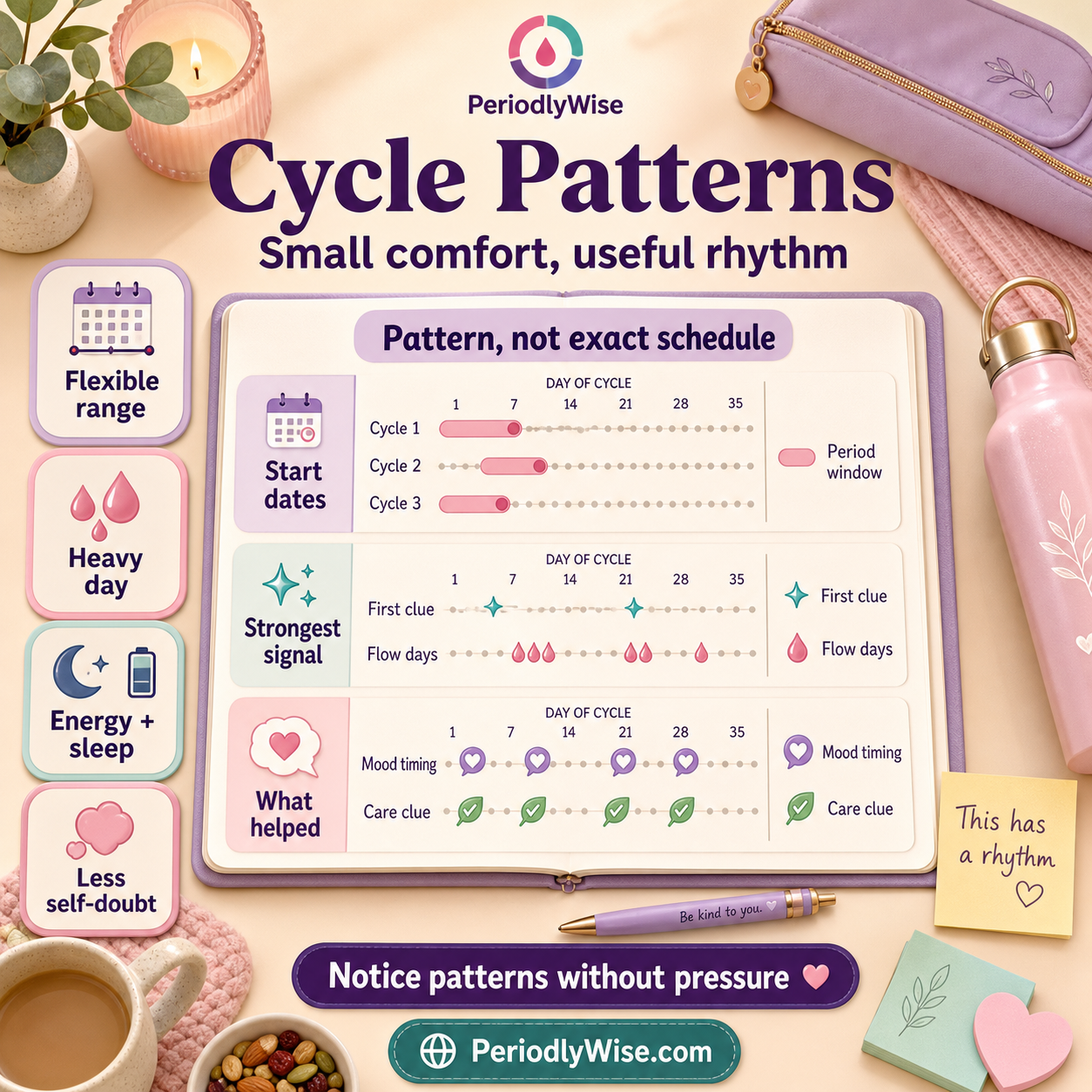
A pattern is not a perfect schedule
One reason cycle awareness can feel stressful is that people sometimes expect a pattern to mean exact repetition. But bodies are not calendar apps. A pattern can be flexible and still be real.
The Office on Women's Health explains that cycle length can vary between people and from month to month. A cycle is counted from the first day of one period to the first day of the next. Many people are taught to expect 28 days, but real cycles are more individual than that. Stress, sleep, illness, travel, medication changes, weight changes, breastfeeding, perimenopause, puberty, and other factors can affect timing.
So a useful pattern might be, "My period often comes near the end of the month," or "My cycle is usually around 30 to 34 days," or "I often feel tender and tired before bleeding." It does not have to be a perfect script.
What kinds of patterns can bring comfort?
Some patterns are about dates. Others are about how life feels. The emotional comfort often comes from seeing both together.
| Pattern you notice | Why it may comfort you | What PeriodlyWise can help you track |
|---|---|---|
| Your period window usually falls within a range. | You can prepare without waiting for one exact date. | Start dates, cycle length, estimated window, and actual start. |
| A first clue often appears before bleeding. | You understand the body signal sooner. | Spotting, cramps, sleep shift, mood sensitivity, appetite, or fatigue. |
| One flow day is usually heavier. | You can plan products, bathroom time, clothes, and sleep setup. | Flow level, product type, wear time, leaks, clots, and energy. |
| Your mood changes at a similar point. | You can pause before turning sensitivity into self-criticism. | Emotional tone, stress, sleep, pain, support, and daily impact. |
| One comfort step repeatedly helps. | You do not have to rediscover care every month. | Heat, rest, food, water, movement, quiet, medication if safe, or support. |
The comfort of less self-doubt
A pattern can soften self-doubt. If you notice that you often feel emotionally tender before your period, the feeling is still real, but it may feel less frightening. If fatigue arrives with heavy flow, you can stop calling yourself lazy. If appetite changes repeat around the same window, you can respond with simpler food instead of criticism.
This is one reason cycle awareness can make daily life feel less random. It helps separate "I am failing" from "my body has context." That difference is small, but emotionally powerful.
Knowing a pattern also supports privacy. You do not have to explain everything to everyone. You can simply know, "This is one of those days when I need more space," or "This is when I prepare my products," or "This is when I sleep better if I slow down earlier."
A gentle way to find your pattern
You do not need a complicated log. If tracking becomes too heavy, it can stop feeling supportive. Try a three-layer approach instead.
Layer 1: dates
Save the first day of bleeding. This is the anchor. Over time, start dates show cycle length and help PeriodlyWise estimate your next period window. If the date moves, that is information, not failure.
Layer 2: the strongest signal
Pick only the strongest signal of the day: mood, energy, cramps, flow, sleep, appetite, bloating, headache, spotting, or discomfort. One good note is often more useful than ten rushed ones.
Layer 3: what helped
Save the care clue. Did heat help? Did a slower morning help? Did packing a product reduce worry? Did quiet time help? Did food, water, rest, movement, or support make the day easier? This is the part your future self can use.
If you want the tracking to stay light, read Learning Your Cycle Without Obsessing Over It. If you want tracking to feel more like care, read When Period Tracking Feels Like Self-Care.
Patterns that feel emotional
Not every pattern is medical or dramatic. Some are quietly emotional. You may realize that you need more reassurance before your period. You may prefer fewer social plans. You may feel more reflective, impatient, sensitive, withdrawn, or easily moved. You may want softer clothing, less noise, more sleep, or fewer decisions.
Those patterns do not make you weak. They can be signals about capacity. The Office on Women's Health describes PMS as a group of physical and emotional symptoms that may occur before a period, including mood changes, sleep problems, appetite changes, fatigue, headaches, digestive changes, and difficulty concentrating. Not everyone has PMS, and not every emotional day is cycle-related, but repeated timing is useful to notice.
The goal is not to excuse every reaction or reduce your personality to hormones. The goal is to give yourself a kinder interpretation before you decide what a feeling means.
When the pattern changes
A changed pattern can be ordinary, especially during stressful months, illness, travel, sleep disruption, major routine changes, or life-stage changes. But some changes deserve attention.
Track the change clearly: Was the period much earlier or later? Did bleeding last longer? Was flow much heavier? Did pain change? Did spotting appear between periods? Did mood symptoms become unsafe or disruptive? Did fatigue come with dizziness or shortness of breath? These details can help you decide whether to seek care and can make a clinical conversation clearer.
If your period timing has been shifting, Why Period Dates Change From Month to Month explains the timing side. If your period often changes plans, Why Your Period Can Change Your Plans Without Warning looks at the everyday impact.
A small pattern note you can use
Try a simple sentence after a cycle ends:
Examples:
- "This cycle, I noticed lower patience two days before bleeding, and a quieter evening helped."
- "This cycle, I noticed day 2 was heavier, and packing extra products helped."
- "This cycle, I noticed poor sleep before cramps, and earlier wind-down helped."
- "This cycle, I noticed appetite felt low on day 1, and warm simple food helped."
That is enough. A pattern note does not need to explain your whole body. It only needs to make next time a little easier.
When to seek medical support
Pattern awareness is useful, but it is not a diagnosis. Seek medical advice if your periods become suddenly irregular, stop unexpectedly, become much heavier, last much longer, or become much more painful than usual. Also seek care for bleeding between periods, severe pelvic pain, fever, fainting, dizziness, shortness of breath, very heavy bleeding, large or frequent clots, possible pregnancy concerns, or symptoms that make you feel unsafe.
If emotional symptoms repeatedly interfere with work, school, relationships, eating, sleep, or safety, professional support matters. You do not have to wait until things are unbearable to ask for help.
FAQ
Does a cycle pattern mean my period should come on the exact same day?
No. A pattern can be a range, not an exact date. Cycles can vary and still have a recognizable rhythm.
What is the easiest way to find my pattern?
Track start dates, the strongest daily signal, flow level, and what helped. Over several cycles, repeated timing becomes easier to see.
Can mood be part of a cycle pattern?
Yes, mood can be part of a pattern for some people, especially before a period. Stress, sleep, mental health, relationships, and daily life also matter.
What if my cycle has no clear pattern?
Some cycles are more variable. Track dates and symptoms without blame. If irregularity is new, persistent, or worrying, seek medical advice.
Should I track everything to understand my cycle?
No. Track what helps you prepare and understand your body. Too much tracking can become stressful, and the goal is support.
Use PeriodlyWise to save start dates, notice repeated signals, and turn cycle patterns into gentle preparation.
Open the Period Tracker