An early period can be unsettling because it changes the plan. You may have expected another week of normal routine, then bleeding appears sooner than the tracker predicted. The first question is not "what is wrong?" The first question is "what kind of early bleeding is this?"
Sometimes an early period is simply a shorter cycle. Sometimes it is spotting before the real period. Sometimes it is breakthrough bleeding from contraception, bleeding after sex, stress-related timing change, illness-related cycle shift, or bleeding that needs medical attention. The difference matters because the same calendar surprise can mean several different things.
PeriodlyWise helps by separating the date from the context. A date alone says your period came early. Your flow, pain, spotting pattern, product changes, pregnancy possibility, contraception history, and recent life changes help explain what may be happening.
First: is it actually early?
Many people judge an early period by the calendar date: "It came on the 18th instead of the 25th." A better measure is cycle length. Cycle length is counted from the first day of one period to the first day of the next. If your last period started on July 14 and bleeding started again on August 8, that cycle was 25 days.
ACOG describes a typical normal menstrual cycle as 21 to 35 days, while the Office on Women's Health discusses irregular periods when the cycle is shorter or longer than average and uses less than 24 days or more than 38 days as examples of irregular timing. These ranges are useful, but your own pattern matters too. A 25-day cycle may be normal for one person and unusually early for someone who is almost always 32 days.
If your "early" period still falls within your usual personal range, it may simply be normal variation. If it is much shorter than your usual range, repeats for several cycles, comes with unusual symptoms, or is not behaving like your usual period, it deserves closer attention.
The three most useful possibilities
Instead of trying to diagnose from one date, sort the bleeding into one of three practical buckets.
| What it may be | What it often looks like | What to track |
|---|---|---|
| A true early period | Bleeding becomes your usual period flow and lasts close to your normal number of days. | Start date, cycle length, flow, cramps, clots, and whether it repeats. |
| Spotting before the period | Light pink, red, or brown spotting that does not become full flow right away. | Spotting date, color, amount, sex, ovulation timing, contraception, and when full flow starts. |
| Bleeding between periods | Bleeding at an unexpected time, after sex, after missed pills, after emergency contraception, or with pain, odor, fever, or unusual discharge. | Timing, trigger, pregnancy possibility, pain, discharge, odor, fever, and medication changes. |
This distinction protects you from two common mistakes: ignoring concerning bleeding because you call it a period, or panicking over mild spotting that does not repeat. A tracker is useful because it preserves the details before memory blurs them.
Common early period reasons
1. Ovulation happened earlier than usual
The period usually follows the earlier events of the cycle. If ovulation happens earlier than usual, the next period may also arrive earlier. This can happen occasionally even in people who usually have predictable cycles. A tracker may predict from past cycles, but it cannot know in advance that ovulation shifted this month.
If this is your pattern, you may notice a shorter cycle length without much change in flow or symptoms. Read Cycle Length Meaning and Why Period Dates Change for more detail.
2. Normal month-to-month variation
Not every cycle is identical. A period that arrives a few days early may still be ordinary variation, especially if your recent cycle history includes similar lengths. This is why PeriodlyWise uses a likely period window rather than pretending one exact date is guaranteed.
The useful question is: "How different is this from my last several cycles?" If your cycles were 27, 29, 28, 26, and now 25 days, that is different from a sudden 16-day cycle after months of 31-day cycles.
3. Stress, sleep disruption, travel, or illness
Stress can affect cycle timing in either direction for some people. Poor sleep, time-zone changes, illness, intense travel, grief, exams, a demanding work stretch, or recovery from infection can also shift the rhythm. The effect is not always delayed periods; sometimes the whole cycle feels less predictable.
Do not use stress as a wastebasket explanation. Use it as context. If the early period repeats after the stressful period passes, track that pattern separately.
4. Contraception changes or missed doses
Starting, stopping, switching, or missing hormonal contraception can lead to breakthrough bleeding or unexpected timing. Emergency contraception can also temporarily shift bleeding or the next period. A copper IUD may make periods heavier or crampier for some people, especially earlier in use.
Write down the exact dates: missed pill, injection timing, patch or ring change, IUD placement, emergency contraception, and when bleeding started. That timeline is more useful than simply labeling the period early.
5. Spotting that is not the full period
Light spotting before a period can be mistaken for an early period. Spotting may happen around ovulation, before the period, after sex, with contraception, during infection, or for other reasons. Brown spotting can be older blood, while pink or red spotting may be fresh bleeding. Color alone cannot diagnose the cause.
If spotting turns into full flow within a day or two, you may choose to count the first day of full flow as period day 1 and record the spotting separately. If spotting repeats, happens after sex, comes with pain or unusual discharge, or occurs with pregnancy possibility, seek medical guidance. You can also read Spotting Before Period.
6. Pregnancy possibility
If pregnancy is possible, unexpected bleeding should not automatically be treated as an early period. Light bleeding can happen in early pregnancy, and bleeding with pain can sometimes signal urgent problems such as ectopic pregnancy or miscarriage. A tracker cannot rule this out.
Consider a pregnancy test if your timing, contraception, or symptoms make pregnancy possible. Seek urgent care for heavy bleeding, severe or one-sided pelvic pain, shoulder pain, fainting, dizziness, or feeling very unwell.
7. PCOS, thyroid issues, prolactin, weight change, or intense exercise
Hormone-related conditions can affect ovulation and bleeding patterns. PCOS can cause irregular timing, sometimes with acne, increased facial or body hair, scalp hair thinning, or metabolic changes. Thyroid conditions and high prolactin can also affect cycle regularity. Major weight changes, under-fueling, eating disorders, and intense exercise can change cycle signaling as well.
These possibilities are not self-diagnoses. They are reasons to track repeat patterns and speak with a clinician when cycles become persistently irregular or symptoms suggest a broader body change.
8. Fibroids, polyps, infection, cervical changes, or other bleeding causes
ACOG includes bleeding between periods, bleeding after sex, heavy bleeding, very short or long cycles, and postmenopausal bleeding under abnormal uterine bleeding patterns. Fibroids, polyps, pelvic inflammatory disease, infection, endometriosis-related conditions, cervical changes, medications, bleeding disorders, and other issues can sometimes be involved.
This is why repeated "early periods" with heavy flow, pain, between-period bleeding, or after-sex bleeding should not be reduced to normal variation.
When an early period needs medical advice
Seek medical advice if early bleeding repeats, your cycle is repeatedly much shorter than your usual pattern, bleeding happens between periods or after sex, bleeding is very heavy, pain is severe or new, bleeding lasts more than 7 days, you feel dizzy or short of breath, pregnancy is possible, or you are bleeding after menopause.
Seek urgent help if you soak through pads or tampons quickly for several hours, feel faint, have chest pain, shortness of breath, severe weakness, severe one-sided pelvic pain, fever, shoulder pain with possible pregnancy, or bleeding that feels unsafe.
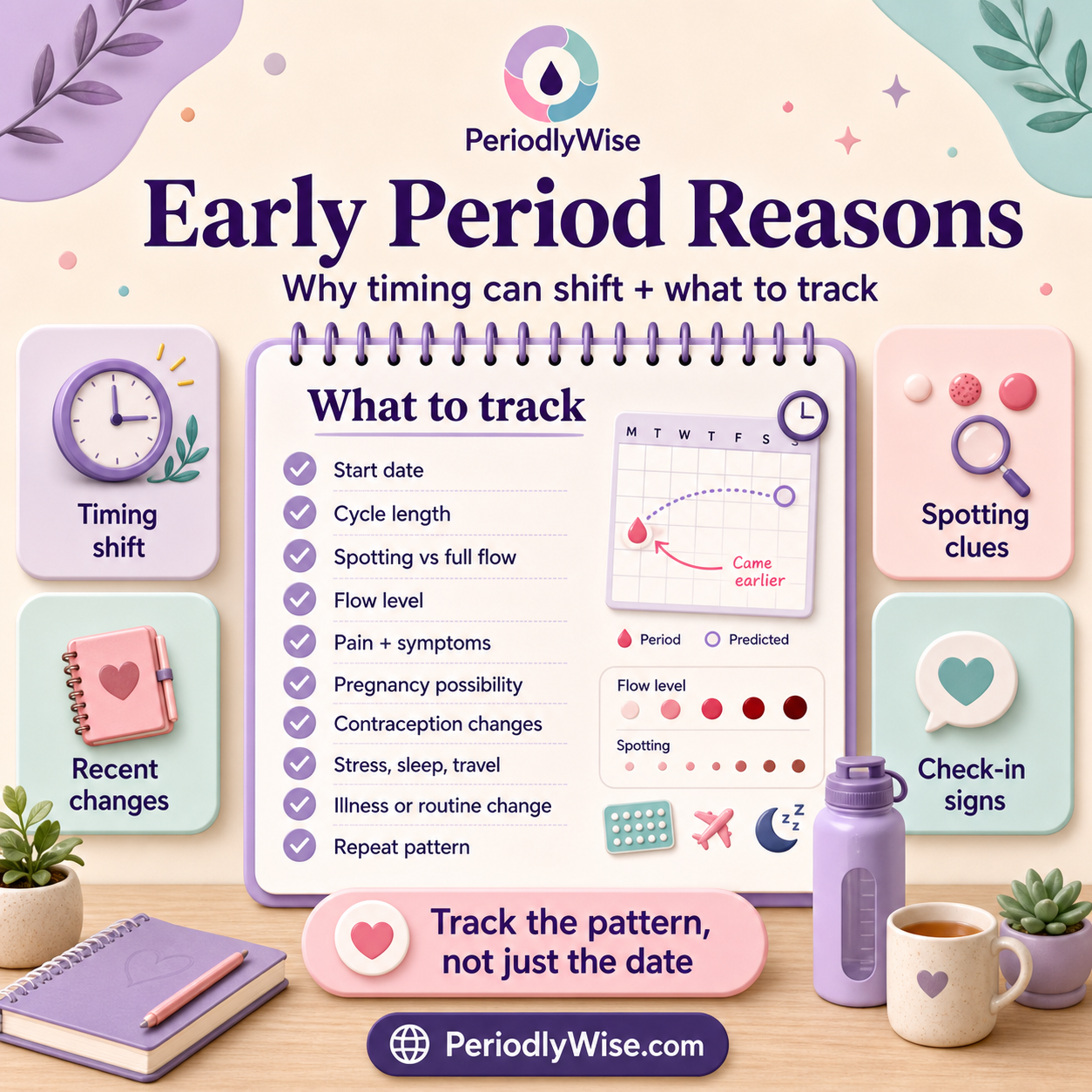
What to track in PeriodlyWise
For an early period, tracking should help you answer whether this was a one-off shorter cycle, spotting, contraception-related bleeding, or a repeated pattern.
- First day of full flow: the day bleeding became period-like for you.
- Spotting before flow: color, amount, and how many days before full flow.
- Cycle length: days from the previous period start to this one.
- Flow level: light, moderate, heavy, very heavy, clots, sudden gushes, or leaks.
- Pain and symptoms: cramps, one-sided pain, dizziness, fever, nausea, fatigue, or unusual discharge.
- Pregnancy possibility: test date, result, and symptoms if relevant.
- Contraception: missed pills, new method, IUD, injection date, emergency contraception, or recent stop/start.
- Life context: stress, sleep, illness, travel, weight change, exercise change, and medication changes.
- Repeat pattern: whether the next cycles also become shorter or unpredictable.
A simple summary you can bring to a clinician
If you need medical help, a short timeline is enough. Try this format:
That summary gives timing, difference from usual, flow, symptoms, contraception context, and pregnancy information. It is much clearer than "my period came early."
FAQ
Is an early period always a problem?
No. A period that arrives a few days early can be normal variation, especially if the cycle length is still near your usual range. Repeated early bleeding, very short cycles, heavy bleeding, severe pain, or bleeding between periods should be taken more seriously.
Should I count spotting as period day 1?
Many people count day 1 as the first day of full period-like bleeding and record spotting separately. The key is consistency. If you are unsure because spotting is heavy, recurrent, or unusual, track both and ask a clinician.
Can stress make a period come early?
Stress can affect cycle timing for some people, but it is not the only explanation. Track stress alongside sleep, illness, travel, contraception, pregnancy possibility, flow, and pain so it does not become a guess.
Can an early period be pregnancy bleeding?
If pregnancy is possible, unexpected bleeding should not be assumed to be a period. Take a pregnancy test when appropriate and seek urgent care for heavy bleeding, severe or one-sided pain, fainting, dizziness, shoulder pain, or feeling unsafe.
Use PeriodlyWise to compare cycle length, flow, spotting, symptoms, contraception changes, pregnancy possibility, and recent life context so one early period does not become a month of guessing.
Open the Period Tracker