A period after COVID infection may arrive a little late, feel lighter or heavier, come with stronger cramps, or simply feel different from your usual rhythm. For many people, that kind of change is temporary. Still, it is worth tracking carefully because a recent infection can overlap with stress, sleep loss, medication changes, contraception gaps, and pregnancy possibility.
A large study summarized by NICHD and OHSU found a small average increase in menstrual cycle length after COVID-19 illness, with changes resolving in the following cycle for the study group. That does not mean every person will notice exactly the same change. It means a short-lived timing shift after infection is biologically plausible and has been observed in cycle-tracking research.
The useful question is not only whether COVID can affect a period. It is what changed, how much it changed, whether pregnancy is possible, whether red flags are present, and whether the pattern settles in the next cycle.
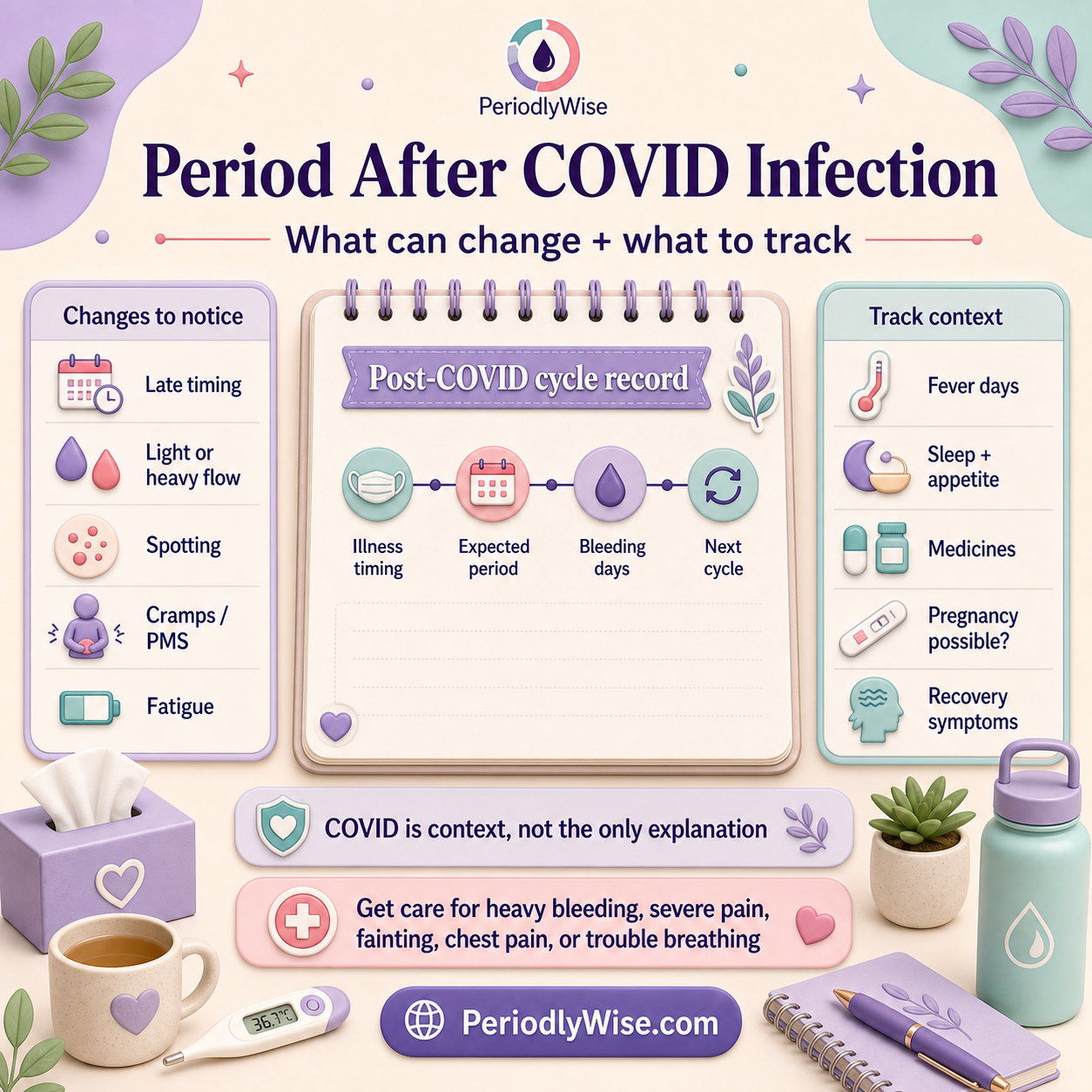
COVID is useful context, but it should not become the only explanation.
Why COVID may affect a period
The menstrual cycle is sensitive to the body as a whole. Fever, immune activation, poor sleep, lower appetite, stress, pain, changes in activity, and some medicines can all affect the hormone signals involved in ovulation and bleeding. If ovulation is delayed, the period that follows may be delayed too.
In the PubMed-indexed Obstetrics & Gynecology study of more than 6,000 app users, the COVID-19 group had an average 1.45-day adjusted increase in cycle length during the illness cycle compared with their pre-event average, and the change resolved in the next cycle. Population averages are reassuring, but individual cycles can still feel more dramatic.
COVID also happens inside real life. A week of poor sleep, missed meals, travel, isolation, stress, or disrupted routines can add their own cycle effects. That is why your record should include the illness timeline, not just the bleeding date.
What the research can and cannot tell you
The research behind this article is useful because it followed cycle data before, during, and after COVID illness. The observed average change in cycle length was small and, for the study group, returned toward baseline in the following cycle. That makes a short timing shift plausible; it does not prove that COVID caused every changed period in every person.
Research averages also do not predict how one individual will feel. They do not replace pregnancy testing, assessment of unusually heavy bleeding or severe pain, or care for symptoms that are not safely explained by a period. Treat the infection as one piece of the timeline, not the entire answer.
Changes people may notice after COVID
| Change | Possible explanation | Track this |
|---|---|---|
| Late period | Delayed ovulation after illness, stress, fever, sleep loss, or routine change. | Expected date, actual date, COVID symptom date, pregnancy-test timing. |
| Lighter flow | Shorter bleed, spotting, changed lining response, contraception context, or pregnancy-related bleeding. | Flow level, number of days, spotting vs full flow, pregnancy possibility. |
| Heavier flow | A shifted cycle or skipped ovulation can sometimes affect lining buildup. | Product changes, clots, leaks, dizziness, fatigue, days of bleeding. |
| More cramps or PMS | Inflammation, poor sleep, stress, digestion changes, and usual PMS can overlap. | Pain level, location, medicines, fever, bowel symptoms, daily impact. |
| Fatigue during period | Recovery from infection plus bleeding, sleep debt, low appetite, or heavy flow. | Energy, sleep, food, fluids, dizziness, shortness of breath. |
Build a recovery-to-cycle timeline
Put the illness and the menstrual cycle on the same timeline. It prevents a vague note such as 'period weird after COVID' from hiding a useful pattern.
| Point in time | What to note | Why it helps |
|---|---|---|
| Before illness | Last period start, usual cycle range, contraception, and pregnancy possibility. | Creates your own baseline. |
| Illness week | First symptom or positive-test date, fever, sleep, appetite, medicines, and activity changes. | Shows the stressors around possible ovulation timing. |
| Expected period window | Expected date, spotting, actual start, and test timing if relevant. | Separates a late period from unexpected bleeding. |
| Bleeding days | Flow level, clots, cramps, pain location, fatigue, dizziness, and daily impact. | Shows whether the change is mild, repeated, or unsafe. |
| Next cycle | Whether timing and flow return toward your usual range. | Helps distinguish a short-lived shift from a continuing pattern. |
Do not blame every change on COVID
It is tempting to explain every unusual period by the recent infection, but other causes can land at the same time. Pregnancy, emergency contraception, missed birth control, starting or stopping hormonal contraception, thyroid disease, PCOS, perimenopause, breastfeeding, weight change, eating difficulties, intense exercise, pelvic infection, fibroids, and medication changes can all affect bleeding.
If you had sex and pregnancy is possible, do not use COVID as the only explanation for a late or strange period. A home pregnancy test is usually most useful after a missed period. If cycles are irregular or dates are unclear, the Office on Women's Health suggests using a longer timeline from cycle start or sex so hCG has time to become detectable.
Also separate COVID symptoms from period red flags. Fever from infection can happen, but fever with pelvic pain, foul-smelling discharge, worsening one-sided pain, fainting, or very heavy bleeding deserves medical attention. Tracking is helpful only when safety is not in question.
Symptoms that need a separate answer
Not every symptom after COVID belongs to the menstrual cycle. Chest pain, trouble breathing, new severe weakness, fainting, or symptoms that feel medically urgent deserve their own care pathway. Do not wait for a period to start, end, or normalize before seeking help for symptoms that feel unsafe.
The same applies to pelvic red flags. Fever can be part of an infection, but fever with pelvic pain, foul-smelling discharge, worsening one-sided pain, heavy bleeding, or a positive pregnancy test needs medical assessment. A tracker is a record, not a reason to delay care.
What to track after COVID infection
A timeline is more useful than a single note that says period changed.
- COVID timing: first symptom date, positive test date, fever days, and recovery date.
- Cycle timing: last period start, expected period date, actual start date, and cycle length.
- Bleeding pattern: spotting, full flow, light/medium/heavy days, clots, leaks, and end date.
- Symptoms: cramps, pelvic pain, headaches, digestion changes, PMS, mood, fatigue, dizziness, shortness of breath, and fever.
- Context: sleep, appetite, hydration, travel, stress, exercise, new medicines, contraception changes, and sex timing.
- Testing: pregnancy test date and result when pregnancy is possible, plus repeat-test plan if testing early.
Questions for the next one or two cycles
- Did ovulation signs or cycle timing move? Record only signs you normally notice, rather than trying to force a precise ovulation date.
- Is the flow change actually repeating? Compare full-flow days, spotting, product changes, clots, and the number of bleeding days with your own usual range.
- Could something else be happening too? Note contraception changes, emergency contraception, pregnancy possibility, new medicines, thyroid history, postpartum changes, or perimenopause context.
- Is recovery affecting daily life? Add sleep, appetite, hydration, fatigue, dizziness, exercise tolerance, and what helps so the next conversation is specific.
What to do if your period changed after COVID
Use the infection as context, then check the basics.
- Mark the illness on your cycle timeline. Put the first COVID symptom or positive test date next to your cycle day.
- Compare with your usual range. A one-cycle shift is different from a new repeated pattern.
- Check pregnancy possibility. Test at the right time if sex timing or contraception makes pregnancy possible.
- Support recovery. Prioritize sleep, fluids, regular food as tolerated, and gentler activity while symptoms settle.
- Get help for severe or persistent changes. Do not wait through repeated heavy bleeding, severe pain, or changes that last several cycles.
When to seek medical advice
Consider medical advice if your period changes for more than two or three cycles after COVID, if cycles become newly irregular, if your period stops for more than 90 days and you are not pregnant, or if symptoms feel very different from your usual pattern.
Get care sooner for bleeding that soaks through a pad or tampon every hour or two, bleeding longer than eight days, large clots, severe pain, fainting, severe dizziness, chest pain, trouble breathing, fever with pelvic pain, unusual discharge, or bleeding after sex.
If you have long COVID symptoms, known anemia, a thyroid condition, a bleeding disorder, postpartum changes, recent miscarriage, perimenopause, or fertility concerns, a changed period after infection may deserve a lower threshold for professional guidance.
Use PeriodlyWise to save illness timing, expected period date, flow changes, symptoms, pregnancy-test timing, and whether the next cycle returns to normal.
Open the Period TrackerFAQ
Can COVID delay your period?
Yes, it can for some people. Research has found a small average cycle-length increase after COVID illness, and illness-related stress or delayed ovulation can also shift timing.
Can COVID make a period heavier or lighter?
Some people report flow changes, but flow can change for many reasons. Track amount, duration, clots, and pregnancy or contraception context instead of assuming one cause.
How long do period changes after COVID last?
In one large study, average cycle-length changes resolved by the next cycle. If changes continue for several cycles or feel severe, seek medical advice.
Should I take a pregnancy test if my period is late after COVID?
Yes, if pregnancy is possible. COVID does not rule out pregnancy, and a late or unusually light bleed should be tested when timing fits.
Is period fatigue after COVID normal?
Fatigue can come from infection recovery, PMS, bleeding, poor sleep, low appetite, or heavy flow. Severe dizziness, shortness of breath, chest pain, or extreme weakness needs care.
The bottom line
A different period after COVID infection can happen and is often temporary, especially when the change is small and settles by the next cycle.
Still, COVID is context, not a diagnosis. Track the timeline, test for pregnancy when relevant, and get help for severe, repeated, or unsafe symptoms.