Rest is often treated as the opposite of productivity, as if doing less means falling behind. But a real body does not work like a machine that simply needs more pressure. A real body needs recovery, sleep, food, hydration, emotional steadiness, pain support, and pauses that make the next part of life possible.
Sometimes rest is not avoidance. Sometimes it is the most practical choice available. Rest can help you think more clearly, reduce preventable mistakes, soften stress, protect relationships, support pain recovery, and make tomorrow less difficult. It can also be part of period care when cramps, heavy flow, PMS, poor sleep, low appetite, or fatigue change your capacity.
PeriodlyWise stands for care without shame. If your body is asking for a slower pace, that request deserves respect. Rest does not mean you are weak. It may mean you are listening before your body has to speak louder.
Productivity is not only output
Most people are taught to count visible output: finished tasks, answered messages, workouts, clean rooms, work hours, grades, errands, meetings, and appointments. Those things matter. But they are not the whole story. The invisible side of productivity is capacity: the sleep, recovery, regulation, nourishment, and emotional space that make action possible.
If output is the part other people can see, capacity is the part that keeps you from breaking under the weight of it. Rest protects capacity. That is why rest can be a productive choice even when it does not look impressive from the outside.
A useful question is not always, "What can I push through?" Sometimes it is, "What would help me return with more steadiness?"
The hidden productivity ledger
Every day has a hidden ledger. Some choices spend energy. Some choices restore it. Some choices prevent a bigger cost later. Rest belongs in that ledger.
| Visible choice | Hidden effect | Why it can be productive |
|---|---|---|
| Taking a short break before continuing | Reduces mental overload | You may return with fewer mistakes and less irritability. |
| Sleeping instead of late-night scrolling or extra work | Supports attention, mood, and recovery | The next day may become easier to handle. |
| Resting during cramps or heavy flow | Reduces unnecessary strain | Your body gets support instead of extra pressure. |
| Canceling one nonessential plan | Protects bandwidth | You preserve energy for health, work, family, or emotional stability. |
| Choosing a quiet evening | Lowers stimulation | Your nervous system gets room to settle. |
Rest is information, not laziness
Needing rest can tell you something. It may say you slept poorly. It may say you are stressed. It may say your period is near, your flow is heavy, your pain is draining you, your appetite has been low, your schedule has been too full, or your mind has carried too much. It may also say you are human.
The mistake is treating every rest signal as a character flaw. A kinder and more useful approach is to ask what kind of tired you are. Different kinds of tired need different kinds of care.
What kind of rest do you need?
Rest is not one thing. A nap will not always solve emotional overload. A quiet room will not always fix heavy bleeding. A day off will not always help if you spend it judging yourself. Try naming the kind of rest you actually need.
| Type of rest | What it can feel like | A useful response |
|---|---|---|
| Physical rest | Heavy limbs, cramps, headache, sore back, fatigue, dizziness, or body weakness. | Lie down, reduce strain, hydrate, eat something manageable, use heat, or seek care if symptoms are concerning. |
| Mental rest | Brain fog, indecision, low focus, mistakes, or difficulty starting. | Pause inputs, choose one task, use a timer, or delay nonurgent decisions. |
| Emotional rest | Sensitivity, irritability, tears, worry, or feeling easily overwhelmed. | Lower demands, use supportive words, talk to someone safe, or take a quiet reset. |
| Sensory rest | Noise, light, touch, screens, tight clothes, or clutter feels too much. | Dim lights, reduce sound, wear comfortable clothing, step away from screens, or simplify the space. |
| Social rest | You feel talked out, overexplained, or unable to perform cheerfulness. | Take privacy, send a short boundary, or choose lower-pressure connection. |
| Cycle-aware rest | Rest need repeats before your period, during heavy flow, after cramps, or after poor sleep. | Track timing in PeriodlyWise and build a softer version of the day. |
Why rest can matter around your period
The Office on Women's Health explains that menstrual-cycle hormone changes can affect emotional, mental, and physical health. PMS can include tiredness, sleep changes, mood changes, anxiety, appetite changes, bloating, headache, digestive changes, and trouble concentrating. Menstrual bleeding, cramps, poor sleep, stress, and low appetite can add to the load.
That does not mean every tired day is caused by your cycle. It means cycle timing can be useful context. If you regularly need more rest before bleeding or during heavy-flow days, you are not failing at productivity. You may be noticing a real body pattern.
For a practical cycle-specific view, read Period Fatigue on Heavy Flow Days. If mornings are the hard part, read When Your Body Needs Slower Mornings During Your Period.
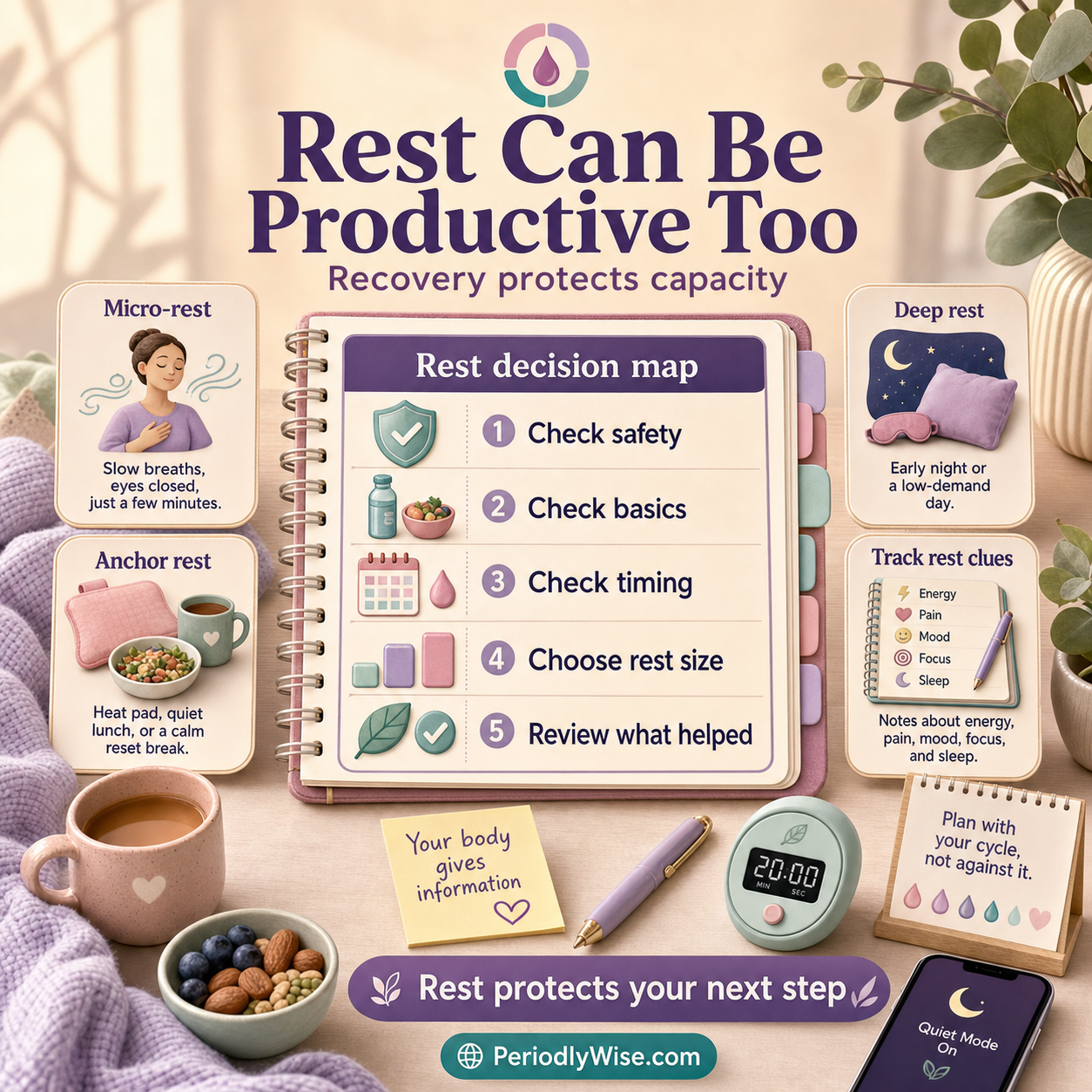
The rest decision map
When you are tired, it can be hard to know whether to rest, keep going, or ask for help. Try this simple map.
- Check safety: Are you dizzy, faint, short of breath, in severe pain, bleeding very heavily, panicking, or feeling unsafe? If yes, rest alone may not be enough. Seek support.
- Check basics: Have you eaten, had water, used the bathroom, changed period products if needed, taken prescribed medication, or slept enough?
- Check timing: Is your period due, starting, heavy, late, or ending? Did PMS symptoms show up around the same time last cycle?
- Choose the smallest useful rest: two minutes, ten minutes, a slower evening, an early night, or a full rest day if possible.
- Review after resting: Did rest help energy, pain, mood, focus, or patience? Save that clue.
Micro-rest, anchor rest, and deep rest
Rest becomes easier to use when you give it sizes. Not every tired moment needs a full day off. Not every exhausted body can be helped by two minutes. Try three rest sizes.
| Rest size | Time | Examples |
|---|---|---|
| Micro-rest | 30 seconds to 5 minutes | Slow breaths, eyes closed, water, loosening clothing, stepping away from a screen, or sitting with feet on the floor. |
| Anchor rest | 10 to 30 minutes | Heat pad, quiet lunch, short nap, gentle stretch, shower, lying down, or one no-phone break. |
| Deep rest | Several hours or more | Early night, canceled nonessential plan, low-demand day, recovery time after heavy flow, illness, intense stress, or poor sleep. |
The NHS describes simple breathing exercises as something that can be done in different positions and in a few minutes. That is the spirit of micro-rest: small enough to use before the day becomes unmanageable.
Rest without guilt: five small scripts
Sometimes the hardest part of rest is not lying down. It is allowing yourself to stop. Short scripts can help you treat rest as a responsible choice.
- When you feel lazy: "My body is giving me information, not a moral grade."
- When you feel behind: "Resting now may protect the next useful step."
- When your period changes your capacity: "This is cycle context, not a failure of character."
- When you need to tell someone: "I need a slower pace today for health reasons."
- When you are restarting: "The next caring step counts."
If you want a wider care framework, read Building a Self-Care Routine That Actually Fits Real Life.
How to track rest in PeriodlyWise
Tracking rest is not about proving you deserve it. It is about learning what keeps you well. You can keep notes short and practical.
- Timing: cycle day, period window, period day, PMS timing, heavy-flow day, or late period.
- Body signals: fatigue, cramps, headache, back pain, dizziness, low appetite, nausea, bloating, or sleep quality.
- Mood signals: sensitive, anxious, irritable, low, foggy, overwhelmed, or calmer after rest.
- Rest used: micro-rest, nap, early night, quiet evening, fewer plans, heat, gentle movement, or screen break.
- Outcome: what improved, what did not, and what to prepare next time.
Over time, these notes can show whether rest is most useful before your period, during day 1 or day 2, after poor sleep, during stress, or after a run of overfilled days. That is practical self-knowledge. For a lighter tracking style, read Learning Your Cycle Without Obsessing Over It.
When rest is not enough
Rest is important, but it should not be used to dismiss symptoms that need care. Seek medical advice if fatigue is severe, new, worsening, or persistent; if you feel faint, dizzy, or short of breath; if bleeding is very heavy; if pain is severe or suddenly worse; if symptoms disrupt daily life; or if pregnancy, infection, anemia, thyroid issues, or another health concern may be involved.
Seek mental health support if low mood, anxiety, panic, hopelessness, eating concerns, body distress, or thoughts of self-harm feel intense, persistent, unsafe, or difficult to manage. Rest can support recovery, but it is not a replacement for professional care when symptoms are beyond self-care.
FAQ
Can rest really be productive?
Yes. Rest can protect focus, energy, mood, pain recovery, sleep, and decision-making. It may not look like output, but it can support the capacity that makes output possible.
How do I know whether I need rest or motivation?
Check basics first: sleep, food, water, pain, stress, cycle timing, and emotional load. If your body is showing real strain, rest may be the more productive first step.
Can period symptoms make rest more necessary?
Yes. Cramps, heavy flow, fatigue, poor sleep, PMS symptoms, low appetite, and stress can all increase the need for rest or a softer schedule.
What if I cannot take a full rest day?
Use smaller rest sizes: a breathing pause, a screen break, a quiet lunch, an early night, simpler food, fewer decisions, or one canceled nonessential task.
When should tiredness be checked?
Get medical advice for fatigue that is severe, persistent, sudden, worsening, linked with very heavy bleeding, dizziness, faintness, shortness of breath, severe pain, or daily-life disruption.
Use PeriodlyWise to notice when rest helps, how energy changes around your cycle, and what support your body asks for on busy, tired, or period days.
Open the Period Tracker