Some days do not feel bold, bright, or impressive. You do what you can. You answer fewer messages. You choose easier food. You move slowly. You wear the comfortable clothes. You rest between ordinary tasks. You let the day be smaller than the plan you had in your head.
Those days still count. A soft day is not a failed day just because it does not look productive from the outside. Sometimes it is the day that keeps your body supported, your mood steadier, your pain from becoming worse, your energy from crashing, and tomorrow from becoming harder than it needs to be.
PeriodlyWise believes care should make room for real bodies. Periods, PMS, fatigue, mood changes, cramps, heavy flow, poor sleep, stress, low appetite, and everyday overload are not shameful interruptions. They are part of a natural human journey, and some days deserve a softer approach.
What is a soft day?
A soft day is a day with lower pressure and more support. It is not necessarily a day when nothing happens. It is a day when the pace, expectations, and decisions are adjusted to match the body and mind you actually have.
Soft days can happen for many reasons: your period is starting, your flow is heavier, cramps are present, sleep was broken, PMS is close, work has been demanding, your social battery is low, grief or stress is heavy, or you are simply tired. You do not need to earn softness by reaching a breaking point.
Soft does not mean useless
One reason soft days are hard to accept is that many people confuse intensity with value. A full schedule looks productive. A visible achievement looks impressive. A busy person looks committed. But real wellbeing is not built only on high-output days.
Soft days do quieter work. They help you recover. They reduce friction. They give your nervous system room to settle. They keep basic care from disappearing. They help you notice what your body is asking for before symptoms get louder.
| Soft choice | What it protects | Why it counts |
|---|---|---|
| Doing fewer tasks | Energy and focus | You leave capacity for what matters most. |
| Choosing simple food | Blood sugar, comfort, and steadiness | You support your body without turning meals into a performance. |
| Taking a quiet break | Mood and stress level | You lower overload before it spills into the rest of the day. |
| Wearing comfortable clothes | Body comfort and sensory ease | You remove one unnecessary source of irritation. |
| Tracking one body clue | Future self-knowledge | You give yourself context for next time. |
Why soft days can matter around your period
The Office on Women's Health explains that menstrual-cycle hormones can affect emotional, mental, and physical health. Some people feel more energetic at certain times and more sluggish, forgetful, sensitive, or uncomfortable at others. PMS can include tiredness, sleep changes, mood changes, anxiety, appetite changes, bloating, headache, digestive changes, and trouble concentrating.
That does not mean every low-energy day is caused by your cycle. It means cycle timing can be one useful piece of context. If the same week each month asks for more softness, your body may be giving you information. For a closer look at fatigue and flow, read Period Fatigue on Heavy Flow Days. If mornings are where the softness is most needed, read When Your Body Needs Slower Mornings During Your Period.
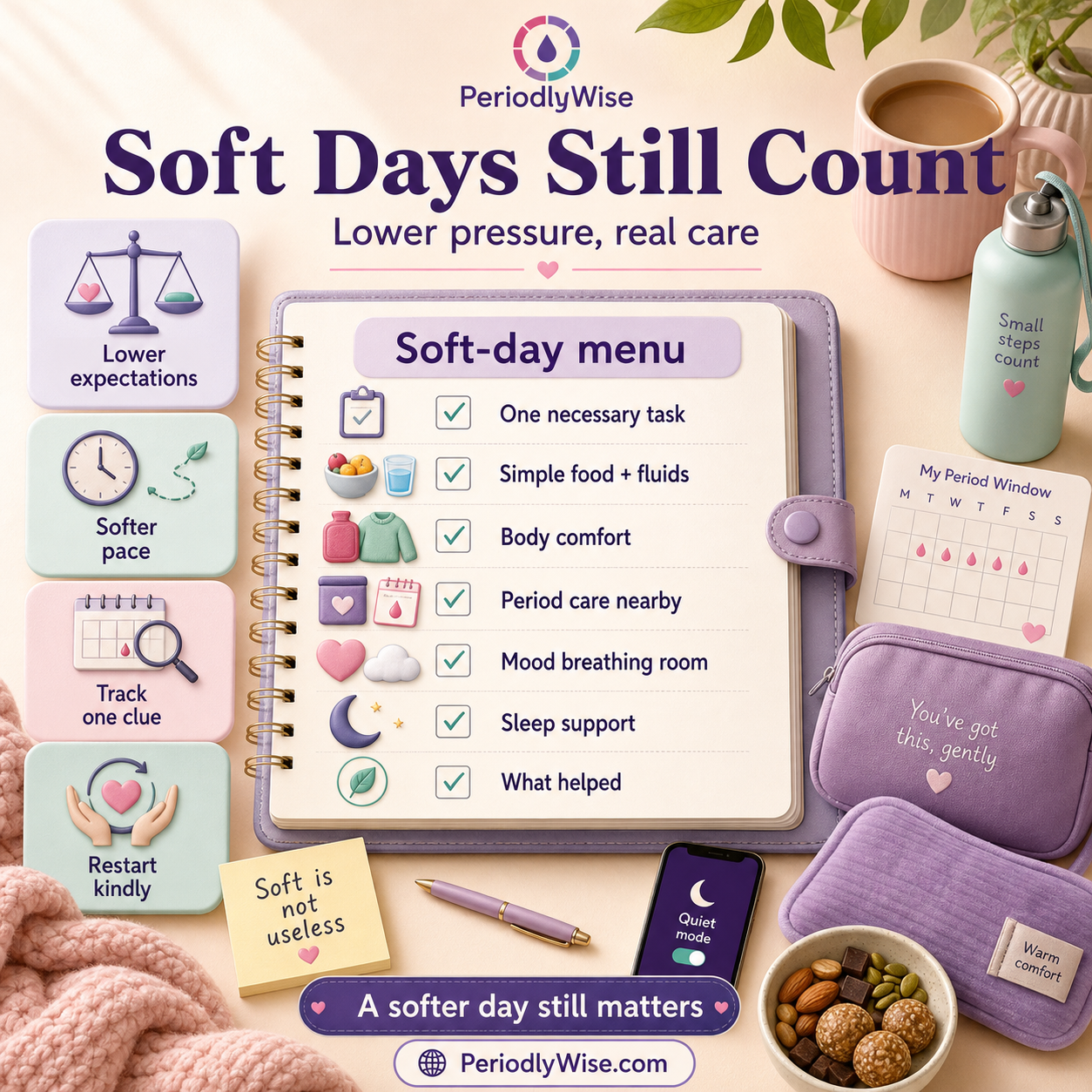
A soft day menu
A soft day becomes easier when you have options. You do not need every option. Choose what fits the day.
| Area | Soft version | Track if useful |
|---|---|---|
| Tasks | Pick one necessary task, one optional task, and one thing to postpone. | Energy before and after. |
| Food | Choose easy, familiar food and fluids instead of a perfect plan. | Appetite, nausea, cravings, bloating, and what felt manageable. |
| Body comfort | Use heat, loose clothing, rest, gentle stretching, or a quieter space. | Pain, cramps, headache, back ache, skin comfort, and fatigue. |
| Period care | Keep products nearby, check flow without fear, and prepare backup if needed. | Flow, product type, wear time, leaks, clots, and comfort. |
| Mood | Lower social pressure, use kinder self-talk, and avoid unnecessary arguments. | Sensitivity, anxiety, irritability, low mood, and what helped. |
| Sleep | Protect one sleep decision: earlier wind-down, fewer screens, or a calmer evening. | Bedtime, wake-ups, restfulness, and morning energy. |
Soft days can still be productive
A soft day may not create dramatic output, but it can protect the conditions that make output possible later. The NHLBI notes that sleep deficiency can affect how well you think, react, work, learn, and get along with others. The NHS also encourages practical steps that support mental wellbeing, including connection, activity, learning, giving, and paying attention to the present moment.
This does not mean a soft day must become another checklist. It means care can be practical. Drinking water, resting during cramps, choosing a quieter evening, or doing one small task can be productive when it supports the body that has to live tomorrow too. For more on this, read Why Rest Can Be a Productive Choice Too.
How to stop calling it a wasted day
The words you use can change the way a soft day feels. "I wasted the day" turns lower capacity into shame. "I had a soft day" gives the same day a kinder frame.
- Instead of: "I did nothing." Try: "I protected my capacity."
- Instead of: "I should have pushed harder." Try: "I listened before things got worse."
- Instead of: "I am behind." Try: "I chose the next realistic step."
- Instead of: "My body is inconvenient." Try: "My body deserves care inside real life."
How PeriodlyWise can help soft days feel less random
Use PeriodlyWise to save the context, not to grade the day. A soft-day note can be short: cycle day, period window, flow, sleep, energy, mood, pain, appetite, stress, what you softened, and what helped.
Over time, these notes can show patterns: soft days before your period, more rest needed on day 1 or day 2, lower appetite after poor sleep, mood sensitivity during stressful weeks, or more body comfort needed during heavy flow. That kind of information can help you prepare without obsessing. For a gentle tracking approach, read Learning Your Cycle Without Obsessing Over It and The Quiet Confidence of Knowing Your Own Needs.
When softness needs more support
Soft days are normal, but some symptoms should not be brushed aside. Seek medical advice if fatigue is severe, new, persistent, or worsening; if bleeding is very heavy; if pain is severe or suddenly different; if you feel faint, dizzy, or short of breath; or if symptoms repeatedly disrupt daily life. Seek mental health support if low mood, anxiety, panic, eating concerns, body distress, hopelessness, or thoughts of self-harm feel intense, unsafe, persistent, or hard to manage.
FAQ
What does a soft day mean?
A soft day is a lower-pressure day that adjusts tasks, rest, food, comfort, and expectations to match your real capacity.
Are soft days lazy?
No. Soft days can protect energy, mood, pain recovery, sleep, and future capacity. Rest and lower friction are meaningful forms of care.
Can period symptoms make soft days more necessary?
Yes. Cramps, heavy flow, PMS, fatigue, poor sleep, appetite changes, and stress can make a softer day more appropriate.
How can I track a soft day?
Note the cycle day, sleep, energy, flow, pain, mood, appetite, stress, what you softened, and what helped. Keep it brief.
Use PeriodlyWise to notice energy, comfort, mood, flow, rest, and what helps you move through softer days with more kindness.
Open the Period Tracker